Alzarri Joseph makes dream debut with six-wicket haul brings memorable win for MI
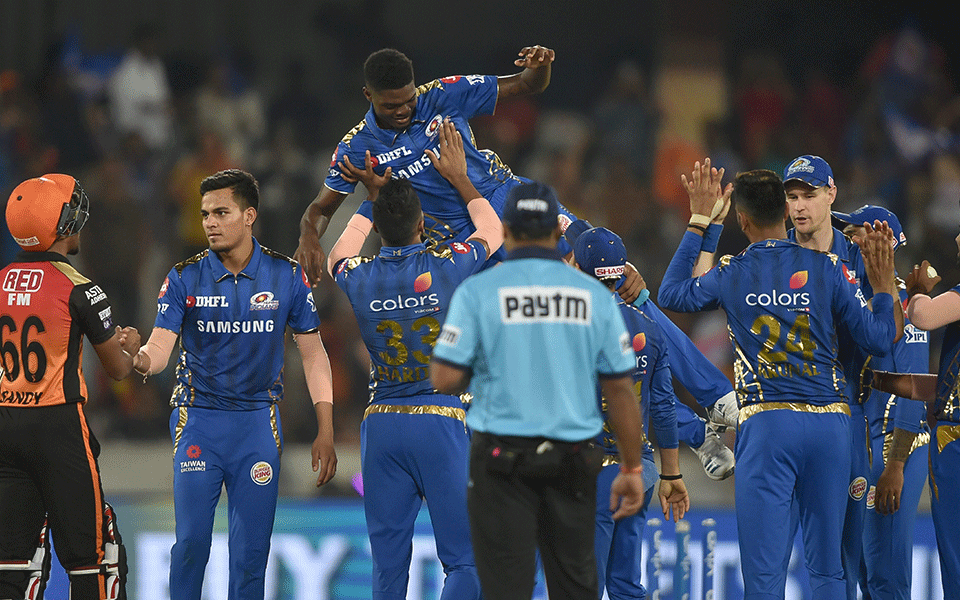
Hyderabad: Young West Indies pacer Alzzari Joseph made a dream IPL debut by recording the best bowling figures in tournament's history as Mumbai Indians picked up a 40-run win over Sunrisers Hyderabad in a low-scoring game here on Saturday.
Keiron Pollard hammered an unbeaten 46 off 26 balls, helping Mumbai Indians recover to 136 for seven after an ordinary start.
While Pollard was the stand out batsman, another West Indian in Joseph made all the difference in the bowling department, ending with sensational figures of six for 12 in 3.4 overs, bettering the effort of Pakistan pacer Sohail Tanvir, who had taken six for 14 in the inaugural IPL edition in 2008. Hyderabad were all out for 96 in 17.4 overs.
It was the third win for Mumbai Indians in five games while Hyderabad suffered their second loss in five matches.
Considering the stellar form of openers David Warner and Jonny Bairstow, 137 was expected to be a comfortable chase for Hyderabad. But they both were dismissed cheaply and that exposed the middle order which had not been tested much courtesy the devastating run of the openers. I
It was the first time this season that Hyderabad lost a wicket in the first six overs.
Young West Indies pacer Joseph bowled a dream first over in the IPL, dismissing Warner in a wicket maiden. In his following over, the 22-year-old got rid of Vijay Shankar to leave Hyderabad at 43 for three in seven overs and spice up the contest.
Leggie Rahul Chahar picked up two important wickets to increase the pressure on the home team which was reduced to 62 for five in the 12th over.
The hosts needed 53 off the last 30 balls and ended up well short of the target with Joseph running through the opposition line-up.
Earlier, it seemed Hyderabad would limit Mumbai to a sub-120 total before Pollard's brute power came to the fore, enabling the visitors to collect 39 crucial runs off the final 12 balls.
Until Pollard cut loose, Hyderabad put up an impressive bowling effort on a slow pitch.
While Hyderabad fielded an unchanged side, Mumbai Indians made two changes in the playing eleven with Ishan Kishan replacing Yuvraj Singh and Joseph coming in for Lasith Malinga, who has gone back to Sri Lanka to play in a domestic event.
It wasn't the best of starts for Mumbai, who lost captain Rohit Sharma (11) and Suryakumar Yadav (7) early to be 30 for two in six overs. Rohit was dropped in the first over by Siddarth Kaul but could not make much use of that life and was holed out at deep midwicket off Mohammad Nabi in the fourth over.
Suryakumar, who had hit a crucial 59 in the previous game against CSK, too did not last long and was adjudged leg before wicket off Sandeep Sharma.
Stroke play was proving to be difficult on a slow surface and the situation became worse for the visitors when the in-form opener Quinton de Kock (19) departed after trying to increase the scoring rate.
The batsmen especially struggled against Nabi, who ended with envious figures of 13 for one in four overs as Mumbai crawled to 52 for three in 10 overs.
After Nabi completed his full quota of overs, his Afghanistan teammate Rashid Khan made life tough for the opposition batsmen. The Hyderabad pacers Sharma and Kaul too were up to the task, using their pace well on a slow wicket to stifle the batsmen.
Mumbai's innings hardly had any flow before Pollard provided the much needed final flourish in the death overs by smashing Kaul for three massive sixes in the 19th over that went for 20 runs.
Bhuvneshwar's final over went for 19 runs with Pollard collecting two fours and a six, giving Mumbai something to bowl at. Poor fielding let Hyderabad down towards the end of the innings.
Let the Truth be known. If you read VB and like VB, please be a VB Supporter and Help us deliver the Truth to one and all.
Rickelton's ton in vain as SRH beat MI by 6 wickets
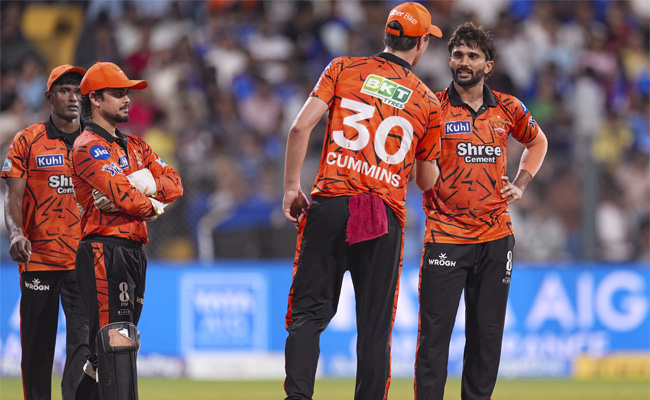
Mumbai (PTI): Ryan Rickelton's whirlwind unbeaten ton was overshadowed by Heinrich Klaasen's unbeaten 65 as Sunrisers Hyderabad defeated Mumbai Indians by six wickets in an IPL match here on Wednesday.
Chasing an imposing 244-run target, Travis Head (76 off 30) and Abhishek Sharma (45 off 24) shared 129 runs for the opening wicket to set the platform for SRH.
Klaasen (65 not out off 30 balls) then displayed his all-round hitting abilities to guide SRH home with the help of Nitish Kumar Reddy (21) and Salil Arora (30 not out off 10) in 18.4 overs.
Earlier, Rickelton's knock powered MI to 243 for five.
MI rode on a 93-run stand between Rickelton (123 not out off 55 balls) and Will Jacks (46 off 22) in 7.1 overs for the opening stand to power the side.
MI skipper Hardik Pandya scored a valuable 31 off 15 balls before being dismissed.
Praful Hinge (2/54), Eshan Malinga (1/29), Sakib Hasan (1/39) and Nitish Kumar Reddy (1/31) were the wicket-takers for SRH.
Brief Scores:
Mumbai Indian: 243 for 5 in 20 overs (Ryan Rickelton 123 not out; Praful Hinge 2/54).
Sunrisers Hyderabad: 249 for 4 in 18.4 overs (Travis Head 76, Heinrich Klaasen 65 not out; AM Ghazanfar 2/51).