Archery WC: India men's team shocks Olympic champions Korea to bag historic gold
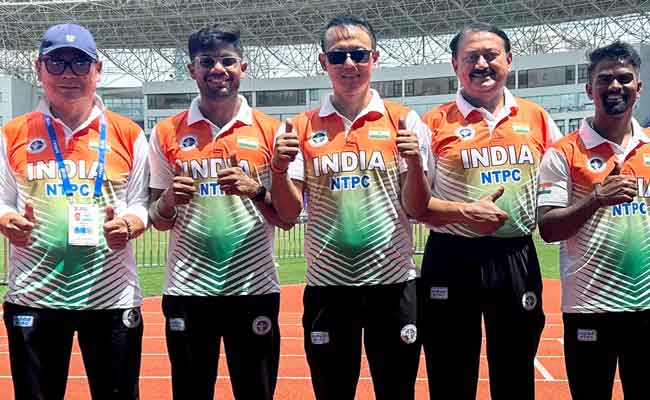
Shanghai (PTI): Indian men's recurve team of Dhiraj Bommadevara, Tarundeep Rai and Pravin Jadhav shocked reigning Olympic champions South Korea in a historic win to land an Archery World Cup gold medal after 14 years, here on Sunday.
This triumph over the archery powerhouse in well over a decade also comes as a boost to their chances of securing a berth in the upcoming Paris Olympics.
The trio of Dhiraj, Tarundeep and Pravin showed ice-cool composure to get the better of mighty Koreans without dropping a set.
The 40-year-old Army man Tarundeep was also a part of the gold medal-winning team in Shanghai World Cup Stage 4 in August 2010. Then the recurve team comprising Rahul Banerjee, Tarundeep and Jayanta defeated Japan.
In a battle between the top-two seeds of the competition, India won 5-1 (57-57, 57-55, 55-53), taking their gold medal count to five in the season-opening Stage 1 World Cup.
The success also rubbed on the recurve mixed team of Ankita Bhakat and Dhiraj who trounced Alejandra Valencia and Matias Grande of Mexico 6-0 (35-31, 38-35, 39-37) to win bronze.
On a comeback trail after missing the whole 2023 after becoming mother in December 2022, Deepika Kumari faltered in the final hurdle to settle for a silver in the women's recurve individual section.
The former world No. 1, who started from the bottom after qualifying as the 30th seed, eliminated two Koreans in the quarterfinal and semifinal.
But in the final, Deepika lost to Hangzhou Asian Games champion Lim Sihyeon in straight sets 6-0 (26-27, 27-29, 27-28).
Deepika had a poor start in the title round, with her second arrow landing in the seven-point red ring.
Rising 20-year-old Lim dropped just one point to take the second set and sealed the gold without much fuss.
Overall, India returned with eight medals -- five gold, two silver and a bronze -- from the global showpiece.
In the men's team final, India were up against their nemesis South Korea, who featured two members of the Tokyo Olympics gold medal winning team in Kim Woojin and Kim Je Deok. Lee Woo Seok was the third member.
But the Indian troika put up a brave front and drilled in three 10s that included two X (closer to the centre) and three 9s to match their rivals (57-all) in the opening set.
It put the pressure back on the Koreans who slipped twice into the 8-ring, while the Indians shot four perfect 10s including three Xs from six arrows to take the second set 57-55 and take 3-1 lead.
In the next set, the Koreans faltered and managed just 53 as the Indians held their nerves to close out the game with a 55 en route to clinch a first men's team World Cup gold since 2010.
Before this victory, the women's team had previously beaten the Koreans twice in the 2013 World Cup -- Medellin Stage 3 in July and Wroclaw Stage 4 in August.
"The nerves always kick in when Korea is in the final. But now, no one can doubt our ability to defeat them," declared former Commonwealth Games gold medalist Rahul Banerjee, a member of the Shanghai 2010 triumph.
"They have been showing perfect rhythm right from the qualifying round and it's definitely one of the biggest wins in archery. They will now have to hold on to this momentum till Paris," he added.
So far, India have a solitary Olympic berth which was earned by Dhiraj in the men's individual section.
The final Olympic qualifying event is the Stage 3 World Cup in Antalya, Turkey, from June 18 to 23 following which the team rankings will offer two additional quotas for the first time.
The two highest-ranked nations, who did not make the cut from the Qualifiers, will receive team berths for Paris from the World Archery rankings.
India (231 points) are now third in the world rankings behind China (241) and No. 1 South Korea (340) and are well-placed to make the Paris Olympics cut.
Earlier on Saturday, Indian compound archers had swept the team events winning men's, women's and mixed team gold medals.
Reigning Asian Games champion Jyothi Surekha Vennam added a fourth gold in women's compound individual section, while Priyansh settled for a maiden World Cup silver in the men's individual compound section.
Let the Truth be known. If you read VB and like VB, please be a VB Supporter and Help us deliver the Truth to one and all.
2 detained after comment over wedding procession to Dalit house sparks clash in UP's Shahjahanpur

Shahjahanpur (UP) (PTI): Two persons have been detained after a clash broke out allegedly over remarks targeting a Dalit family's wedding procession in Uttar Pradesh's Shahjahanpur district, police said on Saturday.
The incident occurred in Lai Kheda village under Tilhar police station area, where a wedding procession from Bareilly had arrived at a Dalit household on April 20.
According to SP Saurabh Dixit, when the procession was near the house of Rajpal Yadav, he allegedly made a remark saying "Now, Dalits will also take out wedding processions riding a buggy", leading to an argument. Yadav's side allegedly turned aggressive, escalating the conflict further.
Police said a scuffle ensued between the two sides. Upon receiving information, police personnel reached the spot and ensured that the procession was conducted peacefully after the incident.
An FIR was registered on Friday against Rajpal Yadav, Sumit, Amit, Surendra, Avdhesh Yadav and five unidentified persons based on a complaint. Rajpal Yadav and his son Sumit have been taken into custody and are being questioned, Dixit said.
The case has been registered under provisions of the Bharatiya Nyaya Sanhita (BNS), 2023 and the Scheduled Castes and Scheduled Tribes (Prevention of Atrocities) Act, police said.
Dixit said preliminary findings suggest that Yadav, too, was hosting a function and processions from both sides had arrived around the same time. A dispute may have initially arisen due to a narrow passage and attempts to move the processions quickly.
Police have registered the case under relevant sections of the BNS and initiated further probe, officials said.