Arpinder Singh Creates History by Becoming First Indian to Win Medal in IAAF Continental Cup
Neeraj Finishes Sixth
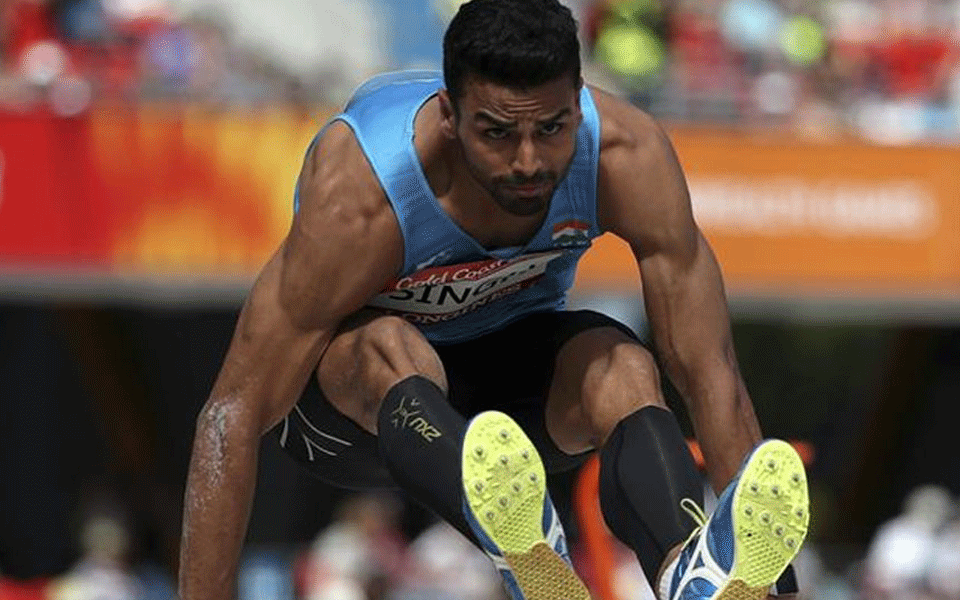
Ostrava, Sept 09: Triple jumper Arpinder Singh Sunday created history by becoming the first Indian to win a medal in the IAAF Continental Cup as he clinched a bronze but star javelin thrower Neeraj Chopra finished sixth with a below-par show.
Arpinder, who had won a gold in the Asian Games in Jakarta, cleared a modest 16.59m in the first of his three jumps to be in the four-man semifinals. He could only clear a 16.33m jump in his next attempt to miss out on the two-man final jump. Nonetheless, he collected a bronze.
The 25-year-old Arpinder was representing the Asia-Pacific team in the meet, held once every four years. He had jumped 16.77m in Jakarta and has a personal best of 17.17m which he recorded in 2014.
No Indian has ever won a medal in the Continental Cup which was known as the IAAF World Cup before 2010. Two top athletes from the four regions of Europe, Americas, Africa and Asia-Pacific were taking part in each of the 36 events in men and women sections taken together.
Reigning Olympic and world champion Christian Taylor of the United States easily took the gold with a jump of 17.59m, which is one metre more than the best effort of Arpinder. The 28-year-old Taylor beat World University Games silver medallist Hugues Fabrice Zango of Burkina Faso, who cleared 17.02m, in the two-man final round. Taylor, who was representing the Americas, has a personal best of 18.21m.
In men's javelin throw, reigning Commonwealth Games and Asian Games champion Chopra finished a disappointing sixth in the eight-man field with a best of 80.24m from his three throws. Chopra began with 80.24m and then could only clear 79.76m in his second attempt. His third throw was a foul attempt. This was Chopra's worst international performance this season. He had a 80.81m in the Eugene leg of the Diamond League Series.
In most of the other events, he has been consistently throwing above 85m. He had won the Asian Games gold with a national record throw of 88.06m last month. Reigning Olympic champion Thomas Roehler of Germany took the gold as he beat Chopra's Asia-Pacific team-mate Chao-Tsun Cheng in the two-man final round. Cheng had a 81.81m while Roehler sent the spear to 87.07m to clinch the gold.
In a change of format by the IAAF, the athletics world governing body, every competitor (in horizontal jumps and throws) was given three attempts. The best athlete from each team from these three rounds gets a chance to have the fourth throw. The top two performers from the fourth round will each have one more attempt and the performance in that fifth and final round will determine the winner.
The new format was introduced this year with an aim to make the event more interesting. In men's 400m, national record holder Mohd. Anas ran with a good timing of 45.72 seconds but that was enough for a fifth-place finish. His Asia-Pacific team-mate Abdalelah Haroun of Qatar won the gold in 44.72.
Haroun had won gold in the Asian Games in 44.89 while Anas had settled for a silver with a timing of 45.69m.
In men's 1500m race, Jinson Johnson finished sixth, clocking 3 minute 41.72 seconds. He had won a gold in the Asian Games in this event with a time of 3:44.72. Johnson had also competed in the 800m race on Saturday, finishing seventh in an eight-man field.
Sudha Singh, meanwhile, did not finish her women's 3000m steeplechase event. She had won a silver in the Asian Games. On Saturday, P U Chitra had finished a surprise fourth in women's 1500m race. She had won a bronze in this event in the Asian Games.
Courtesy: www.news18.com
Let the Truth be known. If you read VB and like VB, please be a VB Supporter and Help us deliver the Truth to one and all.
IMEC momentum to boost Karnataka exports amid global trade disruptions
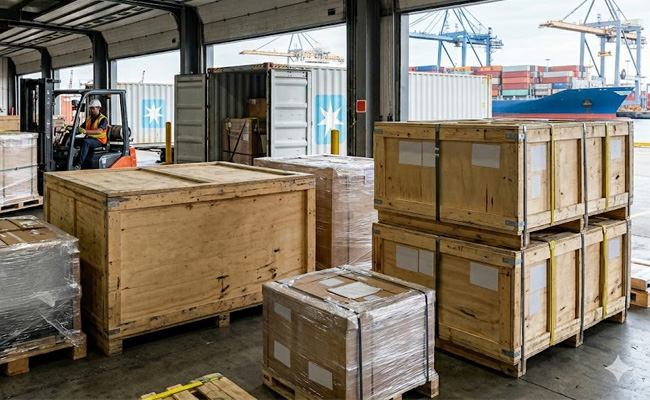
Bengaluru (PTI): Karnataka’s exporters are set to benefit as the India-Middle East-Europe Economic Corridor (IMEC) gathers momentum as an alternative to traditional maritime choke points, a senior tax official said, pointing to shifting global trade routes amid ongoing geopolitical tensions.
Addressing a seminar on “Navigating Geo-Political Challenges: Policy Measures and Preparedness to Build Resilience,” Kotraswamy M, Commissioner of Central Tax, Bengaluru North, said disruptions around key routes such as the Strait of Hormuz and the Suez Canal had underscored the need for more reliable corridors.
The event was organised by the Bangalore Chamber of Industry and Commerce (BCIC) in association with the Indian Institute of Materials Management.
"Owing to geopolitical tensions in West Asia, connectivity was hindered with Strait of Hormuz and Suez Canal as the choke points. Now with India-Middle East-Europe Economic Corridor (IMEC) gaining momentum as alternatives to the choke points, exporters from Karnataka and other states in India stand to gain in the global trade market," Kotraswamy said.
With this development, several critical choke points, especially fuel-related disruptions are expected to increase, he said adding IMEC is now gaining momentum as a more efficient and more reliable pathway, instead of depending on routes like the Suez Canal, the Strait of Hormuz, or even the Cape route, which are costly in terms of freight and sailing time, Kotraswamy said.
He added that exporters were also seeing gains from policy measures under the Goods and Services Tax (GST) regime.
“As exports are treated as zero-rated supplies under GST, the effective tax incidence on exports is zero per cent, allowing businesses to claim refunds on input taxes paid,” he said.
Kotraswamy noted that over 90 per cent of refund claims were now processed within seven days, compared to 15 to 30 days earlier.
He further said recent recommendations had enabled automatic refund processing and reduced documentation, cutting compliance costs by 20 to 25 per cent and easing working capital pressures.
Highlighting the state’s export performance, Prince Mehra of EXIM Bank said Karnataka is the fourth-largest exporter in India, contributing around seven per cent to the country’s merchandise exports and recording a compound annual growth rate of 7.8 per cent from FY19 to FY25.
“In FY25, Karnataka’s exports stood at USD 30.5 billion, driven by telecom instruments (17.3 per cent) and petroleum (14 per cent), followed by electrical equipment (five per cent), RMG/apparel (4.7 per cent), electronics (4.2 per cent), coffee (4.1 per cent) and pharmaceuticals (3.8 per cent),” Mehra said.
He added that the state ranked sixth in NITI Aayog’s Export Preparedness Index 2024 with an untapped export potential of USD 24.4 billion.
Emphasising the need for adaptability, K Ravi, senior vice president of BCIC, said in today’s volatile global landscape, resilience is no longer optional as it is a strategic imperative. Geopolitical challenges are reshaping trade dynamics and compelling businesses to rethink risk, cost, and continuity.
Sivasankari Murugan of ECGC highlighted support mechanisms available to exporters, including insurance products and policy interventions such as the RELIEF Scheme and the Export Promotion Mission.
She said such measures reflected a strong commitment to safeguarding industry competitiveness, and added that platforms like the seminar help stakeholders build the collaborative mindset required to navigate uncertainty.