Aryna Sabalenka defeats Amanda Anisimova for her 2nd consecutive US Open title, 4th major
_vb_24.jpeg)
New York (AP): Aryna Sabalenka was two points away from what eventually would be a second consecutive U.S. Open title when she had what should have been a routine — easy, even — overhead smash. Instead, while backpedaling, she dumped the ball into the net, giving her opponent, Amanda Anisimova, a break chance.
After that excruciating miss Saturday, Sabalenka dropped her racket on the blue court and smiled a rueful smile. She began to feel the sort of emotions that got the better of her during losses in the finals at the Australian Open in January and French Open in June bubble up. She tried to compose herself.
“I just let the doubt get into my head,” Sabalenka explained. “But then I turned around and I took a deep breath in, and I was like, OK. It happens. It's in the past. Let's focus on the next one.'”
So everything was fine from there? Well, no. “She broke me,” Sabalenka said with a loud laugh. “I was like, 'OK. ... Reset.”
It took another 15 minutes to complete the job, but the No. 1-seeded Sabalenka did reset, unlike at those earlier title matches in 2025, and was able to kneel on Arthur Ashe Stadium's court while covering her face with her hands after beating Anisimova 6-3, 7-6 (3). That made Sabalenka the first woman to earn the trophy at Flushing Meadows in consecutive years since Serena Williams in 2012-14.
“I truly really admire her,” said No. 8 seed Anisimova, a 24-year-old American who heard raucous support from the 24,000 or so spectators. “She puts in a lot of work, and that's why she's where she is.”
Sabalenka, a 27-year-old from Belarus, earned her fourth Grand Slam trophy — all on hard courts — and avoided becoming the first woman to lose three major finals in a season since Justine Henin in 2006.
Sabalenka was the runner-up to Madison Keys at Melbourne Park and to Coco Gauff at Roland-Garros.
Those defeats helped on Saturday.
“After the Australian Open, I thought that the right way would be just to forget it and move on. But then the same thing happened at the French Open," said Sabalenka, who showed up at her postmatch news conference with a bottle of Champagne and a pair of dark goggles atop her head. “So after French Open, I figured that, OK, maybe it's time for me to sit back and to look at those finals and to maybe learn something, because I didn't want it to happen again and again and again.”
As Anisimova kept making things close again, and the crowd kept getting loud, Sabalenka reminded herself to focus on herself.
It worked.
When Anisimova trailed Sabalenka 2-0, 30-love as Saturday's match began, some fans might have wondered: There's no way there's going to be a repeat of the Wimbledon, right? That's because Anisimova's first major final, in July at the All England Club, ended with a 6-0, 6-0 shutout against Iga Swiatek.
But Anisimova grabbed the next four points to break back, capping the game with a backhand winner and a forehand winner. That got folks on their feet, shouting, and Anisimova exhaled as she walked to the sideline. Soon, she led 3-2.
That was another moment that could have thrown Sabalenka. Nope. She took the next four games and that set.
It began pouring before the match, so Ashe's roof was shut and its artificial lights were on. That was a problem from Anisimova, who said she had a hard time seeing the ball during serve tosses.
The setup also created windless conditions, ideal for two ball-strikers who really can bring the power with good contact. And that's what they both did.
Some exchanges were breathtaking — to them, certainly, and to those in the stands who gasped at the power during longer points. The rewards can be huge, as can the risks, and Anisimova was seeking the lines with full cuts off both sides.
“I think I didn't fight hard enough for my dreams today,” said Anisimova, who buried her face in a towel after the match.
Of Sabalenka's first 13 points, just one came via her own winner. The others? Six unforced errors and six forced errors by Anisimova.
By the end, Anisimova had nearly twice as many winners as Sabalenka, 22-13, and nearly twice as many unforced errors, too, 29-15.
“There was two moments where I was really close to lose control,” Sabalenka said later, “but ... I told myself, No, it's not going to happen. It's absolutely OK.'”
Let the Truth be known. If you read VB and like VB, please be a VB Supporter and Help us deliver the Truth to one and all.
Real Madrid fines Valverde and Tchouaméni half a million euros each for altercation
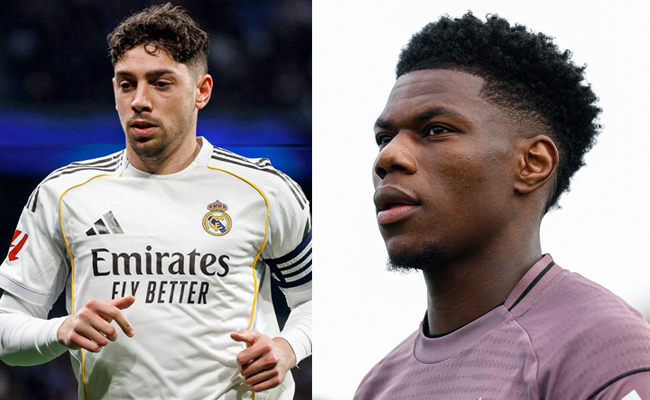
Barcelona (AP): Real Madrid slapped players Federico Valverde and Aurélien Tchouaméni with half-a-million-euro ($588,000) fines on Friday for their altercation during practice.
The massive fines came a day after the midfielders tussled when the team trained. Valverde said in a post on social media on Thursday that no punches were thrown. But Valverde knocked his head on a table and he suffered a small cut that required a brief hospital visit.
On social media, Valverde initially called it a “meaningless fight” with a teammate and said “everything has been blown out of proportion."
His employers, however, considered it a significant enough breach of team discipline to nail both Valverde and Tchouaméni with fines that bite even the bank account of a top soccer player. The half-a-million euro penalties reflect the reputational damage the club was enduring in a chaotic end to a disappointing season.
In a statement, the 15-time European champion said its disciplinary action was concluded after both players expressed to the club “their complete remorse for what happened and apologized to one another.”
Madrid added they also apologized to their teammates, the coaching staff and club supporters, as well as showing their willingness to accept whatever disciplinary action the club deemed “opportune.”
Tchouaméni was back training with Madrid on Friday, two days before they play at Barcelona in a clasico. Madrid has to win otherwise Barcelona will be crowned La Liga champion.
After being notified of the fine, he posted a public apology to the club and its fans on social media.
“What happened this week in training is unacceptable,” Tchouaméni wrote. "I say this while thinking about the example we are expected to set for young people, whether in football or at school.
“Above all, I am sorry for the image we projected of the club.”
Valverde was not at practice due to the head knock.
Both players are set to play in the World Cup next month, with Tchouaméni playing for France and Valverde for Uruguay.
Chaotic end to a poor season
===================
The run-in between the players, who for seasons have played side by side in Madrid's midfield, came after they argued this week in previous training sessions. But tempers boiled over on Thursday. Spanish media was rife with reports that the players previously disagreed over the club's decision to let coach Xabi Alonso go after just months on the job.
It was not the only altercation involving Madrid players during training this week. Álvaro Carreras confirmed he was in a “minor” incident with a teammate. Spanish media said he and fellow defender Antonio Rüdiger got into a scuffle.
Álvaro Arbeloa, the coach who was promoted from Madrid's reserve team when Alonso was fired in January, will face tough questions on what went wrong inside the changing room when he gives a press conference on Saturday ahead of the clasico at Camp Nou.
Madrid is facing a second consecutive campaign without a major trophy amid rumors in the Spanish media that club president Florentino Pérez is considering bringing back Jose Mourinho to straighten out his underperforming team.