Asian Athletics: India sign off with 24 medals; Sachin, Parul, women's relay team win silver
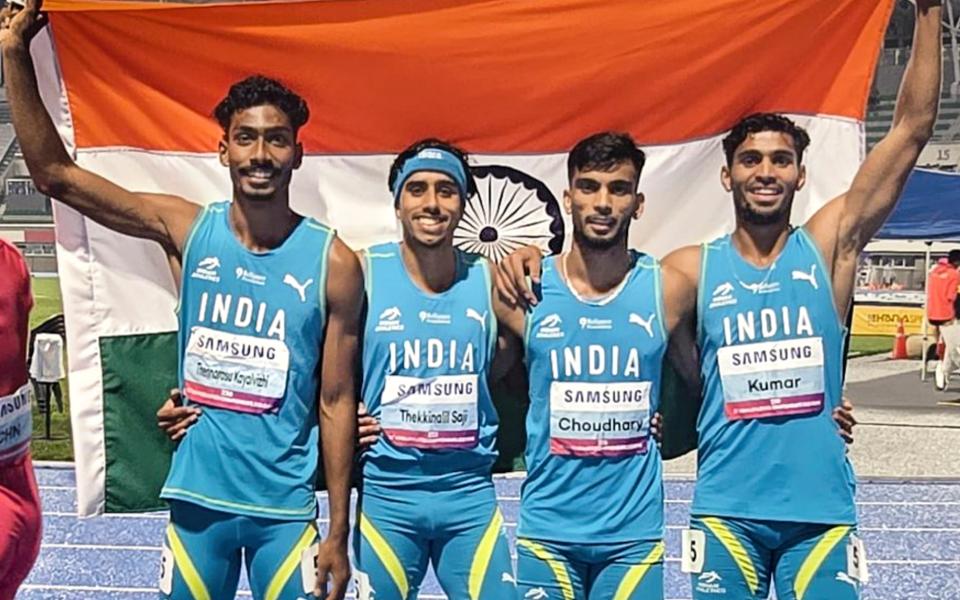
Gumi (South Korea), May 31 (PTI): A new national record, a string of personal bests, and six final-day medals capped India's campaign at the 26th Asian Athletics Championships with the country signing off with a total haul of 24 medals here on Saturday.
While gold proved elusive on the final day, Indian athletes delivered a series of gritty performances to secure three silver and as many bronze medals.
Parul Chaudhary claimed her second silver of the meet with a strong run in the women's 5000m, clocking 15:15.33s to finish second, adding to the silver she had earlier won in the 3000m steeplechase.
While javelin thrower Sachin Yadav earned his silver with a personal best effort, the women's 4x100m relay team, featuring Abinaya Rajarajan, Sneha SS, Srabani Nanda, and Nithya Gandhe, clocked a season-best 43.86s to bag India's final silver.
Sprinter Animesh Kujur blazed to a national record of 20.32s to clinch a a bronze in the men's 200m for India.
Middle distance runner Pooja recorded a personal best to take bronze in the women's 800m, while Asian Games medallist Vithya Ramraj secured the third place in the women's 400m hurdles.
India thus wrapped up the championships with 8 gold, 10 silver, and 6 bronze medals.
While the overall count fell short of the 27 medals won in the previous edition, the contingent has improved on the gold tally, increasing it from 6 to 8.
India finished second in the medal tally behind China (19 gold, 9 silver, 4 bronze), marking the country’s best performance since the 2017 edition in Bhubaneswar, where it topped the standings with 29 medals (10 gold, 6 silver, 13 bronze).
Japan finished third with 5 gold, 11 silver and 12 bronze.
Personal bests for Sachin and Yashvir
In the absence of two-time Olympic medallist Neeraj Chopra, both the Indian javelin throwers produced personal best efforts.
Rising star Sachin sent his spear to 85.16m in his last attempt to finish behind Pakistan's reigning Olympic champion Arshad Nadeem, who was appearing in his first competition since the Paris Games last year. The Pakistani fetched the gold with a 86.40m throw.
Competing in his maiden major international meet, Sachin narrowly missed the World Championships qualification mark of 85.50m, and blamed his twin injuries -- to the ankle and shoulder -- for the shortfall.
“I’m not satisfied, but yes, I’ll go back with a medal and a personal best,” said the 25-year-old, who had a previous personal best of 84.39m.
Asked whether he could breach the qualifying mark in the next 2-3 months, with the World Championships scheduled in Tokyo this September, he remained hopeful.
“Once I return, I’ll give my all in training. I’ve made some mistakes that affected my preparation. For instance, I had injuries -- first in my ankle, then in my shoulder -- which prevented me from training properly,” he said.
“I can’t say exactly how much time I’ll need, but I will try to give my best in the next competition and aim to qualify with a good distance,” added Sachin who hails from a farmer's family at Khekra village near Baghpat in Uttar Pradesh.
Fellow Indian Yashvir Singh also impressed with a personal best of 82.57m for a fifth-place finish.
Kujur wins India's first men's sprint medal in a decade
India's first medal of the day came through Kujur, who ended a decade-long wait for the country in the men’s 200m with a bronze.
It was India's first in the event since Dharambir Singh's bronze in the 2015 edition.
The 21-year-old from Odisha delivered a standout performance, clocking a national record of 20.32 seconds, bettering his own mark of 20.40s set earlier this year at the National Federation Senior Athletics Competition.
Highly impressed with Animesh Kujur’s rapid progress, Adille J Sumariwalla, former president of the Athletics Federation of India and a former sprinter himself, hailed the youngster as one of the best in the country.
"He’s an absolutely outstanding athlete. He’s doing very, very well. And if he can just improve his start a little more, he’ll be almost impossible to beat,” Sumariwalla said.
"He’s one of those very, very talented sprinters among the best I’ve seen in India."
Japan's Towa Uzawa won gold with a time of 20.12s, while Saudi Arabia's Abdulaziz Abdu I Atafi took silver in 20.31s.
Bronze for Vithya, Pooja
Asian Games medallist bronze Vithya sailed smoothly over the women's 400m hurdles to finish on the third step of the podium. The 26-year-old Tamil Nadu athlete clocked 56.46s to finish on the podium.
China's Mo Jiadie clinched gold in 55.31s, edging out Bahrain's Oluwakemi Adekoya, who finished second in 55.32s. Anu Raghavan, the other Indian in the race, was placed seventh with 57.46s.
Pooja grabbed India's third bronze of the day as she finished the women's 800m with a personal best of 2:01.89s.
In the women's 200m final, Jyoti Yarraji finished fifth with a time of 23.47s, while Nithya Gandhe came seventh in 23.90s. Yarraji had won gold in the women's 100m hurdles earlier in the week.
In the men's 800m, Krishan Kumar and Anu Kumar finished seventh and eight respectively.
Let the Truth be known. If you read VB and like VB, please be a VB Supporter and Help us deliver the Truth to one and all.
Five railway staffers injured as van headed to Rajdhani Express fire site overturns in MP
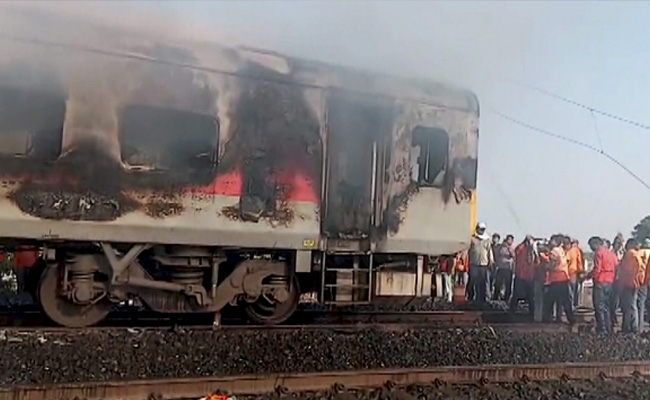
Ratlam (MP) (PTI): Five railway staffers were injured, one of them critically, when their van carrying repair equipment to the site of a Rajdhani Express fire overturned in Madhya Pradesh's Ratlam district on Sunday, officials said.
The blaze erupted in an AC coach of the Delhi-bound Thiruvananthapuram-Hazrat Nizamuddin Rajdhani Express between Vikramgarh Alot and Lunirichha stations under the Kota division of the railways in Ratlam at 5.15 am.
It disrupted the movement of several trains on the Mumbai-Delhi route, as per the officials.
A van carrying necessary equipment to Alot overturned on the way when a cow suddenly strayed into the middle of the road, they said.
ALSO READ: Fire breaks out in coach of Delhi-bound Rajdhani Express in MP's Ratlam; no casualties
Five railwaymen were injured, one of them critically, the officials said.
The incident took place when the van carrying essential equipment for overhead electric line repair, among other things, was on its way to Alot from Shyamnagar in Ratlam, West Central Railway's chief public relations officer Harshit Shrivastava told PTI.
The injured persons were rushed to the hospital and were subsequently referred to Kota in Rajasthan, officials said.
No casualties were reported in the train fire.