At 29, Quinton de Kock announces retirement from Test cricket
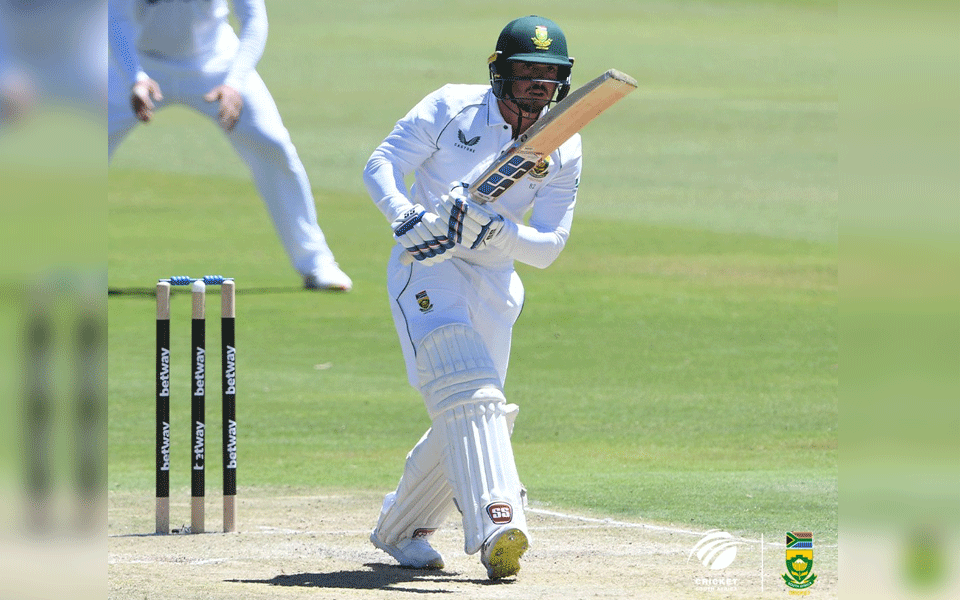
Johannesburg(PTI): South Africa's star wicketkeeper-batter Quinton de Kock on Thursday announced his retirement from Test cricket with immediate effect, said the country's apex body, CSA, hours after the team's defeat in the first Test against India.
A former Test captain, De Kock is only 29 and it is believed that he will continue playing in the white-ball formats for the Proteas, with a lot of focus on franchise-based T20 leagues.
"De Kock has cited his intentions to spend more time with his growing family for the timing and reason for his relatively early retirement from the format. He and his wife, Sasha, are anticipating the imminent birth of their first-born child in the coming days," Cricket South Africa (CSA) said in a statement.
On his part, the player said that it wasn't an easy decision.
"This is not a decision that I have come to very easily. I have taken a lot of time to think about what my future looks like and what needs to take priority in my life now that Sasha and I are about to welcome our first child into this world and look to grow our family beyond that," De Kock said.
"My family is everything to me and I want to have the time and space to be able to be with them during this new and exciting chapter of our lives."
De Kock made his Proteas Test debut against Australia in Gqeberha in 2014. In 54 matches, he scored 3300 runs with a highest score of 141 not out, at an average of 38.82 and strike rate of 70.93.
He has six centuries and 22 half-centuries under his belt along with 232 dismissals, which includes 221 catches and 11 stumpings.
De Kock has also taken the third-most number of catches in the inaugural ICC World Test Championship -- 48 in 11 matches (47 catches and 1 stumping) and has a personal best of six dismissals in an innings, against England in Centurion in 2019.
South Africa lost the opening Test to India by 113 runs in Centurion.
Let the Truth be known. If you read VB and like VB, please be a VB Supporter and Help us deliver the Truth to one and all.
Tribal man brings dead sister's skeleton to bank to withdraw money from her account
Keonjhar (PTI): A tribal man in Odisha's Keonjhar district on Monday brought the skeleton of his dead sister to a bank to withdraw the money deposited in her name, police said.
The incident occurred at Maliposi branch of Odisha Grameen Bank located at Patana block of Keonjhar district. The man was identified as Jeetu Munda (50) of Dianali village. He was seeking to withdraw Rs 20,000 from the bank account of his elder sister, Kalra Munda (56), who died on January 26, 2026.
"I have run several times to the bank, and the people there told me to bring the account holder to withdraw money deposited in her name. Though I told them that she had died, they did not listen to me and insisted on bringing her to the bank. Therefore, out of frustration, I dug the grave and brought out her skeleton as proof of her death," an illiterate Jeetu Munda told reporters.
Patana Police Station Inspector in charge (IIC) Kiran Prasad Sahu, who reached the bank after getting information, said, "Jeetu is an illiterate tribal man. He does not know what the legal heir or nominee is. The bank officials have failed to make him understand the procedure to withdraw money from the dead person's account."
However, after the incident, the police assured Jeetu Munda that they would facilitate the withdrawal of money from the bank account of his dead sister. Later, the skeleton was again buried at the graveyard in presence of police.
Meanwhile, local Block Development Officer (BDO) Manas Dandpat said that he was not approached by anyone for the legal heir of late Kalra Munda. "Today only, I came to know about it. We will see what can be done to resolve the issue," the BDO said.
Meanwhile, bank sources said that the nominee in Kalra Munda's bank account was also dead. Therefore, Jeetu Munda was the lone claimant over the money deposited in her name.
The local administration has directed the bank officers to make arrangements and ensure that Jeetu Munda, who is the only claimant as per the rules, gets the money as soon as possible.