Australia 156/4 at stumps on Day 1, lead India by 47 runs
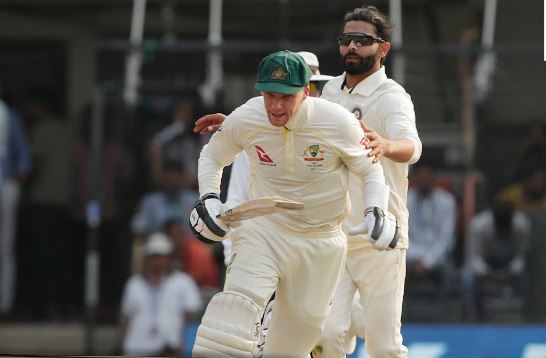
Indore, Mar 1: Indian batters' longstanding struggles against spin were thoroughly exposed before Australia applied themselves on a rank turner to take control of the third Test on a frantic opening day of the match here on Wednesday.
Left-arm spinner Matthew Kuhnemman (5/16) picked up his maiden five-wicket haul as Australia skittled India out for a paltry 109 shortly after lunch on day one. Virat Kohli top-scored for India with 22 off 52 balls.
Trailing 0-2 in the series, Australia came out with a strong resolve and purpose to end the day at 156 for four, taking a 47-run lead.
Ravindra Jadeja (4/63) took all four wickets for India including that of stand-in captain Steve Smith (26 off 38) before close of play.
Usman Khawaja (60 off 147) was the standout performer for Australia as he tackled the skill-full Jadeja and R Ashwin with a straight bat and soft hands.
Marnus Labuschagne (31 off 91 balls), who was bowled off a no ball early in his innings, rode on his luck to share a 96-run stand with Khawaja, the highest partnership of the series for the visitors.
Though the usually accurate Indian spinners were not relentless with their lines and lengths, Khawaja and Labuschagne rectified the "sweeping" mistakes they made in Delhi by playing straight and trusting their defense.
When India were batting, the pitch seemed unplayable but Khawaja and Co. showed the way to the home team.
Khawaja's gritty knock also had a couple of drives on the off-side. He was also not shy of playing the reverse sweep but mostly played straight.
The southpaw hardly put a foot wrong in his crafty knock but when he did, he had to pay for it. In the 43rd over of the innings, Khawaja went for the sweep from around the off-stump off Jadeja and ended up giving a catch at deep midwicket.
Like Nagpur and Delhi, the game is set for another three-day finish and a 100-run lead on this surface will be worth gold.
India were also guilty of bowling four no-balls.
Earlier, having lost seven of the batters by the end of the opening session, India could add only 25 more runs to their total with Kuhnemann ending with career-best figures in first-class cricket.
If it wasn't for Umesh Yadav's 17 off 13 balls, India would have struggled to get past the 100-run mark.
The only wicket that came India's way in the afternoon session was of Travis Head (9), who missed a straight ball from Jadeja to be adjudged lbw.
It was a sign of desperation that India exhausted two of their three views in the first 10 overs. Labuschagne got a second life when India did not review a lbw call off Ashwin.
The great Matthew Hayden on air called the the black soil surface at the Holkar Stadium a day-three pitch and it sure behaved like one.
Three India batters including skipper Rohit Sharma (12), Jadeja (4) and Shreyas Iyer (0) perished while trying to attack.
Kohli looked assured in the middle before being trapped lbw by Todd Murphy towards the end of the session.
Winning the toss for the first time in the series, India expectedly decided to bat first. Shubman Gill replaced an out-of-form K L Rahul in the playing eleven while Umesh Yadav was brought in for the rested Mohammad Shami.
Having regained match fitness, both Mitchell Starc and Cameron Green made Australia's playing eleven.
Starc's first over to Rohit was among the highlights of the morning session. Before the spinners ran through the Indian batting, Starc got the ball to swing giving the India skipper a tough time.
Rohit got a faint outside edge on the very first ball he faced but Australia did not take a review. Three balls later, Starc got the ball to swing back in and it flicked Rohit's pads. Ball tracking showed the ball would have hit the off stump but Australia did not take the review.
Spin was introduced in the sixth over and Kuhnemman got the ball to turn sharply. In the last ball of the over, Rohit stepped out to play across the line and got beaten in the flight and Alex Carey made a clean stumping.
Kuhnemann had Gill caught at first slip with the opener getting a thick outside edge while offering a forward defence.
Cheteshwar Pujara's stay lasted only four balls as Lyon got one to turn massively from wide off stump that crashed into the middle stump. The ball kept a tad low as well and Pujara was found wanting on the back foot.
When Shreyas Iyer played an attempted cut on to his stumps, India had lost half their side.
Let the Truth be known. If you read VB and like VB, please be a VB Supporter and Help us deliver the Truth to one and all.
T'gana RTC strike: Talks between govt, employees successful

Hyderabad (PTI): Talks between employees of Telangana State Road Transport Corporation (RTC) who were on strike and the state government concluded successfully on Friday as the government agreed to the key demands of the workmen.
Following a day-long marathon of talks between the leaders of the employees' Joint Action Committee (JAC) and the cabinet sub-committee, the government announced after midnight that it acceded to the demands, including a merger of RTC with the government, 11 per cent pay revision and elections to the employees' unions.
A committee comprising officials and employee leaders would be appointed over the merger of RTC with the government, it said.
The RTC management has also agreed to address the remaining issues as well, an official release said.
The employees would call off their strike and the RTC buses would hit the roads shortly, it said.
The employees had been on an indefinite strike since April 22 over a series of demands, including the merger of RTC with the government.
Earlier in the day, a driver of the RTC, who attempted suicide on April 23 during the strike, died at a hospital here in the early hours of Friday.
Shankar Goud, a 55-year-old driver, set himself ablaze by pouring petrol at Narsampet in Warangal district when the employees were staging a protest on Thursday in support of their demands.
Goud suffered serious burns, was initially admitted to a state-run hospital in Warangal, and later shifted to a super-speciality hospital in Hyderabad for advanced treatment.
"He succumbed (to injuries) at about 1.30 am on Friday," a senior official said.
The driver’s body was taken to his relative’s village, Muttojipet in Warangal district, for funeral rites.
Tension prevailed in Muttojipet as his family members and RTC employees attempted to take the body to the Narsampet bus station, where he worked, to enable his colleagues to pay their last respects. However, police did not permit this, citing law-and-order concerns.
This led to a deadlock before the funeral could proceed.
Union Minister Bandi Sanjay Kumar criticised the Telangana government for not allowing the body to be taken to the Narsampet bus station.
Kumar, Minister of State (Home), visited Muttojipet village in Warangal district, where the funeral was held, and paid homage to Goud.
“They (family members) want to take the body to the bus depot for five minutes. Is the RTC bus depot in Pakistan or Bangladesh? They are emotionally attached to taking the body there. The government is hurting sentiments and creating fear among RTC employees,” Kumar told reporters.
He also expressed anger at the police for not allowing the body to be taken to the bus station and staged a protest, according to a release from his office.
RTC employees and BJP workers attempted to take the mortal remains in an ambulance to Narsampet, but were stopped by the police.
Later, after discussions with the police, the family members and RTC employees agreed to conduct the funeral in the village.
Sanjay Kumar, stating he would abide by the family’s decision, left the village after the funeral was conducted there.
Transport Minister Ponnam Prabhakar said an ex gratia of Rs 10 lakh, a house, and a government job would be provided to the kin of Goud.
Chief Minister A Revanth Reddy expressed shock over the employee’s death and conveyed deep condolences to the grieving family, according to the release.
The RTC employees’ JAC had earlier announced an agitation programme from April 24 to 29, including silent marches and submission of memorandums to MLAs and other leaders.