Australia retains Ashes with win over England
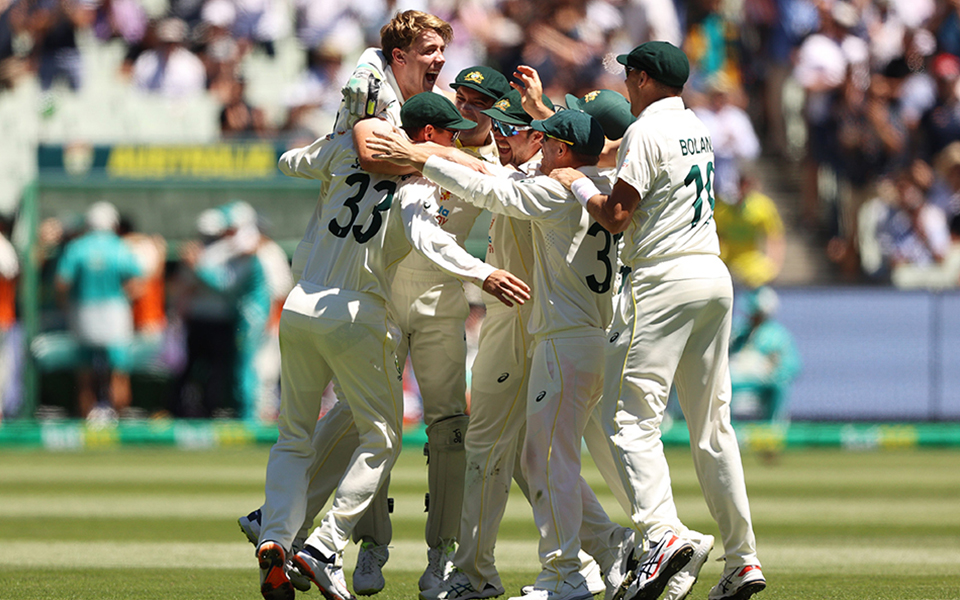
Melbourne, Dec 28 (AP): It was quite a Test debut for Australia fast bowler Scott Boland.
Player-of-the-match Boland claimed the remarkable bowling figures of six wickets for seven runs as Australia beat England by an innings and 14 runs before lunch on the third day of the third Ashes test at the Melbourne Cricket Ground on Tuesday.
The massive victory means Australia retains the Ashes, with a 3-0 lead in the five-match series.
Resuming on Tuesday on 31-4, England was bowled out for 68. Ben Stokes, on 11, was bowled by Mitchell Starc in the fifth over of the day.
The 32-year-old Boland removed Jonny Bairstow for 5 in his first over of the day, then world No. 2-ranked batter Joe Root for 28 in his second over, before dismissing Mark Wood and Ollie Robinson without scoring in his third over.
When James Anderson was bowled by Cameron Green for 2, England's resistance had lasted just 27.4 overs.
Boland, who claimed match figures of 7-55 and is only the second Indigenous player to represent Australia's men's test-cricket side, was awarded the Johnny Mullagh Medal for player of the match. The award honors Australia's Indigenous team which toured England in 1868.
Australia captain Pat Cummins said his side had been relentless and would now aim for a 5-0 sweep of the series.
"Any Ashes series is when you try to make a mark on your test career, so a chance to start cementing our identity," Cummins said.
England captain Joe Root tried to remain positive.
"We have to stay strong and look at the next two games to take something from the tour," Root said at the post-match ceremony.
Play resumed as scheduled on Tuesday after players from both teams were tested for COVID-19 overnight.
"All results have come back negative," Cricket Australia said.
The start of Monday's second day of play was delayed by 30 minutes due to a COVID-19 scare involving two members of England's support staff.
Australia was bowled out for 267 on Monday as the home side grabbed a first-innings advantage of 82 runs. England could not even reach that figure to make Australia bat a second time.
The fourth test is scheduled to begin on Jan. 5 in Sydney, with the fifth from January 14 in Hobart.
Let the Truth be known. If you read VB and like VB, please be a VB Supporter and Help us deliver the Truth to one and all.
Tribal man brings dead sister's skeleton to bank to withdraw money from her account
Keonjhar (PTI): A tribal man in Odisha's Keonjhar district on Monday brought the skeleton of his dead sister to a bank to withdraw the money deposited in her name, police said.
The incident occurred at Maliposi branch of Odisha Grameen Bank located at Patana block of Keonjhar district. The man was identified as Jeetu Munda (50) of Dianali village. He was seeking to withdraw Rs 20,000 from the bank account of his elder sister, Kalra Munda (56), who died on January 26, 2026.
"I have run several times to the bank, and the people there told me to bring the account holder to withdraw money deposited in her name. Though I told them that she had died, they did not listen to me and insisted on bringing her to the bank. Therefore, out of frustration, I dug the grave and brought out her skeleton as proof of her death," an illiterate Jeetu Munda told reporters.
Patana Police Station Inspector in charge (IIC) Kiran Prasad Sahu, who reached the bank after getting information, said, "Jeetu is an illiterate tribal man. He does not know what the legal heir or nominee is. The bank officials have failed to make him understand the procedure to withdraw money from the dead person's account."
However, after the incident, the police assured Jeetu Munda that they would facilitate the withdrawal of money from the bank account of his dead sister. Later, the skeleton was again buried at the graveyard in presence of police.
Meanwhile, local Block Development Officer (BDO) Manas Dandpat said that he was not approached by anyone for the legal heir of late Kalra Munda. "Today only, I came to know about it. We will see what can be done to resolve the issue," the BDO said.
Meanwhile, bank sources said that the nominee in Kalra Munda's bank account was also dead. Therefore, Jeetu Munda was the lone claimant over the money deposited in her name.
The local administration has directed the bank officers to make arrangements and ensure that Jeetu Munda, who is the only claimant as per the rules, gets the money as soon as possible.