2nd ODi: Marsh fires Australia to 298/9
Adelaide, Jan 15: Shaun Marsh smashed his seventh hundred before India pacer Bhuvneshwar Kumar produced a brilliant spell in the death overs to limit Australia to 298-9 in the second ODI here on Tuesday.
At the Adelaide Oval, Marsh arrived at the crease at 26-2 and scored 131 runs, inclusive of 11 fours and three sixes, adding 94 runs off 65 balls runs with Glenn Maxwell (48 off 37 balls).
This was after Australia won the toss and opted to bat in searing heat. The hosts were unchanged from the previous game, while India brought in debutant Mohammed Siraj in place of Khaleel Ahmed.
Bhuvneshwar (4-45) and Mohammed Shami (3-58) exerted themselves on proceedings with the new ball, and didn't let the Australian openers get away quickly.
Kumar bowled Aaron Finch (6) through the gate in the seventh over, in a near-similar replay of his dismissal in the first ODI. At the other end, Alex Carey (18) looked set once again before getting out two overs later, a top-edge off Shami's quick bouncer caught at mid wicket as Shikhar Dhawan took a skier.
It brought Marsh and Usman Khawaja (21) together, and they put on 56 runs off 65 balls. Their partnership threatened to turn the game away, but Ravindra Jadeja affected a sensational run-out in the 19th over to dismiss Khawaja with a direct throw from backward point.
Marsh was able to manoeuvre the middle overs very well, as Mohammed Siraj (0-76) was proving expensive in every spell. The debutant sprayed the ball all over and was never able to hit a consistent line.
India were forced to bowl Kuldeep Yadav (0-66) and Jadeja (1-49) earlier in the innings than planned, and even Shami came back for a spell before the 25th over as the lack of a sixth bowling option started to show.
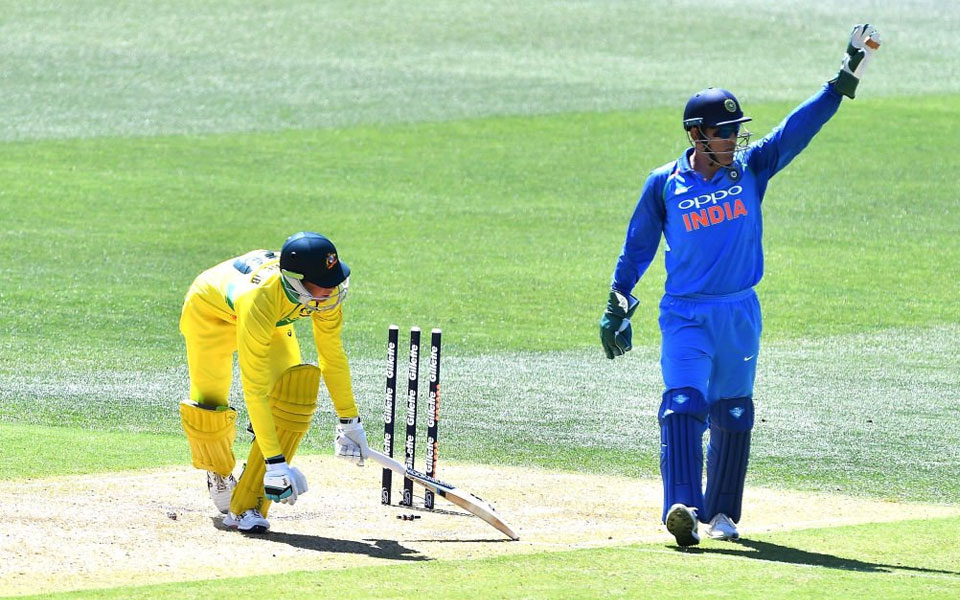
Australia did them a favour by losing wickets at regular intervals. Peter Handscomb (20) was stumped off Jadeja in the 28th over with MS Dhoni affecting another quick dismissal. But he had added 52 runs with Marsh for the fourth wicket carrying Australia past 100 in the 22nd over.
Marsh reached his half-century off 62 balls, and used his feet well against the spinners. In doing so, he added 55 runs with Marcus Stoinis (29) for the fifth wicket.
Their partnership threatened to change the pace of scoring but Shami struck in the 37th over, an inside edge caught behind, to dismiss Stoinis. This brought Maxwell to the crease, and the floodgates opened.
Maxwell hit five fours and a six as Australia accelerated after reaching 200 in the 39th over. Marsh, meanwhile, had reached his hundred off 108 balls.
Siraj had a woeful day as he missed out twice on Maxwell's wicket as the hard-hitting batsman survived on 26 and 41. First, DRS overturned an lbw decision in the 44th over with the ball going down leg, and then Rohit Sharma dropped a tough chance at extra cover in the 47th over.
Kumar returned to account for both Maxwell and Marsh in the 48th over and it dented momentum towards 300, as Australia lost a flurry of wickets.
But Nathan Lyon (12 not out) smacked 10 runs in the last three balls as they scored 93 runs in the last ten overs.
Let the Truth be known. If you read VB and like VB, please be a VB Supporter and Help us deliver the Truth to one and all.
Rickelton's ton in vain as SRH beat MI by 6 wickets
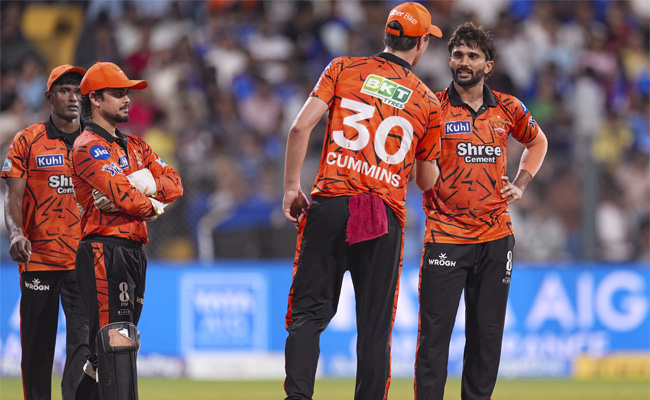
Mumbai (PTI): Ryan Rickelton's whirlwind unbeaten ton was overshadowed by Heinrich Klaasen's unbeaten 65 as Sunrisers Hyderabad defeated Mumbai Indians by six wickets in an IPL match here on Wednesday.
Chasing an imposing 244-run target, Travis Head (76 off 30) and Abhishek Sharma (45 off 24) shared 129 runs for the opening wicket to set the platform for SRH.
Klaasen (65 not out off 30 balls) then displayed his all-round hitting abilities to guide SRH home with the help of Nitish Kumar Reddy (21) and Salil Arora (30 not out off 10) in 18.4 overs.
Earlier, Rickelton's knock powered MI to 243 for five.
MI rode on a 93-run stand between Rickelton (123 not out off 55 balls) and Will Jacks (46 off 22) in 7.1 overs for the opening stand to power the side.
MI skipper Hardik Pandya scored a valuable 31 off 15 balls before being dismissed.
Praful Hinge (2/54), Eshan Malinga (1/29), Sakib Hasan (1/39) and Nitish Kumar Reddy (1/31) were the wicket-takers for SRH.
Brief Scores:
Mumbai Indian: 243 for 5 in 20 overs (Ryan Rickelton 123 not out; Praful Hinge 2/54).
Sunrisers Hyderabad: 249 for 4 in 18.4 overs (Travis Head 76, Heinrich Klaasen 65 not out; AM Ghazanfar 2/51).