Australia will have plans set for world-class Rohit Sharma: Lyon
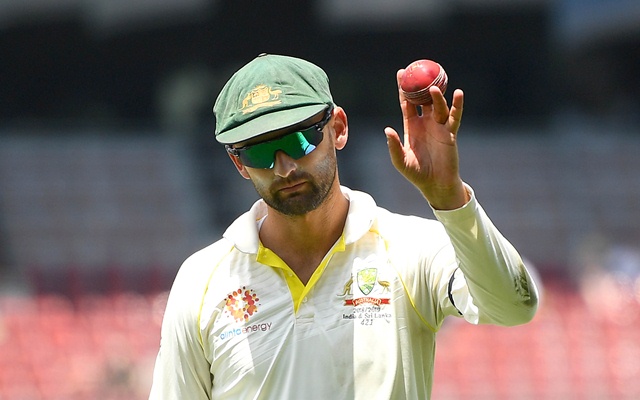
Melbourne: Australia will have plans chalked out for the returning Rohit Sharma, seasoned off-spinner Nathan Lyon said on Monday, describing the swashbuckling India opener as one of the best players in world cricket.
Having missed the limited-overs leg of the tour and the Tests in Adelaide and Melbourne due to an injury, Rohit has joined an upbeat Indian team for the last two matches and Lyon is aware of the threat the batsman can pose with his wide range of strokes.
"Obviously, Rohit Sharma is one of the best players in the world going around, so it is going to be a big challenge for us bowlers, but we are going to show our way from it, we love challenging ourselves," Lyon said at a virtual press conference.
"He (Rohit) is a big input for the Indian side, so it is going to be interesting to see who they leave out.
"But we will have our plans ready for Rohit, and hopefully, we can get on top of him nice and early, but respecting how good a cricketer Rohit is," added Lyon, who is on the verge of playing his 100th Test.
Rohit has been named India's vice-captain for the remaining two Tests after he missed the first two as he was recovering from an injury sustained during the IPL.
Lyon said one of India skipper Ajinkya Rahane's strengths is that he does not indulge in sledding or conversations with the opposition bowlers while he is in the middle.
"He (Rahane) is obviously a world-class batter, which obviously helps with everything. I think the patience that he shows at the crease, he doesn't seem to get (frustrated) much.
"He (Rahane) doesn't buy into any sledding or any conservation out there in the middle, he is pretty calm and collective batter (of the) opposition, so it is few different things that he offers.
"... But he is obviously the leader of India at the moment as Virat (Kohli) is not here, so he is standing up at the moment and I know we will have our plans ready to hopefully combat him come to the SCG Test," he said.
Lyon also had words of praise for his Indian counterpart Ravichandran Ashwin and said the Tamil Nadu off-spinner has bowled quite straighter to the Australian batsman and they had no answer to that.
"Yeah, Ashwin is bowling very well. He is a world-class spinner and I have said that throughout my whole career. He has bowled quite a straight line to our batters, which they haven't had come up with a plan as yet.
"I think they will come up with one of them and counter Ashwin's plan in Sydney," said Lyon, who has 394 wickets from 94 Tests.
"But he (Ashwin) is a world-class bowler and what you expect, he has got a decent record around the world, so hats off to him," the Australian added.
Lyon also stated that he has devised "a couple of different plans" for Rahane, who hit a dogged match-winning 112 in the Melbourne Test.
"I think (Ajinkya) Rahane played me extremely well in Melbourne, so I know I am going to come up with a couple of different plans for him and a few different guys, so I am looking forward to putting them in place.
"But, to be honest with you, we have been pretty accurate with our bowling, as a squad to take 20 wickets quite quickly in Adelaide but then challenged a little bit in Melbourne.
"But to stay there and keep creating chances, that was positive. So, we are very confident as a bowling group and I know personally I have got a few different plans to put in place."
According to the 33-year-old Lyon, Indian batters have always tried to be attacking against him.
"I think they (Indian batsmen) have played me pretty similar. Every series I come up against India, they try to be quite attacking," he said.
Currently, the series is tied at 1-1 with Australia winning the Pink-Ball opener in Adelaide and India emerging triumphant in Melbourne.
The third Test will be aired live on Sony Six, Sony Ten 1, and Sony 3 from January 7.
Let the Truth be known. If you read VB and like VB, please be a VB Supporter and Help us deliver the Truth to one and all.
Student found dead in hostel room in IIT Kharagpur

Kolkata (PTI): A 22-year-old M Tech student was found dead in his hostel room in the Indian Institute of Technology, Kharagpur, the second such incident reported on the campus within a span of 10 days.
The student, identified as Soham Haldar, was found hanging from the ceiling of his hostel room on Tuesday and he was immediately taken to the institute hospital, where doctors declared him brought dead, an IIT Kharagpur official said.
Haldar, a dual-degree student in Electronics and Electrical Communication Engineering, was a boarder of the Pandit Madan Mohan Malaviya Hall of Residence on the campus.
Police from the Kharagpur Town police station have initiated a probe into the incident as preliminary findings indicated that it could be a case of suicide, though the exact cause of death will be ascertained following the post-mortem examination, the official said.
In a statement, the institute expressed deep grief over the student's death and said a detailed inquiry has been initiated.
The authorities have informed the family and are extending all possible assistance to them, it added.
Director Suman Chakraborty told PTI that the institute will strengthen the mechanism to identify stressed-out and depressed students and take follow-up steps to address their issues.
The grief-stricken parents of the student, who hailed from Barasat in North 24 Parganas district, have come to the campus and the authorities will speak to them, he said.
"Haldar's friends, faculty and staffers also could not gauge any stress or anxiety in him. But we need to enable students suffering from anxiety and extreme stress to open up their minds and do everything needed to prevent such incidents," he said.
Investigators are also scrutinising CCTV footage from the hostel premises to piece together the sequence of events leading to the incident.
The incident comes close on the heels of another student's death reported on April 18, when 21-year-old Jaibir Singh Dodia, a third-year Mechanical Engineering student from Ahmedabad, allegedly died after jumping from the eighth floor of the Atal Bihari Vajpayee Hall of Residence. That case is also under investigation.
The back-to-back incidents have once again brought the issue of mental health and student support systems at the institute into focus, especially in view of several such cases reported last year.