Australians appear jittery over pitch behaviour, Cummins clicks photos of match strip
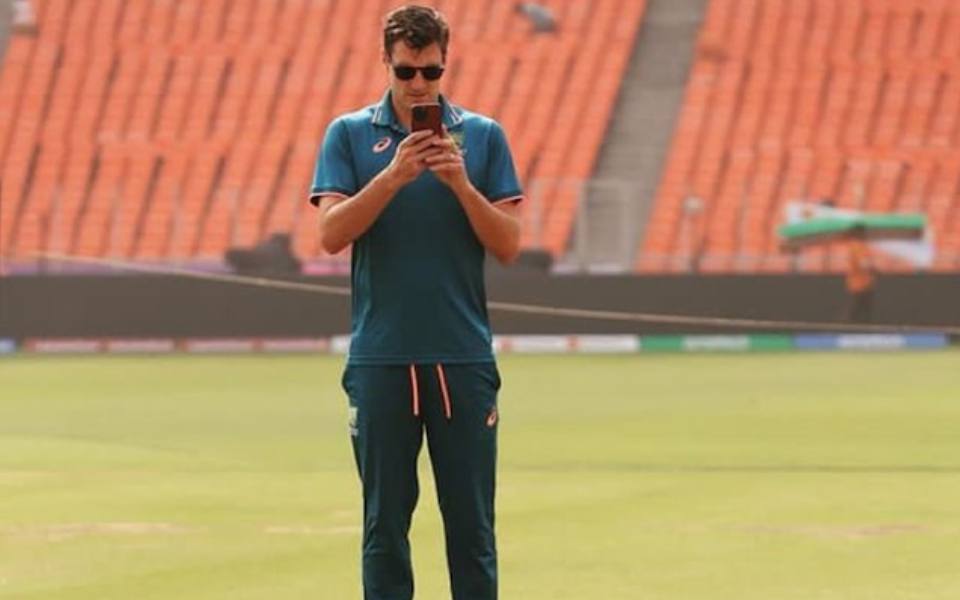
Ahmedabad, Nov 18: Inspecting the pitch before a match is routine but clicking pictures of the track, for possible dressing room discussion and strategy building, is a bit unusual.
That's exactly what happened this morning when Australia skipper Pat Cummins came to have a look at the 22-yard-strip which will be used for the World Cup title clash between India and Australia on Sunday.
Probably the pitch is playing on Australians' mind before the big match.
Cummins was guarded in his response when asked about his assessment of the pitch, which has already been used for the marquee India-Pakistan match.
"Just had a look," Cummins replied when asked about the track.
So what do you make of it? He was probed further.
"I'm not a great pitch reader, but it looked pretty firm. They've only just watered it, so yeah, give it another 24 hours and have a look, but it looks like a pretty good wicket."
"I think Pakistan played someone there," he said without taking India's name.
While Australian team had an afternoon training session, Cummins was at the Narendra Modi Stadium just after half past 9.
He went up to the square and then started clicking pictures to possibly check and compare how much the track's look will change from Saturday morning to afternoon and subsequently on the match-day afternoon.
In fact, before the Australian training session started, Steve Smith, Travis Head, head coach Andrew McDonald also wanted to have a close look.
Head, a good off-spinner in conducive conditions tried to gauge the hardness of the surface.
Eden Gardens strip had a few deliveries turning at right angles but Cummins believe that it won't be like that in Motera.
A black soil track, rolled heavily to ensure slowness, is on offer. Batting will be difficult under the lights if opposition has two quality spinners operating in the middle overs.
"It's been a bit more high scoring here throughout the tournament. It's obviously the same for both teams. No doubt playing on your own wicket in your own country has some advantages, similar to wickets that you've been playing your whole life," he said.
Unlike Wankhede where New Zealand virtually lost the game after losing the toss, it won't be the case at Motera.
"I think, of all the venues, perhaps this venue - the toss isn't as important as, say, a Mumbai Wankhede Stadium or other venues. So, we'll be ready in terms of anything they'll throw at us. Yeah, we'll wait and see, but we'll make sure we have some plans."
Dew will be big factor
ICC's pitch consultant Andy Atkinson did pay a visit and was around for an hour as BCCI's curators monitored the last day touch up before it is handed over to match referee Andy Pycroft.
The GCA ground-staff were seen using anti-dew spray in the afternoon as the last 20-25 overs of the match are always affected by late evening dew.
"I think the biggest difference is the dew. This city and venue seems to have more dew than a lot of the other places we play. So perhaps, yeah, that's something to think about ahead of tomorrow."
If Australia bat second, keeping dew factor in mind, Cummins indicated that batting order could be tweaked a bit.
"You've got to weigh up batting during the day when it might be a bit easier than under lights, but knowing that late in the second innings it could also slide on.
"Again, it (dew) might only be the last quarter of the game but once that settles in and the ball is skidding on, it's quite different to say the first 20 overs where it might be swinging. So, something to consider," he further stated.
Captain Pat Cummins inspects the pitch ahead of the final 🔍#CWC23 #INDvAUS pic.twitter.com/fUNpHgJXtd
— ICC Cricket World Cup (@cricketworldcup) November 18, 2023
Pat Cummins taking some pics of the pitch to make sure that they don’t change the pitch at the last moment 😀 #CWC2023 pic.twitter.com/ePxlxe7QJh
— Nibraz Ramzan (@nibraz88cricket) November 18, 2023
Pat Cummins clicking picture of Narendra Modi stadium pitch.pata. Nahi midinnings me change ho Jaye to pehle se hi photo click kar deta hu.. pic.twitter.com/N4VGksNQWh
— Manchester United FC (@DesaiDipen7) November 18, 2023
Let the Truth be known. If you read VB and like VB, please be a VB Supporter and Help us deliver the Truth to one and all.
T'gana RTC strike: Talks between govt, employees successful

Hyderabad (PTI): Talks between employees of Telangana State Road Transport Corporation (RTC) who were on strike and the state government concluded successfully on Friday as the government agreed to the key demands of the workmen.
Following a day-long marathon of talks between the leaders of the employees' Joint Action Committee (JAC) and the cabinet sub-committee, the government announced after midnight that it acceded to the demands, including a merger of RTC with the government, 11 per cent pay revision and elections to the employees' unions.
A committee comprising officials and employee leaders would be appointed over the merger of RTC with the government, it said.
The RTC management has also agreed to address the remaining issues as well, an official release said.
The employees would call off their strike and the RTC buses would hit the roads shortly, it said.
The employees had been on an indefinite strike since April 22 over a series of demands, including the merger of RTC with the government.
Earlier in the day, a driver of the RTC, who attempted suicide on April 23 during the strike, died at a hospital here in the early hours of Friday.
Shankar Goud, a 55-year-old driver, set himself ablaze by pouring petrol at Narsampet in Warangal district when the employees were staging a protest on Thursday in support of their demands.
Goud suffered serious burns, was initially admitted to a state-run hospital in Warangal, and later shifted to a super-speciality hospital in Hyderabad for advanced treatment.
"He succumbed (to injuries) at about 1.30 am on Friday," a senior official said.
The driver’s body was taken to his relative’s village, Muttojipet in Warangal district, for funeral rites.
Tension prevailed in Muttojipet as his family members and RTC employees attempted to take the body to the Narsampet bus station, where he worked, to enable his colleagues to pay their last respects. However, police did not permit this, citing law-and-order concerns.
This led to a deadlock before the funeral could proceed.
Union Minister Bandi Sanjay Kumar criticised the Telangana government for not allowing the body to be taken to the Narsampet bus station.
Kumar, Minister of State (Home), visited Muttojipet village in Warangal district, where the funeral was held, and paid homage to Goud.
“They (family members) want to take the body to the bus depot for five minutes. Is the RTC bus depot in Pakistan or Bangladesh? They are emotionally attached to taking the body there. The government is hurting sentiments and creating fear among RTC employees,” Kumar told reporters.
He also expressed anger at the police for not allowing the body to be taken to the bus station and staged a protest, according to a release from his office.
RTC employees and BJP workers attempted to take the mortal remains in an ambulance to Narsampet, but were stopped by the police.
Later, after discussions with the police, the family members and RTC employees agreed to conduct the funeral in the village.
Sanjay Kumar, stating he would abide by the family’s decision, left the village after the funeral was conducted there.
Transport Minister Ponnam Prabhakar said an ex gratia of Rs 10 lakh, a house, and a government job would be provided to the kin of Goud.
Chief Minister A Revanth Reddy expressed shock over the employee’s death and conveyed deep condolences to the grieving family, according to the release.
The RTC employees’ JAC had earlier announced an agitation programme from April 24 to 29, including silent marches and submission of memorandums to MLAs and other leaders.