Bairstow, Rashid set up season's first win for Sunrisers Hyderabad

Abu Dhabi: Opener Jonny Bairstow's sublime fifty was complemented by a stellar bowling effort from Rashid Khan as Sunrisers Hyderabad outplayed Delhi Capitals by 15 runs to open their account in the 13th IPL here on Tuesday.
Put in to bat, Bairstow (53 off 48) scored his second fifty of the tournament, while David Warner (45 off 33) and Kane Williamson (41 off 26) also came up with valuable contributions, helping Sunrisers Hyderabad post a competitive 162 for four.
Defending the total, leg-spinner Rashid (3/14) returned with three crucial wickets, while Bhuvneshwar Kumar (2/25) scalped two and T Natarajan and Khaleel Ahmed (1/43) claimed too chipped in to restrict Delhi to 147 for 7 in 2 for a deserving win.
Delhi lost opener Prithvi Shaw (2) early in their chase but Shikhar Dhawan (34 off 31) and skipper Shreyas Iyer (17) took them to 34 for one in the first six overs.
Rashid got into the act straightaway, dismissing Iyer with his second ball and then returned to remove Dhawan with a wrong'un in the 12th over as DC slipped to 63 for three.
Rishabh Pant then smashed two sixes on both sides of the wicket in the 13th over to ease the pressure. Shimron Hetmyer (21) also joined the party, launching Khaleel Ahmed for successive sixes in the 15th over.
However, Bhuvneshwar came back to dismiss Hetmyer, before Pant became the third victim of Rashid.
Needing 59 runs from 30 balls, all eyes were on Marcus Stoinis (11) but he was done in by a well placed yorker from Natarajan to end Delhi's hopes.
Earlier, Bairstow smashed two fours and one six in his innings and shared two crucial partnerships -- 77 off 57 balls with Warner for the opening stand and 52 off 38 balls with Williamson for the third wicket.
Making his IPL debut, Jammu and Kashmir's Abdul Samad (12 off 7) blasted a four and six in his useful cameo.
Warner and Bairstow were circumspect with the pace trio of Ishant Sharma, Kagiso Rabada (2/21) and Anrich Nortje maintaining their line and length.
The result was Sunrisers could only score 38 in the powerplay, which yielded just two fours and a six -- all hit by Warner.
Bairstow picked his first boundary in the seventh over, launching a slog sweep for a six off leg-spinner Amit Mishra (2/35).
The duo tried to make up for the lack of boundaries on the slow track with their excellent running between the wickets to keep the scoreboard ticking.
Warner sent one straight over Ishant's head for his second six and then picked a four off Mishra with a reverse sweep but the spinner had the last laugh as he had him caught behind with SRH reaching 82 for one in 10 overs.
Mishra returned to dismiss Manish Pandey (3) before Sunrisers crossed the 100-mark in 14th over.
Playing his first match of the season after recovering from an injury, Williamson smashed two fours in the 16th over to take SRH to 128 for two.
Bairstow reached his fifty off 44 balls before holding out to Nortje in the 18th over. Williamson too was dismissed in the last over.
Let the Truth be known. If you read VB and like VB, please be a VB Supporter and Help us deliver the Truth to one and all.
Karnataka School Edu Dept prohibits children from being made to dance to obscene songs
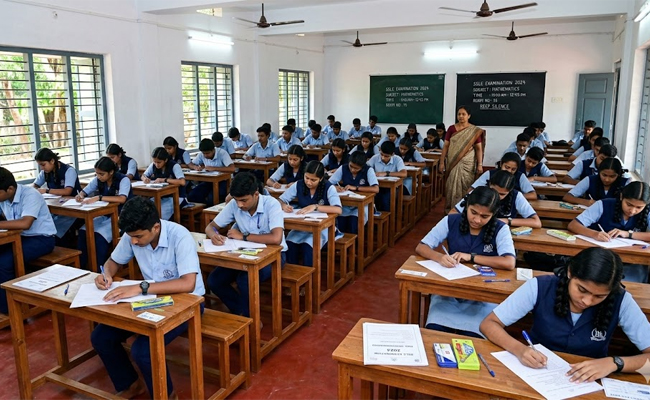
Bengaluru (PTI): The Karnataka School Education Department has issued a circular strictly prohibiting children from being made to dance to obscene songs in educational and cultural programmes.
It stated that such dances would negatively impact students' mental health and moral values. It will create indiscipline and harm the sanctity of education.
"All the Deputy Directors (Administration) of the state's School Education Department have been asked to take strict measures to prevent children or students from dancing to obscene songs in all government, aided and unaided schools in the state," the office of the commissioner of the School Education Department said in a recent circular.
"If it is found that children are being made to dance to obscene songs, appropriate action will be taken against the headmaster or management of such school," it added.
The department also listed certain measures in this regard, which include: strictly prohibiting children from being made to dance to obscene songs during educational and cultural programmes; selecting songs that are inspiring, positive, instilling national pride in children and reflecting the greatness, dignity, values, culture, and morality of the state.
Stating that the school headmaster and management are responsible for selecting songs and dances for cultural programmes, it said, they should also ensure that students wear decent clothes in dance or cultural programmes.