Barbara Walters, news pioneer and "The View" creator, dies
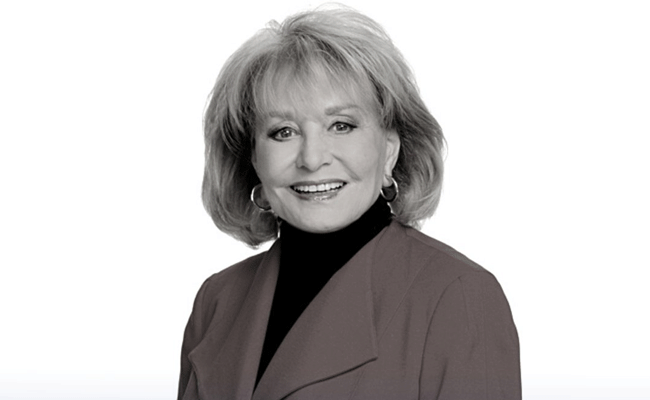
New York (AP): Barbara Walters, the intrepid interviewer, anchor and program host who blazed the way as the first woman to become a TV news superstar during a career remarkable for its duration and variety, has died.
She was 93.
ABC broke into its broadcast to announce Walters' death on air Friday night.
"She lived her life with no regrets. She was a trailblazer not only for female journalists, but for all women," her publicist Cindi Berger also said in a statement, adding Walters died peacefully at her New York home.
"Barbara was a true legend, a pioneer not just for women in journalism but for journalism itself," Iger said.
During nearly four decades at ABC, and before that at NBC, Walters' exclusive interviews with rulers, royalty and entertainers brought her celebrity status that ranked with theirs, while placing her at the forefront of the trend that made stars of TV reporters.
Late in her career, she gave infotainment a new twist with "The View," a live ABC weekday kaffee klatsch with an all-female panel for whom any topic was on the table and who welcomed guests ranging from world leaders to teen idols. With that side venture and unexpected hit, Walters considered "The View" the "dessert" of her career.
A statement from the show said Walters created "The View" in 1997 "to champion women's voices."
"We're proud to be part of her legacy," the statement said.
Walters made headlines in 1976 as the first female network news anchor, with an unprecedented
1 million salary that drew gasps. Her drive was legendary as she competed not just with rival networks, but with colleagues at her own network for each big "get" in a world jammed with more and more interviewers, including female journalists following in her trail.
"I never expected this!" Walters said in 2004, taking stock of her success.
But she was a natural on camera, especially when plying notables with searing questions.
In a voice that never lost its trace of her native Boston accent or its substitution of Ws-for-Rs, Walters lobbed blunt and sometimes giddy questions, often sugarcoated with a hushed, reverential delivery.
In May 2014, she taped her final episode of "The View" amid much ceremony to end a five-decade career in television.
However, her career had begun with no inklings of majesty.
Walters graduated from Sarah Lawrence College in 1943 and eventually landed a "temporary," behind-the-scenes assignment at "Today" in 1961. Shortly afterwards, what was seen as the token woman's slot among the staff's eight writers opened. Walters got the job and began to make occasional on-air appearances with offbeat stories.
As she appeared more frequently, she was spared the title of "Today' Girl" that had been attached to her predecessors. But she had to pay her dues, sometimes sprinting between interviews to do dog food commercials.
She had the first interview with Rose Kennedy after the assassination of her son, Robert, as well as with Princess Grace of Monaco and President Richard Nixon. She travelled to India with Jacqueline Kennedy, to China with Nixon and to Iran to cover the shah's gala party. But she faced a setback in 1971 with the arrival of a new host, Frank McGee, who insisted she wait for him to ask three questions before she could open her mouth during interviews with "powerful persons."
Sensing greater freedom and opportunities awaiting her outside the NBC studio, she hit the road to produce more exclusive interviews, including with Nixon chief of staff HR Haldeman.
By 1976, she had been granted the title of "Today" co-host and was earning
700,000 a year. But when ABC signed her to a
5 million, five-year contract, she was branded the "the million-dollar baby."
Reports failed to note her job duties would be split between the network's entertainment division and ABC News, then mired in third place. Meanwhile, Harry Reasoner, her seasoned "ABC Evening News" co-anchor, was said to resent her salary and celebrity orientation.
Later, ABC News president Roone Arledge moved her out of the co-anchor slot and into special projects. Meanwhile, she found success with her quarterly primetime interview specials. She became a frequent contributor to newsmagazine "20/20," and later co-host.
By 2004, when she stepped down from "20/20," she had logged more than 700 interviews, ranging from Ronald Reagan, Margaret Thatcher and Muammar Gaddafi, to Michael Jackson, Erik and Lyle Menendez and Elton John. Her two-hour talk with Monica Lewinsky in 1999, timed to the former White House intern's memoir about her affair with President Bill Clinton, drew more than 70 million viewers.
Her work also received high praise. She won a Peabody Award for her interview with Christopher Reeve shortly after the 1995 horseback-riding accident that left him paralysed.
Walters is survived by her daughter, Jacqueline Danforth.
Let the Truth be known. If you read VB and like VB, please be a VB Supporter and Help us deliver the Truth to one and all.
Explosive device kills 13, injures 38 on bus in southwestern Colombia as violence persists
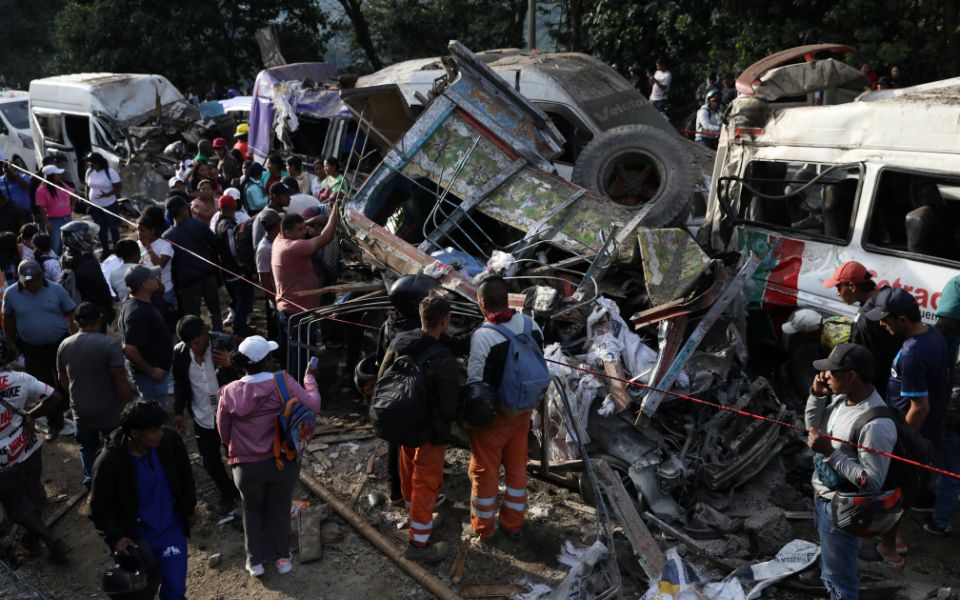
Bogota (Colombia) (PTI): An explosive device killed 13 people travelling on a bus in southwestern Colombia on Saturday, an attack the country's army chief described as a “terrorist act" that also left at least 38 injured as violence linked to drug trafficking in the region escalates.
Octavio Guzman, the governor of the region of Cauca, said on X that the device was set off while the bus was travelling along the Panamerican Highway in the municipality of Cajibio. Five children were among the injured, Cauca Health Secretary Carolina Camargo told Noticias Caracol, a TV news program.
Gen. Hugo Lopez, commander of Colombia's Armed Forces, told a news conference that it was a “terrorist act" and blamed the network of a man known as “Ivan Mordisco” — one of Colombia's most wanted figures — and the Jaime Martínez faction. Both are dissidents of the now-defunct Revolutionary Armed Forces of Colombia that operate in the region.
Neither Ivan Mordisco nor the Jaime Martínez faction abide by the peace agreement signed with the state in 2016.
Colombian President Gustavo Petro condemned the attack on X.
“Those who carried out the attack and killed seven civilians — and wounded 17 others — in Cajibío — many of them Indigenous people — are terrorists, fascists, and drug traffickers,” he wrote.
The attack is the latest in a spate of explosions that have attempted to target public infrastructure. At least 26 incidents have taken place in the past two days in southwestern Colombia, which Lopez said have only affected civilians.
They included a shooting at a police station in the rural area of Jamundi, and an attack on a Civil Aviation radar facility in El Tambo, where authorities took down three explosives-laden drones earlier on Saturday. No one was hurt.
On Friday, two vehicles rigged with explosives were detonated near military units in Cali and Palmira, causing material damage.
The escalation of violence in that region — a territory contested by illegal armed groups linked to drug trafficking — prompted the mobilisation of high-ranking officials on Saturday. Led by Defence Minister Pedro Sanchez, the delegation that includes regional governors and local authorities, was meeting in Palmira when the deadly explosion occurred.
“These criminals seek to instil fear, but we will respond with firmness,” Sanchez said on X.
Meanwhile, Francisca Toro, governor of Valle del Cauca, has called upon the national government to provide “immediate support.” In a message on X, Toro called for a reinforcement of public security forces, enhanced intelligence operations and “decisive actions” against crime in the face of a “terrorist-level escalation.”
According to authorities, Cauca and Valle del Cauca serve as a critical hub for illicit activities of illegal armed groups vying for control over sea and river access routes leading to the port of Buenaventura — a key transit point used to traffic drugs to Central America and Europe.
The government has also offered a reward of more than 1 million dollars for information leading to the capture of “Marlon,” who is identified as the leader of the region's dissident group. On Friday, local authorities offered more than USD 14,000 for information leading to the identification and location of those behind the attacks in Cali and Palmira.