BCCI AGM on September 29 at Bengaluru; no secretary election, new NCA to be inaugurated
Bengaluru (PTI): The BCCI’s 93rd Annual General Body Meeting (AGM) will take place here on September 29, but it is unlikely that the election of the new board secretary will take place at the high-profile summit.
However, the AGM will coincide with the inauguration of the state-of-the-art National Cricket Academy (NCA) centre in the outskirts as all the board members will be present in the city.
Currently, the NCA functions at the M Chinnaswamy stadium premises since its inception over two decades back.
While the new BCCI secretary will not be elected at the AGM, the date for the Special General Meeting (SGM) for that purpose could be fixed here.
The appointment of a new secretary was made mandatory after the incumbent Jay Shah was elected unanimously as the ICC Chairman.
However, Shah will not abdicate his present role as the BCCI secretary at the AGM because he has to assume the new office only from December 1.
The other important point in the meeting’s 18-point agenda, which has been sent to all the state associations, is the appointment of BCCI’s representative to the ICC meetings, as Shah will no longer be available for that role.
The name of current BCCI president Roger Binny might be discussed for the board’s representative to the ICC, or it could fall on the incoming secretary.
But at 69, Binny does not have age on his side with 70 being the upper ceiling to be in administration.
Other than those two pressing matters, the AGM will also see the induction of two representatives of the general body in the IPL Governing Council and the induction of one representative from the Indian Cricketers' Association (ICA) in the IPL Governing Council.
The AGM will also include some regular board activities such as ratification of the annual budget for 2024-25 and the appointment of Ombudsman and Ethics Officer.
The meeting will appoint a Cricket Committee and Standing Committee as per the BCCI Constitution, along with the formation of a new Umpires Committee under Rule 27.
The AGM will also consider the 'Report of the Internal Committee of BCCI formed under Prevention of Sexual Harassment Policy', besides approving rules formed by the Apex Council pertaining to domestic cricket.
Let the Truth be known. If you read VB and like VB, please be a VB Supporter and Help us deliver the Truth to one and all.
PM Modi is controlled by Donald Trump, wants to do the same in TN: Rahul Gandhi
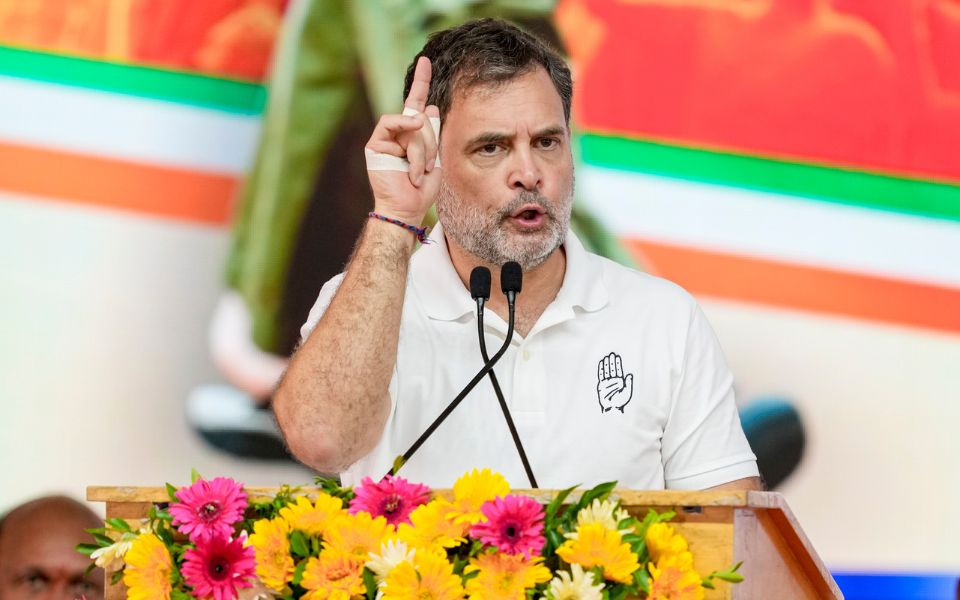
Ranipet (Tamil Nadu) (PTI): Congress leader Rahul Gandhi on Saturday alleged that Prime Minister Narendra Modi was being "controlled" by US President Donald Trump and that the PM wanted the AIADMK to capture power so that he could control Tamil Nadu Chief Minister.
Also, he claimed that the prime minister "handed out our energy security and gave away our data, besides selling our farmers and small and medium industries."
"You saw yesterday (in Parliament) the face of Prime Minister Narendra Modi completely lacking confidence," Rahul said on the delimitation bill.
"He (PM) could not even face the opposition. He was sitting sideways. And the reason is, he is controlled by the United States. He signed the India-US deal that sold our country out," Rahul said while addressing an election rally here.
He further said, "Today, if Donald Trump tells Modi to jump, Modi jumps. If Donald Trump tells Modi to lie down, Modi lies down. Why? Because Donald Trump controls Modi fully. How does he control him? He controls through the Epstein files. He controls him because he knows Modi's financial systems and understands Modi's link with Adani," the Congress leader alleged.
Just as he was being controlled by Trump, Modi wanted to do the same to the chief minister of Tamil Nadu. "That is why he wants to put AIADMK in power in TN," Rahul said.
The Union government had rejected references to PM Modi in the latest Jeffrey Epstein case files, describing it as “little more than trashy ruminations by a convicted criminal that deserves to be dismissed with the utmost contempt”.