BCCI to release Rs one crore for treatment of cancer-stricken Gaekwad
Mumbai (PTI): In a noble gesture, the BCCI on Sunday decided to release Rs one crore for the treatment of former India coach Anshuman Gaikwad, who is battling blood cancer at a medical facility in London.
BCCI's decision has come following emotional appeals for support from former captain Kapil Dev and Sandip Patil, who had enjoined the cricket board to help Gaikwad.
"Mr. Jay Shah has instructed the Board of Control for Cricket in India (BCCI) to release Rs 1 crore with immediate effect to provide financial assistance to India's veteran cricketer Mr Anshuman Gaekwad, who is battling cancer," BCCI apex council said in a statement.
Gaekwad, son of former India captain D K Gaekwad, is undergoing treatment for blood cancer at the King's College Hospital in London.
"Shah has also spoken to Mr Gaekwad's family to take stock of the situation and extend support. The board stands by Gaekwad's family in this hour of crisis and will do whatever is essential for Mr Gaekwad's quick recovery," the statement continued.
"The BCCI will continue to monitor Mr Gaekwad's progress and is confident that he will come out of this phase strongly," it added.
The 71-year-old Gaekwad played 40 Tests and 15 ODIs for India between 1975 and 1987.
Let the Truth be known. If you read VB and like VB, please be a VB Supporter and Help us deliver the Truth to one and all.
Allen, Raghuvanshi, Green power KKR to 29-run win over GT
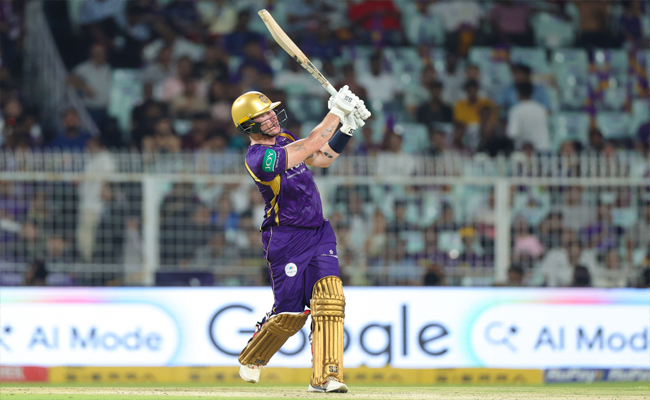
Kolkata (PTI): Finn Allen blasted a 35-ball 93, while Angkrish Raghuvanshi hit an unbeaten 44-ball 82 as Kolkata Knight Riders kept their playoff hopes alive with a 29-run win over Gujarat Titans in the IPL match here on Saturday.
Sent in to bat, Allen went on a six-hitting spree, smashing 10 maximums and four boundaries to add 95 off 41 balls with Raghuvanshi (82).
Raghuvanshi then shared another 108 off 53 balls with Cameron Green (52 not out) to power KKR to a challenging 247 for 2.
In reply, GT could manage 218-4, riding on skipper Shubman Gill's 49-ball 85 and a 35-ball 57 from Jos Buttler. Opener Sai Sudarsan was retired hurt but returned to make a 28-ball 53 not out.
Sunil Narine (2/29) claimed two wickets and Saurabh Dubey snapped one for KKR.
For GT, Mohammed Siraj (1/50), Sai Kishore (1/38) were the wicket-takers.
Brief Score:
KKR: 247 for 2 in 20 overs (Finn Allen 93, Angkrish Raghuvanshi 82 not out, Camero Green 52 not out; Mohammed Siraj 1/50).
GT: 218 for 4 in 20 overs (Shubman Gill 85, Sunil Narine 2/29).