Bopanna-Ebden clinch Miami Open title, return to world No. 1 ranking

Miami (US) (PTI): Ace Indian tennis player Rohan Bopanna rewrote his own record to continue to be the oldest ATP Masters 1000 champion as he and his Australian partner Matt Ebden clinched the men's doubles crown at the Miami Open here.
Continuing their fine run this year, the 44-year-old Bopanna and Ebden fought back from a set down to pull off an exhilarating 6-7(3), 6-3, 10-6 win over Crotia's Ivan Dodig and American Austin Krajicek at the Hard Rock Stadium on Saturday.
With the win, Bopanna surpassed his record created last year when he won the Indian Wells title at the age of 43, and also reclaimed the top spot in the doubles ranking.
"It's amazing. As long as you are doing well in these big events, it's what we play for," Bopanna said after the win.
"I want to do well in the Masters 1000s and the Grand Slams. It's good to keep that record going and keep giving everyone else a run for their money," added Bopanna, who won his maiden doubles Grand Slam title at the Australian Open earlier this year.
This was Bopanna's 14th ATP Masters 1000 final. Overall, it was the veteran Indian player's 63rd ATP Tour level final and 26th doubles title.
Bopanna also achieved a rare feat as he became the second Indian after Leander Paes to reach the final of all nine ATP Masters events.
Bopanna and Ebden, the top seeds for the tournament, tapped into their deep reservoir of experience to fetch the final six points of the summit clash. They had three set points on serve at 6-5 in the opening set but their second-seeded opponents warded off all three to force a tiebreaker before taking a 1-0 lead.
"It's tough. These guys, they fight back in tough moments," said Ebden.
"Last time we played them it was similar, it's a bit of a see-saw. They return so well, make so many balls and we missed one or two shots when we were up [at the end of] the first set. They played a great tie-break, and then we just reset."
Bopanna and Ebden then staged a comeback as they broke their opponent early in the second set which helped them level the game.
Like the opening two sets, the tiebreaker was also fought on an even keel with the reigning Australian Open champions emerging victorious.
Following the Australian Open triumph, Bopanna climbed to the world No.1 spot in the ATP rankings, becoming the oldest player to do so. But slipped to the second spot in the doubles rankings after a quarterfinal loss at the Dubai Championships and a round-of-32 exit at the Indian Wells Masters.
But with the win here, the pair will be back to the top spot.
Let the Truth be known. If you read VB and like VB, please be a VB Supporter and Help us deliver the Truth to one and all.
Bird flu: Karnataka completes 10-day H5N1 surveillance, containment operation
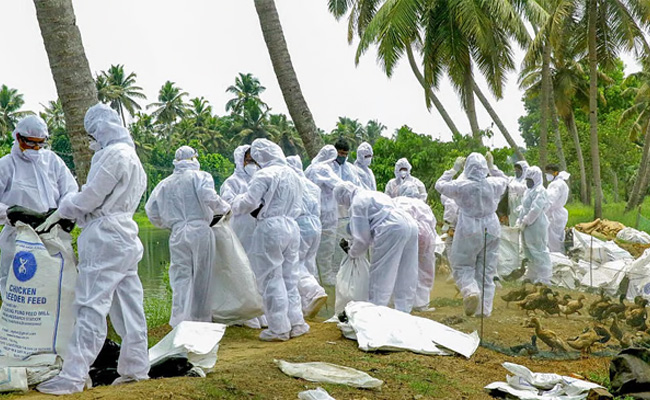
Bengaluru (PTI): The Karnataka government has successfully completed a 10-day intensive surveillance and containment operation following the detection of the H5N1 Avian Influenza outbreak here, officials said on Saturday.
The outbreak was reported in the State Poultry Rearing Training Centre in Mathkuru village, Hesaraghatta, on April 14, they said.
The surveillance was conducted by the Department of Health and Family Welfare of the state government in coordination with the Animal Husbandry and Veterinary Services Department, officials said.
According to an official statement, once the outbreak was confirmed, following laboratory reports from the National Institute of High Security Animal Diseases (NIHSAD-Bhopal), State and District Rapid Response Teams along with Hesaraghatta and Sonnenahalli PHC (Primary Health Centres) teams were immediately deployed.
An infected zone of 0-3 km and a surveillance zone of 3-10 km radius was established. The Department of Animal Husbandry and Veterinary Services, culled all the birds and safely disposed of eggs and of contaminated feed, adhering to national and international biosecurity protocols, it said.
The health department said the surveillance zone from the infective focus in the 10 km radius, a total population of 28,172 across 22 villages was surveyed from day 1 to day 10. Multiple rounds of surveillance were conducted and sanitation activities were completed as per protocol.
During the surveillance period, nasopharyngeal samples collected from all quarantined staff on Day 5, sent to NIV-Bengaluru, were found to be negative for H5N1, it said.
On day 10, nasopharyngeal samples were collected and the results are awaited. No human case of H5N1 infection has been detected in the infected or surveillance zones, the health officials said.
"All healthcare facilities in Bengaluru have been instructed to continue ILI/SARI (Influenza-Like Illness/Severe Acute Respiratory Infection) case surveillance, and ensure adequate stocks of PPE, triple-layer medical masks, oseltamivir, viral transport medium, and throat swab kits," it said.
The Department of Animal Husbandry and Veterinary Services issued a Sanitization Certificate on April 21, officials said.
"No poultry activity will be undertaken for a period of 90 days as a precautionary measure. During the three months of surveillance, the entire area of the farm will be repeatedly disinfected by fumigation (indoors) or sprays (open place) every 15 days," it further stated.
The public has been advised to avoid handling or consuming meat or eggs from sick or dead poultry and report sightings of sick or dead birds promptly to local veterinary or health authorities.
Ensure poultry meat and eggs are thoroughly cooked before consumption, as proper cooking effectively inactivates the virus, they said.
"The public is advised to follow official health advisories and avoid spreading unverified information," the department added.