Boxing champion Mary Kom named Global Indian Icon at UK-India Awards
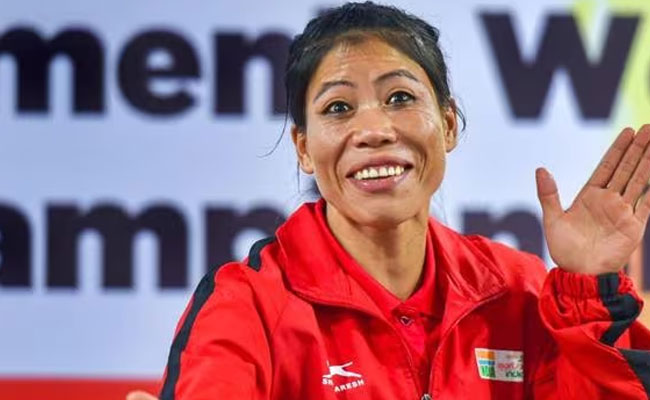
London (PTI): Sporting legend and India's first-ever Olympic medallist in women's boxing, Mary Kom, has been honoured with the Global Indian Icon of the Year award at the annual UK-India Awards in Windsor, south-eastern England.
The 40-year-old former Rajya Sabha member spoke of her 20-year journey of hard work and devoting her life to boxing as she accepted the award from Indian High Commissioner to the UK Vikram Doraiswami at a gala ceremony on Thursday night.
"I have been fighting for 20 years, putting in so much effort, hard work in my life, in boxing, it means a lot... making sacrifice for my country, for my family. I really thank from the bottom of my heart for this recognition," she said.
Filmmaker Shekhar Kapur, behind Oscar-nominated 'Elizabeth: The Golden Age' received a Lifetime Achievement Award for his contribution to the field of cinema across both nations at the awards, organised by India Global Forum (IGF) as part of UK-India Week.
The Nehru Centre in London, the cultural wing of the Indian High Commission, won the UK-India Award for Significant Contribution to UK-India Relations.
"This is one of the most exciting times to be an Indian in the last many centuries, and India's growing economy has made many others, including many Westerners, think differently about India. But India's culture will actually make many others, including many Westerners, think differently period. And it's our privilege at the Nehru Centre to contribute to the growth and to the popularisation of Indian culture in the West," said author Amish Tripathi, Director of the Nehru Centre.
The awards, now in their fifth year, recognise outstanding contributions of leaders in business, professional services, government, culture and social impact, highlighting their remarkable achievements in strengthening bilateral ties.
"These awards are not just about recognising achievements of some outstanding contributors to the UK-India corridor, but also about celebrating the power of collaboration and the limitless potential that lies within our partnership," said IGF founder and chairman Manoj Ladwa.
Spanning across several categories, the UK-India Award for Business Promotion Organisation of the Year was conferred upon the Federation of Indian Chambers of Commerce & Industry (FICCI) UK.
Among the other awards were Market Entrant of the Year for startup investment platform CrowdInvest, Consultancy of the Year for SannamS4, Legal Practice of the Year for Cyril Amarchand Mangaldas and Financial Services Organisation of the Year for ICICI Bank UK Plc. While Mphasis bagged the Technology Company of the Year, Action Aid UK was named as the Social Impact Project of the Year.
The awards were selected from a shortlist by a jury of industry experts and marked the penultimate event of the six-day UK-India Week, which included a special reception hosted by British Prime Minister Rishi Sunak at 10 Downing Street during which he committed to working towards a "truly ambitious" free trade agreement (FTA) with India.
"It's not just UK-India Week, but a whole Indian summer over the next few weeks the eyes of the world will be on India. There's the G20 in New Delhi, I can't wait to be there," he said, indicating plans for a visit for the world leader's summit hosted by Prime Minister Narendra Modi in September.
Let the Truth be known. If you read VB and like VB, please be a VB Supporter and Help us deliver the Truth to one and all.
Choose faith or future: BJP alleges 'second-class treatment' of Hindus in K'natka CET row
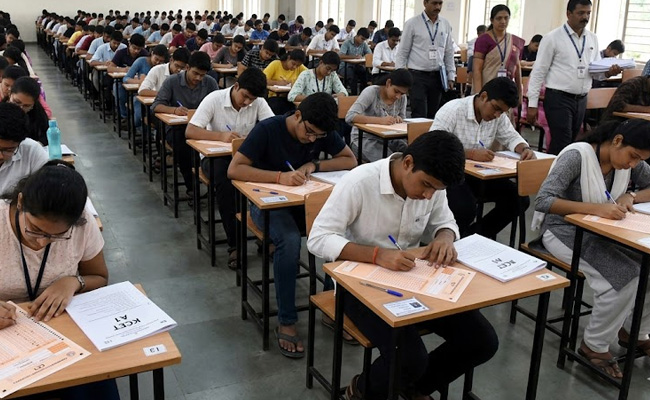
New Delhi (PTI): The BJP on Saturday accused the Karnataka Congress government of being "anti-Hindu" and following double standards after students appearing for the Common Entrance Test (CET) were allegedly asked to remove their 'janeu'.
A political row erupted after five Brahmin students were allegedly forced to remove the thread, considered sacred and worn across the torsos, at a city college in during the CET on Friday.
Students alleged that the invigilators at Madivala asked them to remove their janeu/yajnopaveetha if they wanted to write the exam.
In a video post on X, BJP national spokesperson Shehzad Poonawalla lambasted the act.
"Is it a crime to be a Hindu in Karnataka? In Karnataka, students were stopped from entering the examination hall for wearing a janeu and were given a brutal option -- choose your faith or your future. This happened last year as well," Poonawalla alleged.
ALSO READ: ECI to release exact voter turnout in TN
He accused the Karnataka government of practising double standards and engaging in appeasement politics.
"In Karnataka, we have seen the politics of appeasement. Muslim reservation, a Muslim-only budget, and quotas and contractual work for Muslims. But Hindus have to remove their sacred thread if they want to take an exam, which even the courts have, by the way, allowed," he alleged.
He accused the Congress government of adopting a similar approach in other states where it is in power, while allowing hijab and burka in classrooms.
"It has happened in various Congress-ruled states. We have seen that the Congress party advocates the right to hijab and burkha within the classroom. They say this should be allowed. Even the courts have overruled it.
"But in the case of janeu, they want it to be removed. This is not the first time this has happened. In Telangana and other states, the tilak and mangalsutra were removed. But hijab is fine. This is the kind of second-class treatment being given to Hindus," he added.
Poonawalla said the Congress should rename itself from INC to "MMC -- Muslim League Maowadi Congress" or the "Islamic National Caliphate Party".
As the controversy took a political turn, the college suspended the invigilator pending inquiry. The government also ordered a probe.
The police registered a case and detained three staff members of Krupanidhi College who were in charge of examination checking for questioning, officials said.
A similar incident took place last year in Karnataka, following which the government directed that the candidates would not be asked to remove the janeu while appearing for the CET.