Brilliant Cummins puts Australia on top as India dismissed for 244
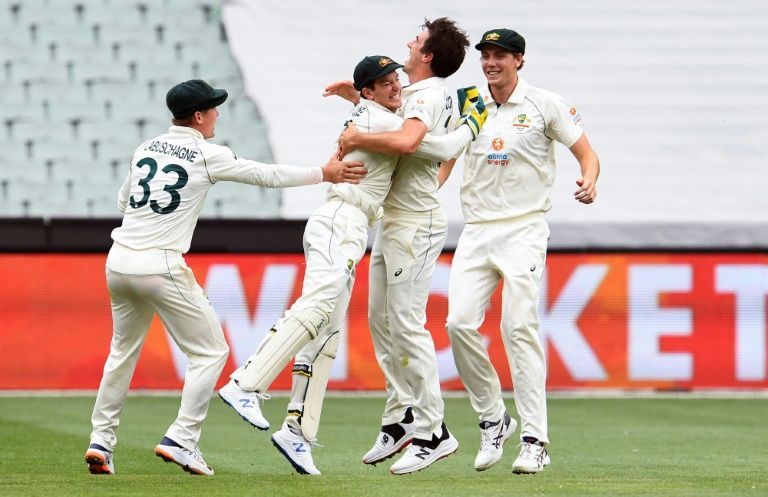
Sydney: A relentless Patrick Cummins and a mean Josh Hazlewood dismissed India for 244 after Cheteshwar Pujara's slowest half-century helped Australia take complete command at tea on the third day of the third Test here on Saturday.
Australia took a first-innings lead of 94 runs and it would be an uphill task for India to make a comeback in this match.
Pujara's (50 off 176 balls) ultra-defensive approach put tremendous pressure on his colleagues and India never quite got the momentum going as Cummins (4/29 in 21.4 overs), Hazlewood (2/43 in 21 overs) and Mitchell Starc (1/61 in 19 overs) continuously attacked the batsmen -- first with a leg-side field and short-ball strategy and then on the corridor of uncertainty.
Pujara doesn't play the pull or hook shot well and he wasn't allowed room to either cut or drive. While he never tried to rotate the strike, the likes of Ajinkya Rahane (22 off 70 balls) and Rishabh Pant (36 off 67 balls) felt the urge to break the shackles in the absence of any such intention from the other end.
It also resulted in three run-outs including the one-off Hanuma Vihari (4 off 38 balls), who fell short while going for a quick but non-existent single.
It was then left to Ravindra Jadeja (27), who had to throw his bat around to bring the lead down to less than 100 runs, but that would be of little comfort considering that India would now have to bat fourth to save the match.
A total of 84 runs from 34 overs in the first session, with lack of intent especially from Pujara, didn't help India's cause and Rahane's dismissal was purely due to the scoreboard pressure.
The Indian captain failed to get a move-on initially on a slow track where bounce became variable as the session progressed.
He did hit a cover drive and then tried to take on Nathan Lyon by lofting him for a six over long-on.
However, Cummins bowled one where he got an extra bounce in his off-cutter, cramping Rahane for room and he was played on. The duo added 32 runs in 22.3 overs and it didn't help the team in any way.
Had KL Rahul been fit, there could have been a case of Vihari getting dropped as he didn't show in any way that he was in control during his half an hour stay at the crease.
Pant got into the groove quickly but a nasty blow on the forearm did affect his shot-making and the result was a caught behind off Hazlewood, after a 53-run stand in a little over 20 overs.
Pujara, at the other end, was bowled short initially with three men on the leg side and then on the off-side with his cover drive dried up.
Even the drive wide off mid-on didn't fetch him boundaries. In the first 100 balls, he didn't have a single boundary.
Finally, after completing his slowest ever half-century in Test cricket, Cummins got one to rear up from short of a length and it was that one good ball every batsman gets when he is not scoring runs.
From 195 for four, suddenly it was 210 for eight and there was only Jadeja left to score a few runs.
Let the Truth be known. If you read VB and like VB, please be a VB Supporter and Help us deliver the Truth to one and all.
Student found dead in hostel room in IIT Kharagpur

Kolkata (PTI): A 22-year-old M Tech student was found dead in his hostel room in the Indian Institute of Technology, Kharagpur, the second such incident reported on the campus within a span of 10 days.
The student, identified as Soham Haldar, was found hanging from the ceiling of his hostel room on Tuesday and he was immediately taken to the institute hospital, where doctors declared him brought dead, an IIT Kharagpur official said.
Haldar, a dual-degree student in Electronics and Electrical Communication Engineering, was a boarder of the Pandit Madan Mohan Malaviya Hall of Residence on the campus.
Police from the Kharagpur Town police station have initiated a probe into the incident as preliminary findings indicated that it could be a case of suicide, though the exact cause of death will be ascertained following the post-mortem examination, the official said.
In a statement, the institute expressed deep grief over the student's death and said a detailed inquiry has been initiated.
The authorities have informed the family and are extending all possible assistance to them, it added.
Director Suman Chakraborty told PTI that the institute will strengthen the mechanism to identify stressed-out and depressed students and take follow-up steps to address their issues.
The grief-stricken parents of the student, who hailed from Barasat in North 24 Parganas district, have come to the campus and the authorities will speak to them, he said.
"Haldar's friends, faculty and staffers also could not gauge any stress or anxiety in him. But we need to enable students suffering from anxiety and extreme stress to open up their minds and do everything needed to prevent such incidents," he said.
Investigators are also scrutinising CCTV footage from the hostel premises to piece together the sequence of events leading to the incident.
The incident comes close on the heels of another student's death reported on April 18, when 21-year-old Jaibir Singh Dodia, a third-year Mechanical Engineering student from Ahmedabad, allegedly died after jumping from the eighth floor of the Atal Bihari Vajpayee Hall of Residence. That case is also under investigation.
The back-to-back incidents have once again brought the issue of mental health and student support systems at the institute into focus, especially in view of several such cases reported last year.