Candidates chess: Gukesh slips to tied 2nd after draw; losses for Pragg, Gujrathi
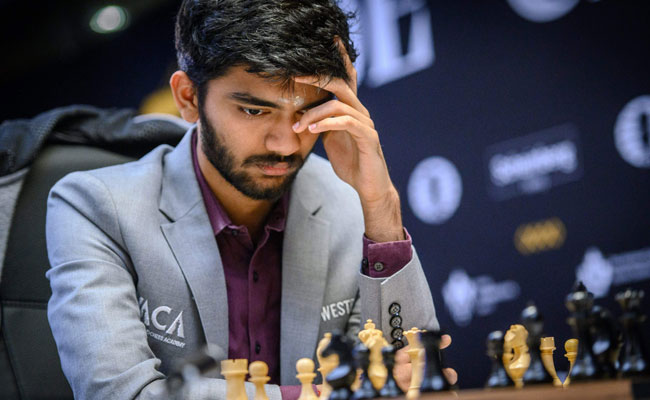
Toronto (PTI): Grandmaster D Gukesh played out a creditable draw against top seed Fabiano Caruana but slipped a rung to the joint second position on a day when two other Indians endured frustrating losses in the Candidates Chess Tournament's 11th round here.
Nerves finally came into play as R Praggnanandhaa and Vidit Gujrathi lost their way against American Hikaru Nakamura and Russian Ian Nepomniachtchi respectively.
But 17-year-old Gukesh held his own against Caruana. In the other encounter, Frenchman Firouza Alireza proved superior to Nijat Abasov of Azerbaijan.
With just three rounds remaining, the die seems to be cast in favour of Nepomniachtchi, who is gunning for his third straight Candidates title.
The Russian, who has to compete under the FIDE flag here owing to his country's international suspension, shot back to sole lead on seven points out of a possible 11 and it would be difficult for other contestants to get past him.
Caruana, Nakamura and Gukesh are in pursuit of the leader half a point behind in the standings.
Praggnanandhaa and Gujrathi have fallen apart with 5.5 and five points respectively. Coming back from behind is Alireza, who probably has no contest from Abasov in the bottom half.
In the women's competition, the Chinese continued to dominate as Zhongyi Tan scored over Kateryna Lagno of Russia to regain sole lead ahead of compatriot Tingjie Lei, who played out a draw with Anna Muzychuk of Ukraine.
R Vaishali came back roaring, albeit a bit late, to beat top-seeded Russian Aleksandra Goryachkina while Koneru Humpy proved too good to avenge her early loss at the hands of Nurgyul Salimova of Bulgaria.
Tan continued to reign supreme with seven points. Lei stood half a point behind, and the Russian duo of Lagno and Goryachkina were virtually out of the race along with a resurgent Humpy, who has warmed up towards the close, with 5.5 points.
Praggnanandhaa, who has been quite popular among the fans, played with white and faced an irregular queen pawn opening. For once, the Indian did not seem to know much about the subtleties.
Nakamura took command when necessary and it was one of those days for Praggnanandhaa when nothing went right. The Indian lost a piece trapped in the corner of the board and Nakamura was never going to let him get away with any lapses.
Gujrathi lost to Nepomniachtchi out of a Petroff defense. The opening has been serving well for the Russian since 2018 when he won his first Candidates tournament and it did not disappoint him.
The middle game saw Gujrathi on top more than once but Nepomniachtchi hung in there to his credit.
Gujrathi had more than a few chances to come up victorious but one spoiler took over another till Nepomniachtchi had the game firmly in his grasp.
The Russian is a known technician and won a piece for effectively no counter-play. The rest was easy.
Gukesh was the only one to keep his nerves intact despite his tender age. The Queen's gambit landed in a worse position for the talented lad but he fought on to equalise against Caruana in the ensuing queen and pawns endgame.
In the women's section, Humpy skilfully won a pawn against Salimova out of a queen pawn opening. The Bulgarian tried hard for a counter-play but that did not happen and in the endgame, Humpy was class personified.
Liquidating into a rook and pawns endgame, Humpy showed her true mettle and went on to score a commendable victory.
For Vaishali it was a game of fluctuating fortunes in which she had several chances to force a draw. Goryachkina might have been satisfied with a drawn result but Vaishali was on a mission in the Queen's and pawns endgame. The game lasted 70 moves.
Results round 11 (Indians unless specified):
D Gukesh (6.5) drew with Fabiano Caruana (Usa, 6); Vidit Gujrathi (5) lost to Ian Nepomniachtchi (Fid, 7); R Praggnanandhaa (5.5) lost to Hikaru Nakamura (Usa, 6.5) (Aze, 3); Firouza Alireza (Fra, 4.5) beat Nijat Abasov (Aze, 3).
Women: Koneru Humpy (5.5) beat Nurgyul Salimova (Bul, 4); R Vaishali (4.5) beat Aleksandra Goryachkina (Fid, 5.5); Zhongyi Tan (7.5) beat Kateryna Lagno (Fid, 5.5); Tingjei Lei (Chn, 7) drew with Anna Muzychuk (Ukr, 4.5).
Let the Truth be known. If you read VB and like VB, please be a VB Supporter and Help us deliver the Truth to one and all.
Ranchi: Temple guard bludgeoned to death during robbery attempt, 3 held
Ranchi (PTI): A 60-year-old security guard of a temple in Ranchi was bludgeoned to death with a stone during a robbery attempt, police said on Saturday.
The incident happened late on Thursday at the Jagannath Temple in the Dhurwa Smart City area, they said.
"Three persons were arrested on Friday for killing the security guard. They confessed to the crime and told police that the victim had identified them. Therefore, in fear of being caught, they killed him by attacking him with a stone on his head," SSP Rakesh Ranjan said.
"Thereafter, they took money from the donation box and fled the scene. Two of them have criminal antecedents," he added.
Ranjan said the investigators recovered Rs 3 lakh in cash that had been robbed, the stone with blood-stained marks, and the iron rod used to break open the lock of the donation box kept there.
An FIR in this regard was lodged at the Dhurwa police station, he said, adding that the accused were sent to judicial custody by a court.