Candidates Chess: India's Gukesh takes sole lead after outwitting Alireza
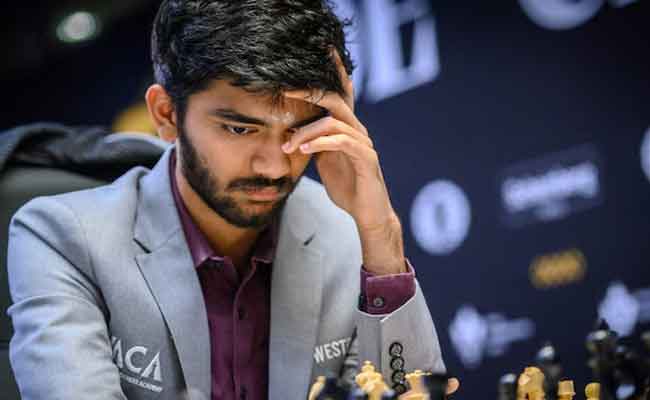
Toronto (PTI): Teenaged Indian Grandmaster D Gukesh shot into sole lead after defeating Firouzja Alireza of France in the 13th and penultimate round of Candidates' Chess tournament here, his quest for the extraordinary placing him on the cusp of becoming the youngest ever world championship contender.
If the 17-year-old from Chennai emerges victorious at the Candidates, he will take on China's Ding Liren for the world champion's crown.
In the women's event, Humpy Koneru drew with Anna Muzychuk while Vaishali Rameshbabu got the better of Lei Tingjie. The 22-year-old Vaishali has now registered four consecutive wins in her last four games.
Needing a win to go ahead after the other overnight leaders, Russian Ian Nepomniachtchi and American Hikaru Nakamura played out a quick draw, Gukesh was awarded for his perseverance as he capitalised on a late blunder by Alireza in a difficult situation.
Gukesh took his tally to 8.5 points out of a possible 13 to emerge a half point ahead of Nepomniachtchi, Nakamura and Fabiano Caruana of the United States.
R Praggnanandhaa and Vidit Gujrathi share the fifth spot on six points apiece with Firouzja on 4.5 and Abasov has 3.5 points.
Of the three players in pursuit, Caruana defeated Praggnanandhaa in a hard-fought game while Gujrathi could only get a draw with Nijat Abasov of Azerbaijan.
Gukesh will next meet Nakamura who plays white in the last round game and Caurana will have the advantage of the favourable colour against Nepomniachtchi.
While anyone among the four players can win the event, the odds are hugely in favour of Gukesh as the pundits believe that a draw might just be enough to see him emerge as the youngest ever contender for the world championship match.
In the women's section, Zhongyi Tan took a full point lead over nearest rival and compatriot Tingjie Lei following a draw with top seed Russian Aleksandra Goryachkina.
R Vaishali spoiled the party for Lei by scoring a fine victory while Koneru Humpy and Nurgyul Salimova of Bulgaria drew with Anna Muzychuk of Ukraine and Kateryna Lagno of Russia respectively.
Just a draw away from clinching the crown, Lei is in second spot on 7.5 points. Goryachkina, Lagno, Humpy and Vaishali are on 6.5 points, sharing the third spot as Salimova and Muzychuk share the seventh spot with five points apiece.
Made for big games
Gukesh, by consent, is made for big games on his day and the 13th round was no different. Playing the white side of a Berlin defense out of a Ruy Lopez, Gukesh went for a line known to have a sound reputation with little risk for white.
Alireza equalized comfortably but then started to show some ambition in the middle game that led to king side weakness. The Frenchman fell under time pressure too under the first time-control but did well to keep a tangible position.
It was on the 47th move that Alireza finally faltered and allowed Gukesh to reach a winning rook and minor piece endgame. Gukesh knocked down a few pawns en route to finishing the technicalities in style. The game lasted 63 moves.
Ian Nepomniachtchi decided against taking much risk even as Nakamura chose a rare variation as black in another Ruy Lopez of the day.
The Russian had reasons to be pleased as his position was preferable in the middle game but the absence of any real threats did not leave much to be desired. Nakamura drew vide repetition in a mere 26 moves.
Praggnanandhaa was outdone out of a Rossolimo opening as white against Caruana. The American launched a dangerous looking attack on the king side after the players castled on different flanks and Praggnanandhaa parted with a rook for a knight to stay afloat.
The nature of the position however remained difficult and with the clock ticking away, the defense was always difficult to find. The longest game of the day ended after 89 moves.
Gujrathi faced the Petroff defense as white against Abasov. The Azerbaijani has stuck to the same opening as black against the King pawn and in his final black game too, he decided to employ the same set-up.
Gujrathi went for one of the main lines and a couple of minor pieces got changed in a symmetrical pawn structure. The game got a little spiced up on the 14th move and white got an optical advantage with better control in the centre.
However, as things happened, Abasov neutralized white's initiative by just keeping his position intact. Gujrathi improved and carried on for some time before realising there was not much to hope for. The game lasted 31 moves and ended through repetition.
In the women's section, the trading of queens ensured that black did not get any chance in the game and a draw was a just result between Zhongyi Tan and Goryachkina.
After a rather subdued 7th to 9th round where she lost three in a row, Vaishali continued with her demolition act to score her fourth victory on the trot. The Indian is in with a chance to finish in top three if she can pull off another win in the final round.
Zhongyi Tan has her task cut out against Muzychuk, while Tingjie has a tough nut to crack in Humpy. Vaishali meets Lagno and Goryachkina is up against Salimova.
Results round 13 (Indians unless specified): Vidit Gujrathi (5) vs Nijat Abasov (Aze, 3); D Gukesh (7.5) vs Firouza Alireza (Fra, 4.5); R Praggnanandhaa (6) vs Fabiano Caruana (Usa, 7); Ian Nepomniachthi (Fid, 7.5) vs Hikaru Nakamura (Usa, 7.5).
Women: Zhongyi Tan (Chn, 8.5) drew with Aleksandra Goryachkina (Fid, 6.5); Koneru Humpy (6.5) drew with Anna Muzychuk (5); R Vaishali (6.5) beat Tingjie Lei (Chn, 7.5); Nurgyuaal Salimova (Bul, 5) drew with Kateryna Lagno (Fid, 6.5).
Let the Truth be known. If you read VB and like VB, please be a VB Supporter and Help us deliver the Truth to one and all.
Ranchi: Temple guard bludgeoned to death during robbery attempt, 3 held
Ranchi (PTI): A 60-year-old security guard of a temple in Ranchi was bludgeoned to death with a stone during a robbery attempt, police said on Saturday.
The incident happened late on Thursday at the Jagannath Temple in the Dhurwa Smart City area, they said.
"Three persons were arrested on Friday for killing the security guard. They confessed to the crime and told police that the victim had identified them. Therefore, in fear of being caught, they killed him by attacking him with a stone on his head," SSP Rakesh Ranjan said.
"Thereafter, they took money from the donation box and fled the scene. Two of them have criminal antecedents," he added.
Ranjan said the investigators recovered Rs 3 lakh in cash that had been robbed, the stone with blood-stained marks, and the iron rod used to break open the lock of the donation box kept there.
An FIR in this regard was lodged at the Dhurwa police station, he said, adding that the accused were sent to judicial custody by a court.