Captain Virat Kohli ruled out of second Test due to back spasm
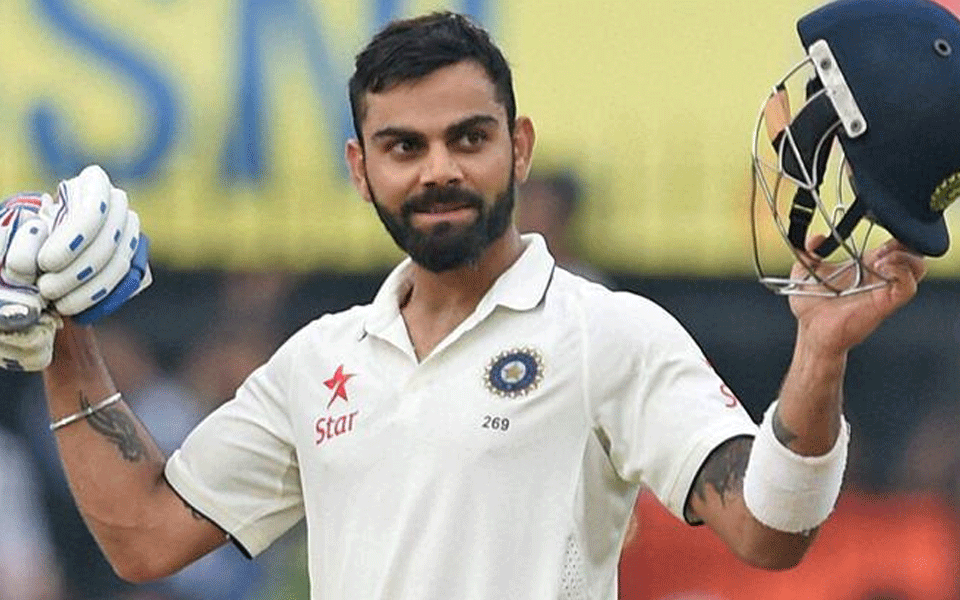
Johannesburg(PTI): India captain Virat Kohli was on Monday ruled out of the second Test against South Africa here just before start of the game because of an upper back spasm, leaving K L Rahul to lead the side in the crucial match.
Rahul said at the toss that Kohli is expected to be available for the third and final Test from January 11.
"Unfortunately, Virat is having an upper back spasm. The physios are working on him and hopefully he will recover in time for the next Test," Rahul said at the toss when asked about Kohli's absence from the match.
All-rounder Hanuma Vihari has come in the playing XI to replace Kohli.
Kohli, who has been battling a prolonged lean patch with the willow, will thus not be able to complete his landmark 100th Test in the series-finale at Cape Town.
The 33-year-old will be playing in the ODI series against the Proteas starting January 19. Rahul will captain India in that rubber as regular white-ball skipper Rohit Sharma is out injured.
The BCCI also issued a statement later in which it informed that Jasprit Bumrah would be Rahul's deputy during the match here. Bumrah is also due to play the same role during the ODI series
As per the Indian team's fixtures, Kohli, if all goes well, will now get to play his 100th Test against Sri Lanka at Bengaluru in February.
It is worth noting that head coach Rahul Dravid, while addressing the pre-match press conference on Sunday, gave no indication of any possible injury concerns over Kohli, who is locked in a war of words with the BCCI over the way his white-ball captaincy tenure ended.
Dravid, one of India's all-time greats, had lent support to the superstar batter for the "phenomenal" manner in which he has led the team despite "all the noise around him".
Kohli kicked up a storm before the ongoing tour by stating that he was never asked to reconsider leaving T20 captaincy as asserted by BCCI President Sourav Ganguly.
His statement was met with a rebuttal from chief selector Chetan Sharma who said that Kohli was requested to hold his decision at least till the end of the T20 World Cup. After relinquishing T20 leadership, Kohli was remoed as ODI captain in December.
Ever since that dramatic press conference in which he contradicted Ganguly, Kohli has not had a media interaction and Dravid on Sunday said that the star would make himself available for questions on the eve of his 100th Test.
With that now effectively moved to next month, it remains to be seen whether Kohli would show up for the media conference before the Cape Town Test, on Monday next.
Kohli enjoys an impeccable record in Johannesburg where he has scored a century and a couple of half-centuries in two Test matches.
Overall, he has scored 310 runs at the iconic Wanderers and stood just seven runs away from owning another batting record -- most Test runs scored at the venue.
The visiting team won the series-opener last week and is now eyeing its maiden Test series triumph in South Africa.
Let the Truth be known. If you read VB and like VB, please be a VB Supporter and Help us deliver the Truth to one and all.
Tribal man brings dead sister's skeleton to bank to withdraw money from her account
Keonjhar (PTI): A tribal man in Odisha's Keonjhar district on Monday brought the skeleton of his dead sister to a bank to withdraw the money deposited in her name, police said.
The incident occurred at Maliposi branch of Odisha Grameen Bank located at Patana block of Keonjhar district. The man was identified as Jeetu Munda (50) of Dianali village. He was seeking to withdraw Rs 20,000 from the bank account of his elder sister, Kalra Munda (56), who died on January 26, 2026.
"I have run several times to the bank, and the people there told me to bring the account holder to withdraw money deposited in her name. Though I told them that she had died, they did not listen to me and insisted on bringing her to the bank. Therefore, out of frustration, I dug the grave and brought out her skeleton as proof of her death," an illiterate Jeetu Munda told reporters.
Patana Police Station Inspector in charge (IIC) Kiran Prasad Sahu, who reached the bank after getting information, said, "Jeetu is an illiterate tribal man. He does not know what the legal heir or nominee is. The bank officials have failed to make him understand the procedure to withdraw money from the dead person's account."
However, after the incident, the police assured Jeetu Munda that they would facilitate the withdrawal of money from the bank account of his dead sister. Later, the skeleton was again buried at the graveyard in presence of police.
Meanwhile, local Block Development Officer (BDO) Manas Dandpat said that he was not approached by anyone for the legal heir of late Kalra Munda. "Today only, I came to know about it. We will see what can be done to resolve the issue," the BDO said.
Meanwhile, bank sources said that the nominee in Kalra Munda's bank account was also dead. Therefore, Jeetu Munda was the lone claimant over the money deposited in her name.
The local administration has directed the bank officers to make arrangements and ensure that Jeetu Munda, who is the only claimant as per the rules, gets the money as soon as possible.