Clinical India eye series whitewash against wobbly Sri Lanka in third T20I
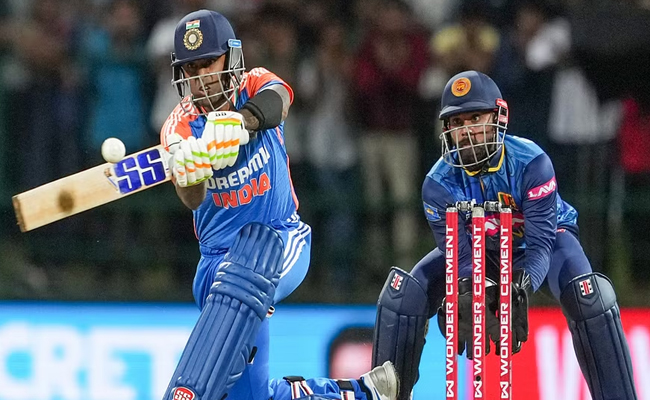
Pallekele (PTI): There will be no let-up in intensity as a ruthless India, under the leadership of new coach Gautam Gambhir and captain Suryakumar Yadav, seek to exploit Sri Lanka's weaknesses and push for a series whitewash in the inconsequential third and final T20I here on Tuesday.
The fate of the series was decided after India swept aside Sri Lanka in the first two games, leaving the possibility of an embarrassing whitewash hanging over the hosts’ heads.
India secured a seven-wicket victory on Sunday in a rain-shortened match in the second T20I, thwarting Sri Lanka's charge once again.
Despite the hosts' flying start, their fight fizzled out for the second consecutive game due to subpar batting.
On the same day, the Sri Lankan women's team beat tournament-favourites India in the final for their maiden Women's T20 Asia Cup title in Dambulla but it seemed to have no impact on the men's side which continued to grapple with existing issues.
Sri Lanka's embarrassing batting collapses in the middle overs is the prime reason of their undoing in this series so far, while India have gone about their business like a true world champion side.
India has proven to be the superior side by a significant margin, demonstrating greater confidence in their plans, skills, and execution, and never faltering under pressure.
There have been moments when Sri Lanka have appeared to be running away with the contest but each time India has found their way back, particularly with their incisive bowling, to keep their upper hand.
The 'bowlers' captain' Suryakumar has not only marshalled his troops with precision to make effective bowling changes, but he has looked to lead from front with the bat having scored 58 and 26 in the two outings so far.
India have remained aggressive right from the word go to reap rich benefits, putting a 200 plus score in the opener.
In the second game, a slight change in the batting line-up delivered a seven-wicket win which helped them seal the series.
It remains to be seen if vice-captain and opener Shubman Gill is fit in time for this contest after he missed the second game due to a stiff neck.
His replacement, Sanju Samson had to wait for over an hour to face his first ball due to a rain break and when his chance arrived, the right-hander missed one from Maheesh Theekshana for a golden duck.
Samson and India will be seeking improved performances from the batter, who has been a fixture around the T20I squad for some time, including serving as a non-playing member of the World Cup-winning team.
But at the other end, Yashasvi Jaiswal has looked to go all-out with his attacking game to rake up 70 runs in two outings and he remains one of the biggest threats for the Lankans.
For the hosts, Pathum Nissanka (111 runs) and Kusal Perera (73) have provided the fireworks at the top but Sri Lanka’s middle-overs struggles have led to their downfall.
India spinner Ravi Bishnoi, who helped script a win in the second game with 3/26, highlighted Sri Lankan batters' inability to navigate spin bowling in the series.
"They play spin really well but I do not know what (has) happened, they are collapsing in the middle overs," Bishnoi said after the second T20I.
"They are known as a good spin-batting team but I think something has gone wrong,” said Bishnoi, possibly hinting at the lack of skills and aptitude among Sri Lankan players generally which has led to their struggles across formats.
With the ball, Matheesha Pathirana returned an expensive 4/40 in the opening game but Sri Lanka will want a lot more from their bowlers.
Teams (from):
India: Suryakumar Yadav (c), Shubman Gill, Yashasvi Jaiswal, Rinku Singh, Riyan Parag, Rishabh Pant (wk), Sanju Samson (wk), Hardik Pandya, Shivam Dube, Axar Patel, Washington Sundar, Ravi Bishnoi, Arshdeep Singh, Khaleel Ahmed, Mohammed Siraj.
Sri Lanka: Dinesh Chandimal, Avishka Fernando, Kusal Mendis (wk), Pathum Nissanka, Kusal Perera, Charith Asalanka (c), Wanindu Hasaranga, Kamindu Mendis, Dasun Shanaka, Chamindu Wickramasinghe, Binura Fernando, Asitha Fernando, Dilshan Madushanka, Matheesha Pathirana, Maheesh Theekshana, Dunith Welalage.
Match starts at 7:00pm IST.
Let the Truth be known. If you read VB and like VB, please be a VB Supporter and Help us deliver the Truth to one and all.
Explainer: CBSE's three-language formula for Class 9; What does it mean, what changes?

New Delhi (PTI): Two months after beginning of the 2026-27 academic session, the Central Board of Secondary Education (CBSE) has notified implementation of the three-language formula for Class 9 from July 1, 2026.
Here is an explainer of what the formula is:
1. What is three-language formula?
The three-language formula in the National Education Policy (NEP) 2020 recommends that students learn three languages, at least two of which must be native to India. This formula applies to both government and private schools, giving states the flexibility to choose languages without any imposition.
2. What is the history of three-language formula?
The formula was first proposed by the Education Commission (1964-66), officially known as the Kothari Commission. It was formally adopted in the National Policy on Education (NPE) 1968 under then Prime Minister Indira Gandhi. The policy was reaffirmed in NPE 1986 under PM Rajiv Gandhi and revised in 1992 by Narasimha Rao’s Congress government to promote linguistic diversity and national unity.
The formula included three languages -- mother tongue or regional language, official language and a modern Indian or European language.
3. What does NEP 2020 say about the three-language formula?
The NEP proposes an “early implementation of the three-language formula to promote multilingualism" from the school level. The document states that the three-language formula will continue to be implemented "while keeping in mind the constitutional provisions, aspirations of the people, regions, and the Union, and the need to promote multilingualism as well as promote national unity”.
However, the NEP also states that there will be greater flexibility in the three-language formula, and no language will be imposed on any state.
The policy states that the three languages learned by children will be the choices of states, regions, and of course, the students themselves, so long as at least two of the three languages are native to India.
4. What about foreign languages?
According to NEP 2020, in addition to Indian languages and English, students at the secondary level can also learn Korean, Japanese, French, German and Spanish, among other foreign languages.
However, a key shift in the curriculum is the classification of English as a foreign language, with the Board allowing only one foreign language within the three-language framework. This could restrict students from choosing both English and another foreign language as their second and third languages.
5. Are books ready?
The board has said till the dedicated R3 textbooks are available, Class 9 students shall use the Class 6 R3 textbooks (2026-27 edition) of the chosen language.
The board has further said schools facing a shortage of adequately-qualified native Indian language teachers may, as an interim arrangement, engage existing teachers of other subjects who possess functional proficiency in the language concerned.
6. What is the controversy about three language formula?
The three-language formula has been at the centre of the political row between the former DMK-led Tamil Nadu government and the Centre.
The state has historically opposed the three-language formula. In 1937, the then Madras government, headed by C Rajagopalachari, introduced compulsory Hindi in schools. This move sparked widespread protests by the Justice Party and Dravidian leaders like Periyar. The policy was revoked in 1940, but anti-Hindi sentiments persisted.
When the three-language formula was introduced in 1968, Tamil Nadu opposed it, seeing it as an attempt to impose Hindi. Under Chief Minister C N Annadurai, the state adopted a two-language policy, teaching only Tamil and English.
Tamil Nadu remains the only state that has never implemented the three-language formula, choosing English over Indian languages, including Hindi and other regional languages.