Coach feared for Vinesh Phogat’s life during extreme weight cut before Olympic final: Report
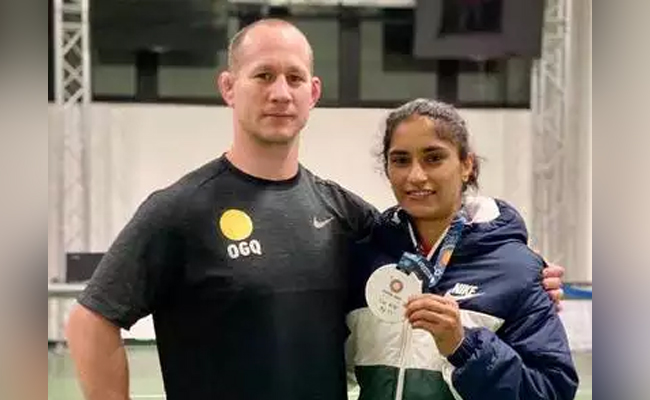
New Delhi: Vinesh Phogat’s coach, Woller Akos, has revealed that he had concerns over her health during the weight-cutting process before the 50kg freestyle final at the Paris Olympics. According to The Indian Express, Akos posted on Facebook, later deleting it, that he feared for Phogat’s life as she attempted to cut the last few grams for the weigh-in, where she eventually missed the mark by 100 grams, resulting in disqualification.
The post, originally written in Hungarian, described how Phogat had 2.7 kilograms to lose after the semi-final. Despite over an hour of exercise and 50 minutes in the sauna, 1.5 kilograms remained. Phogat worked through the night on cardio machines and wrestling drills, but collapsed at one point. She eventually recovered and continued her efforts in the sauna.
After being hospitalised and later discharged, Phogat reflected on the experience with her coach, stating, "Coach, don’t be sad. I achieved my goal; I proved I am one of the best in the world. Medals and podiums are just objects, but performance cannot be taken away."
Despite missing out on a medal, Phogat took pride in her performance, particularly in defeating Japan's top wrestler, Yui Susaki.
Let the Truth be known. If you read VB and like VB, please be a VB Supporter and Help us deliver the Truth to one and all.
Road crash in UP leaves 10 dead
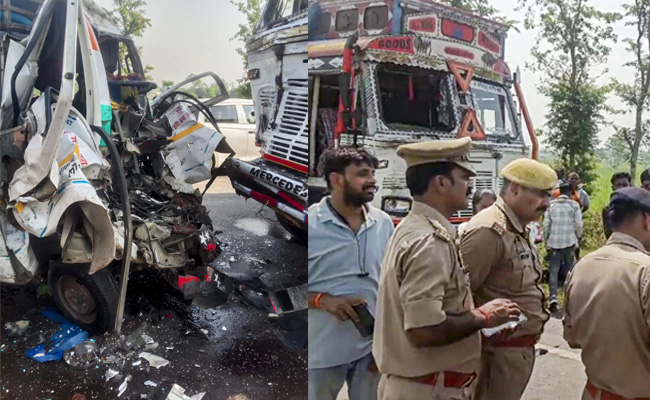
Lakhimpur Kheri (UP) (PTI): Ten people were killed when a van collided head-on with a truck on the Sisaiya-Lakhimpur national highway on Monday, police said.
The van was going to Sisaiya from Lakhimpur when the accident took place between Unchgaon and Bharehta villages.
Circle Officer of Dhaurahra, Shamsher Bahadur Singh, said all nine passengers travelling in the van and the driver were killed.
District Magistrate of Lakhimpur Kheri Anjani Kumar Singh told reporters that the van collided with a truck coming from the opposite direction, leading to nine casualties on the spot, while one succumbed to injuries at the district hospital.
Circle Officer, Dhaurahra, Shamsher Bahadur Singh told PTI, "Efforts are on to establish the identity of other deceased persons."
The seven of the deceased have been identified as Jaideep Singh (25), Pawan (23), Sohan (21), Ram Goyal (42), Sahajram (35), Pappu (18), all residents of Bahraich district and Adnan Khan (15), a resident of Lakhimpur Kheri district, police said.
Condoling the loss of lives in the accident, Uttar Pradesh Chief Minister Yogi Adityanath in a post on X, said, "The loss of life in the unfortunate road accident in Lakhimpur Kheri district is deeply distressing and heart-wrenching. My condolences are with the bereaved families."
"I have directed the local administration to provide prompt and adequate assistance to the injured and the victims. I pray to Lord Shri Ram to grant the departed souls a place at His divine feet and to bestow a speedy recovery upon the injured," Adityanath said on X.
Deputy Chief Minister Keshav Prasad Maurya and Brajesh Pathak too condoled the loss of lives in the accident.
"The loss of lives resulting from the road accident in Lakhimpur Kheri district is deeply tragic and heart-wrenching. My deepest condolences go out to the bereaved families," Maurya said.