CSK beat KKR by 7 wickets to go top of the points table

Chennai, Apr 9: A clinical Chennai Super Kings maintained their unbeaten run at home with a seven-wicket thrashing of Kolkata Knight Riders in the Indian Premier League here on Tuesday.
The hosts put up a top-class bowling effort yet again after winning the toss, limiting KKR to 108 for nine despite an unbeaten 50 off 44 balls from the dangerous Andre Russell.
With the dew making batting easier in the second half of the match, CSK chased down a rather comfortable target in 17.2 overs.
With an emphatic win, CSK are back at the top of the table with five victories from six games while KKR suffered their second loss in six matches and will be hoping that Tuesday's performance was just a blip in otherwise a promising campaign so far.
Shane Watson (17 off 9) smashed two fours and a six early on in the run chase before falling to a soft dismissal off spinner Sunil Narine.
Suresh Raina (14) too did not cash in on the opportunity to make a big score and perished in an attempt to hit Narine out of the park, leaving CSK at 35 for two in five overs.
Since the asking rate was not an issue, Faf du Plessis (43 not out off 45) and Ambati Rayudu (21) went about their job with little difficulty. The South African, who scored 54 in his first game of the season here on Saturday, played another solid innings to take the team home.
Earlier, a lot depended on the in-form Russell after a poor show from the KKR batting unit. He played the only way he knows, going for big shots, and succeeded to a certain extent to finish with five fours and three sixes.
The under-rated Deepak Chahar, who returned with impressive figures of three for 20 from four overs, rattled the KKR top-order with early strikes, including that of the big-hitting Chris Lynn as the visitors struggled to 29 for four in the powerplay.
Harbhajan Singh (2/15), Imran Tahir (2/21) and Ravindra Jadeja (1/17) put the brakes on the KKR batting with a disciplined effort.
KKR were under pressure from the word go as Lynn and Sunil Narine fell within the space of five balls. First, Chahar trapped Lynn leg-before wicket for a duck in the first over, as the Aussie missed a pull off a delivery that kept low.
In the next over, Harbhajan tossed one up to Narine, who attempted a big shot, only to skew it to the point region where Chahar took a good catch running backwards.
Nitish Rana (0) became Chahar's second victim, taken smartly by Rayudu. Robin Uthappa (11, 9 balls, 2X4) played a couple of good shots, before perishing to a pull which landed in the safe hands of Kedar Jadhav at deep-square leg.
A lot was expected of skipper Dinesh Karthik but he flattered to deceive, hammering a shot off Tahir straight into the hands of Harbhajan at mid-wicket, to be dismissed for 19 to leave KKR in trouble at 44 for five.
That KKR's 50 came up only in the 12th over, indicating how much their batsmen struggled to come to grips with the surface at Chepauk.
Let the Truth be known. If you read VB and like VB, please be a VB Supporter and Help us deliver the Truth to one and all.
CM Siddaramaiah alleges ‘criminal conspiracy’ in Sringeri recount, vows legal action
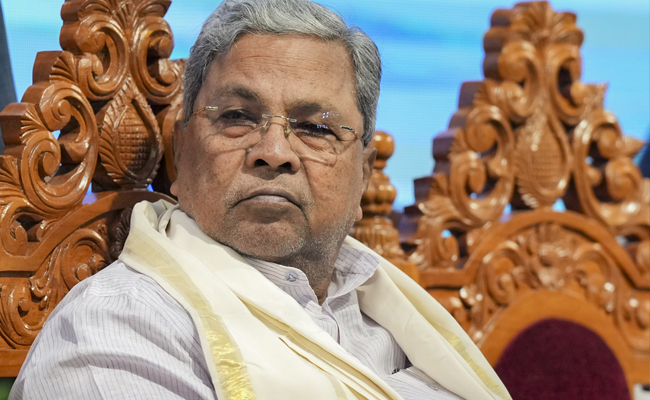
Bengaluru (PTI): Alleging a “criminal conspiracy” by BJP candidate D N Jeevaraj in the Sringeri Assembly poll recounting, Karnataka CM Siddaramaiah on Tuesday said the outcome was manipulated after valid postal ballot votes in favour of Congress leader T D Raje Gowda were tampered with during the recounting process.
Following a Karnataka High Court order on an election petition filed by Jeevaraj, challenging Raje Gowda’s election, the reverification and recounting were conducted on Saturday.
After the reverification and recount of postal ballots for the Sringeri Assembly constituency, votes polled in favour of Raje Gowda were reduced by 255, the returning officer said.
A report on the matter has been submitted to the Election Commission of India for further action, the officer added.
Congress leader Raje Gowda had won the 2023 Assembly polls from Sringeri by 201 votes, defeating his nearest rival Jeevaraj.
Addressing a press conference in Bengaluru, Siddaramaiah said the High Court had directed the recounting of postal ballots and that irregularities were noticed during the exercise conducted on May 2.
“This is a clear case of criminal conspiracy,” Siddaramaiah said, alleging that valid votes cast in favour of Raje Gowda were altered after being accepted by counting agents of all parties, including Congress, BJP, and JD(S).
He claimed that during the recounting of postal ballots, 255 votes were initially accepted as valid by all agents but were later tampered with by subordinate officials.
“There is a second mark on the votes polled in favour of Raje Gowda. They had accepted these as valid votes. Subsequently, another mark was made by officials. This is a clear case of criminal conspiracy,” he said.
When asked who was behind the alleged conspiracy, the CM replied, “It was hatched by Jeevaraj and others. It is planned.”
Siddaramaiah further alleged that the returning officer acted improperly by declaring the result despite the presence of an Election Commission observer during the recounting.
“Immediately after the counting, the returning officer announced the result. He should not have done so; this is against the law,” he said.
He pointed out that Raje Gowda had originally won by 201 votes, but after the recounting, the BJP candidate was declared the winner by 52 votes.
“The BJP has committed a criminal act of conspiracy. This is not vote chori but vote dacoity,” he alleged.
The CM said a police complaint had already been filed by Raje Gowda’s election agent, Sudhir Kumar, and emphasised the need for electoral integrity.
“We want transparency and free and fair elections. That is what our Constitution mandates,” he added.
Stating that the government would pursue legal remedies, Siddaramaiah said, “We are preparing an appeal challenging the returning officer’s announcement in a court of law.”
Responding to a separate query on elections in other states, the CM said there appeared to be an anti-incumbency factor in West Bengal, while results in Tamil Nadu were “surprising,” adding that Vijay’s party was emerging as the largest there.
Following the victory of party candidates in Bagalkote and Davanagere South, Siddaramaiah expressed confidence about future electoral prospects in Karnataka.
“Even in 2028, we will win the Assembly elections. We will come back,” the CM said.
Siddaramaiah added that he would order a forensic examination into the alleged tampering of postal ballots.