Cummins doubtful for T20 World Cup? It's quite grey right now, says Aus head coach
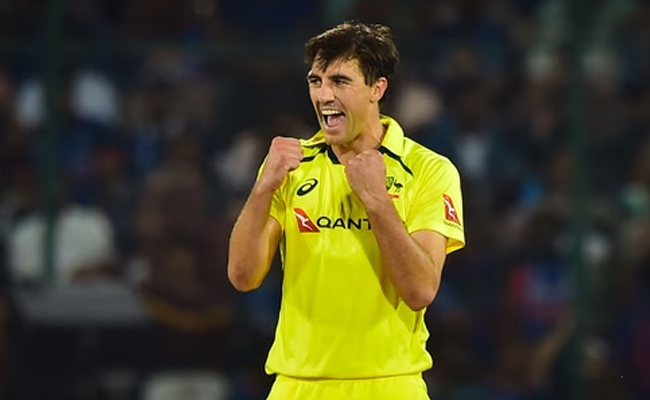
Melbourne (PTI): Australia skipper Pat Cummins' chances of playing at next year's T20 World Cup in India and Sri Lanka are "quite grey at the moment" as he battles a back stress issue that has affected his participation in the ongoing Ashes series against England.
Cummins returned to play the third Ashes Test in Adelaide after missing the opening two matches, picking up six wickets to help Australia clinch the series 3-0.
However, the Australian Test and ODI skipper will take no further part in the series and even his participation at the T20 World Cup is also uncertain. All-rounder Mitchell Marsh is Australia's T20I captain.
"Looking forward to the World Cup, whether he will be there or not, I can't really say. It's quite grey at the moment. We're hopeful," head coach Andrew McDonald was quoted as saying by 'ESPNCricinfo'.
The fast bowler was diagnosed with a lumbar stress reaction during Australia's tour of the West Indies in July. He underwent rehabilitation before being cleared for a carefully managed return in Adelaide.
"He's pulled up fine. He won't play any part in the rest of the series and that was a discussion that we had a long time out around his return," McDonald said.
"We were taking on some risk and people that reported on that would understand the risk associated with that rebuild. We've now won the series and that was the goal.
"So, to position him for further risk and jeopardise him long-term is not something that we want to do and Pat's really comfortable with that," he added.
The T20 World Cup is scheduled to begin on February 7 across India and Sri Lanka with the summit clash set for March 8.
Australia's first match is on February 11 against Ireland at Colombo. Although Cummins captains the Test and ODI teams, all-rounder Mitch Marsh leads Australia in the shortest format.
Let the Truth be known. If you read VB and like VB, please be a VB Supporter and Help us deliver the Truth to one and all.
Vartha Bharati–Sankalp predictions align closely with Karnataka bypoll results
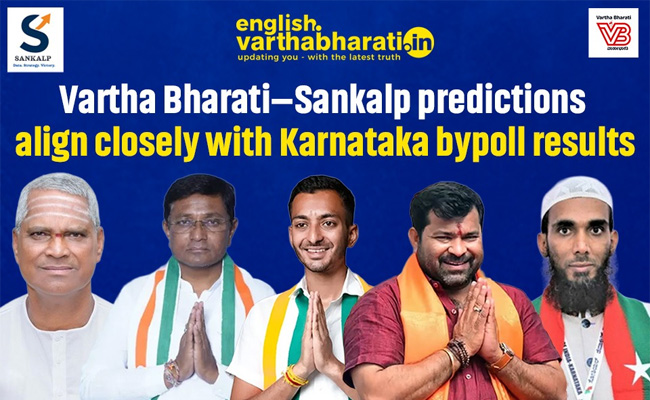
Bengaluru: The Vartha Bharati–Sankalp election analysis has shown a high level of accuracy in predicting the outcome of the recent Karnataka Assembly by-elections held in May 2026, correctly calling winners in both constituencies and closely estimating vote share trends.
The by-elections were held in Bagalkot and Davanagere South, drawing significant political attention as both seats were seen as key tests for the ruling Congress and opposition BJP.
According to the analysis, Vartha Bharati–Sankalp had made three major projections ahead of the results the winning party, vote share percentages, and margin of victory.
In both constituencies, the platform accurately predicted that the Congress would emerge victorious. The outcome matched the projections, with Congress candidates winning in Bagalkot and Davanagere South.
In terms of vote share, the predictions were largely in line with the final results. In Bagalkot, the BJP’s vote share was forecast in the range of 40 to 46 per cent, while the actual figure stood at 42.9 per cent. The Congress vote share, however, exceeded expectations, with the party securing 55.4 per cent against a projected range of 43 to 48 per cent.
The margin of victory in Bagalkot turned out to be significantly higher than anticipated. While the projection had placed the margin between 2,000 and 3,500 votes, the final margin was around 22,332 votes.
In Davanagere South, the predictions also remained largely accurate. The Congress vote share was projected between 43 and 51 per cent, and the final figure stood at 43.9 per cent. The BJP was expected to secure between 42 and 50 per cent but ended with 40.3 per cent.
The analysis had also identified the role of SDPI as a potential spoiler in the constituency. While its vote share was estimated around 6 per cent, the party eventually secured around 12 per cent of the vote.
The margin of victory in Davanagere South was predicted to be between 1,500 and 2,600 votes. The actual margin was higher at around 5,708 votes, though the contest remained relatively close as anticipated.
Overall, the performance of Vartha Bharati–Sankalp stood out for correctly identifying the winning parties in both seats and maintaining close accuracy in vote share estimates, with only limited deviations in specific cases.