CWG: Judoka Shushila wins silver in women' 48kg, Vijay gets bronze
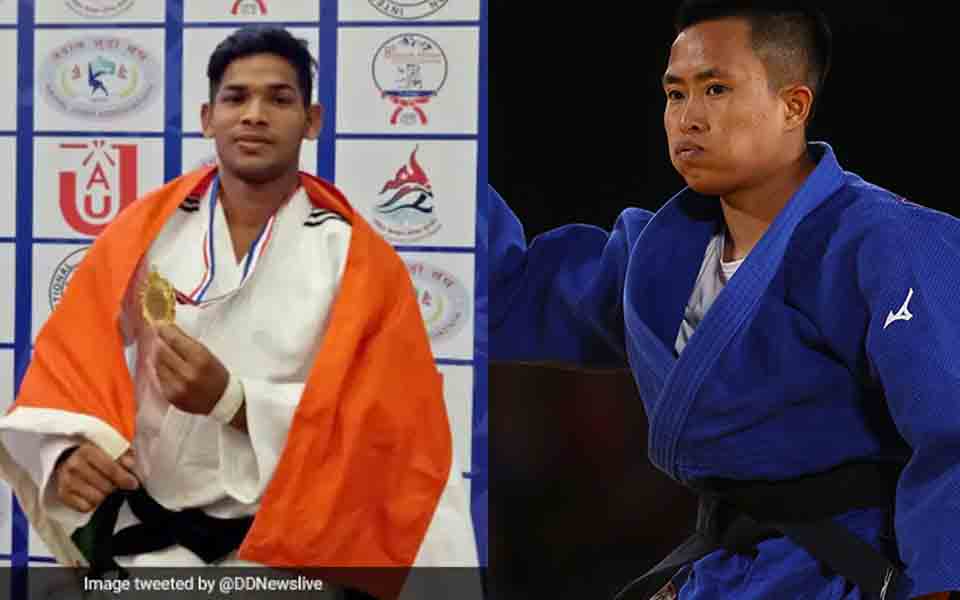
Coventry, Aug 1: Indian judokas L Shushila Devi and Vijay Kumar Yadav signed off with a silver and a bronze medal in women's 48kg and men's 60kg respectively at the Commonwealth Games here on Monday.
The 27-year-old Shushila fought hard before losing the final via 'Waza-Ari' in the 4.25-minute final against South Africa's Michaela Whitebooi, while Yadav dished out a dominating show to take down Petros Christodoulides of Cyprus with a 'Ippon' in the bronze medal match.
For Shushila, it was her second silver medal at the showpiece event. She had finished runners-up at the 2014 Glasgow games as well.
A sub-inspector with Manipur Police, Shushila had progressed to the final, beating Priscilla Morand of Mauritius. she had beaten Harriet Bonface of Malawi on way to her quarterfinals earlier in the day.
The 26-year-old Yadav, on the other hand, produced a superlative performance as he pounced on the mistake of his opponent and pinned him down for 10 seconds to end the contest in just 58 seconds.
Ippon is a move in which a contestant throws his opponent to the mat with considerable force and speed so that the opponent lands on his back. An ippon is also awarded when a contestant immobilizes his opponent with a grappling hold-down for 20 seconds, or when an opponent gives up.
Yadav, who has won the Commonwealth Championships in 2018 and 2019, had lost to Joshua Katz of Australia in the quarterfinal, but he produced a superb performance in 60kg repechage to advance to the bronze medal match with a win by 'Waza Ari' over Dylon Munro of Scotland.
A 'waza-ari' is awarded after a player throws his opponent with control and accuracy, but not to the extent of an ippon.
Jasleen Singh Saini will also fight for a bronze medal after losing the men's 66kg semifinal to Scotland's Finlay Allan.
Saini, who sailed into the semifinals earlier in the day, lost after the Scot performed an 'Ippon' in a match that lasted a little less than two and half minutes.
The 24-year-old Saini, however, has a chance to earn a podium finish as he will compete in the bronze medal play-off against Australian Nathan Katz later tonight.
Suchika Tariyal has already reached the bronze medal round after defeating Donne Breytenbach of South Africa in the women's 57kg repechage.
India had won two silver and two bronze at the Glasgow 2014, their best ever show in judo.
Let the Truth be known. If you read VB and like VB, please be a VB Supporter and Help us deliver the Truth to one and all.
Nashik court sends ‘godman’ Kharat to 3-day police custody in 7th sexual exploitation case
Nashik (PTI): A court in Maharashtra's Nashik has remanded self-styled astrologer-cum-godman Ashok Kharat to police custody till April 29 in the seventh case of sexual exploitation registered against him.
Kharat, a former Merchant Navy officer arrested on March 18, is accused of sexually exploiting several women and indulging in large-scale financial fraud by claiming to have divine powers and knowledge of black magic.
In the seventh case, Kharat sexually exploited a married woman who had approached him in search of solutions to her family problems.
ALSO READ: ED cracks down on suspected interstate liquor racket, raids 9 sites in Arunachal
The accused allegedly gave the woman something to drink, sexually assaulted her while her husband sat outside his office and threatened to kill her if she told anyone about it.
The Special Investigation Team (SIT), which is probing into 12 cases of sexual exploitation and financial fraud registered against Kharat in Nashik and Ahilyanagar districts, on Sunday filed a request application in the court demanding his custody in the seventh case.
Kharat was produced in court for a virtual hearing in the seventh case on Monday.
The prosecution demanded six-day police custody for Kharat, citing the discovery of a locker in Kharat's house during the investigation, from which the police recovered two blank cheques and other documents, all of which have to be probed.
The court agreed to the prosecution's demand and remanded Kharat to three-day police custody till April 29 in the case.
Kharat has been at the centre of a political firestorm, as he was well-connected, and photographs of him with political leaders and other important members of society have been surfacing in mainstream and social media since his arrest.