Day 1: India 135/1 at stumps, trail by 83 runs vs England in Dharamsala
Dharamsala, Mar 7: The fragility of England batters against high-quality spin was exposed once again before India showed them how to bat on a flat track by cruising to 135 for one at stumps on day one of the fifth and final Test here on Thursday.
Opting to bat, England were all at sea against the mastery of left-arm wrist spinner Kuldeep Yadav whose fourth five-wicket haul in Tests allowed India to bowl out the visitors for 218 in their first innings shortly after tea.
Playing his 100th Test, R Ashwin cleaned up the tail with four wickets while Ravindra Jadeja took one. Contrary to expectations, all 10 wickets went to the spinners at the scenic HPCA Stadium and the last seven batsmen fell while adding only 43 runs.
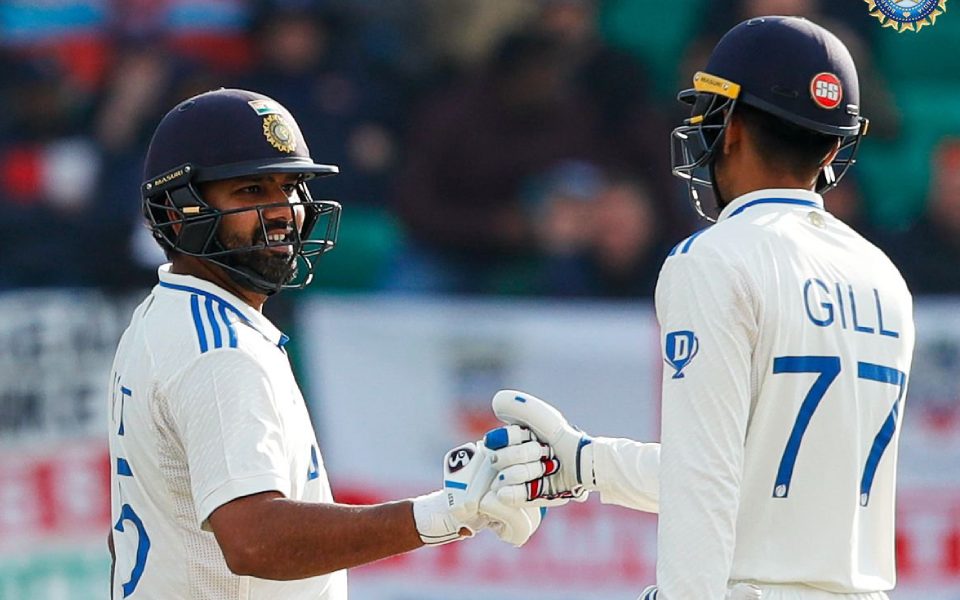
India came out to bat in bright sunshine and Rohit Sharma (52 batting off 83 balls) and Yashasvi Jaiswal (57 off 58b) put the hosts in firm control with a 104-run stand. India reached 135 for one in 30 overs at close. Shubman Gill (26 off 39b) was batting alongside Rohit.
It was the highest opening stand of this series for India and was broken when Jaiswal got a bit carried away to be stumped off Shoaib Bashir after collecting back-to-back boundaries.
The southpaw's pre-meditated charge down the ground came soon after he became only the second Indian to amass 700 runs in a series after the legendary Sunil Gavaskar, who achieved the feat twice against the West Indies in 1971 and 1978-79.
The ball did not do much for the England pacers and spinners compared to their Indian counterparts.
Jaiswal was watchful to start with and waited for the spinners to be in operation. He put Bashir to sword in his very first over by dispatching him for three sixes into the stands, two of them over extra cover.
The Indian skipper, at the other end, too played confidently. He made his intentions clear by pulling a 150kmph rising delivery off Mark Wood over fine leg for six in the fourth over of the innings.
His second maximum came off spinner Tom Hartley in the cow corner region.
However, India's march to command started in the second session when they reduced the visitors to 194 for eight at tea as Kuldeep engineered a middle-order collapse that saw England lose three wickets for no run.
All of a sudden England found themselves reeling at 175 for six from three down on the same score.
England lost six wickets in the middle session for 94 runs.
Kuldeep could have got rid of Zak Crawley (79 off 108) on the second ball after lunch break but India opted against DRS for a catch.
But the 29-year-old spinner did not have to wait long thereafter as he got one to turn massively from the imaginary fifth stump to shatter the England opener's leg-stump. Both the inward drift and the sharp turn led to Crawley's dismissal.
Jonny Bairstow (29 off 19b), who is also playing his 100th Test, showed plenty of intent in his innings but could not last long. Like the other batters, he could not read Kuldeep from his hands and got a faint outside edge off a googly.
He went for a review but ended up wasting it, exactly what Joe Root (26) and Ben Stokes (0) did on the same score of 175. Jadeja trapped Root in front with a straighter one after beating the English batter's outside edge on the previous ball.
Stokes was the fifth victim of Kuldeep who had the opposition skipper plumb in front with a googly. Kuldeep ended up bowling 15 overs straight on either side of the lunch and afternoon session.
Ashwin sent back Hartley and Wood in quick session to join the spinners' party.
In the morning, Crawley made a classy unbeaten half-century after surviving an extended opening spell from the Indian pacers before Kuldeep struck twice to leave the visitors at 100 for two at lunch.
On expected lines, the skillful duo of Jasprit Bumrah and Mohammed Siraj made the ball talk but Ben Duckett (27 off 58) and Crawley were able to see off the first 14 overs of fast bowling after being beaten multiple times.
Crawley, who has been England's stand-out batter in this series, was meticulous with his shot selection and played some delightful cover drives off pacers on way to his half-century.
Siraj ended up bowling eight overs in the morning session and Bumrah seven with both conceding 24 runs.
Kuldeep came to bowl in the 18th over and struck instantly.
Despite being hit for two fours off his first five balls, Kuldeep was not afraid to flight the ball and was rewarded when Duckett's mistimed hit was pouched by Gill, who took a spectacular catch running backwards from cover.
Like Duckett, Crawley too was beaten by the pacers in the first hour of play but he picked the right balls to flaunt his cover drives.
He reached his fourth half-century of the series with a boundary down the ground but that remained the only bright spot for England this day.
Let the Truth be known. If you read VB and like VB, please be a VB Supporter and Help us deliver the Truth to one and all.
Shaheen Group announces free education for SSLC toppers scoring 95% and above

Bidar: Shaheen Group of Institutions has announced free education for students across Karnataka who have secured 95 per cent and above marks in the SSLC examinations.
The announcement was made by Dr. Abdul Qadeer, Chairman of the institution, as part of an initiative aimed at encouraging academic excellence and supporting deserving students.
According to the institution, eligible students from across the state will be provided free education for both First Year and Second Year PUC at Shaheen institutions.
The initiative is expected to benefit a large number of meritorious students by helping them continue higher education without financial burden.
In addition, Dr. Abdul Qadeer announced special scholarships for Kannada medium students and those studying in government schools, recognising their efforts and encouraging them to pursue further studies.
Speaking on the occasion, he said the initiative reflects Shaheen’s continued commitment to inclusive education and merit-based support, ensuring that talented students from all backgrounds receive opportunities to progress.