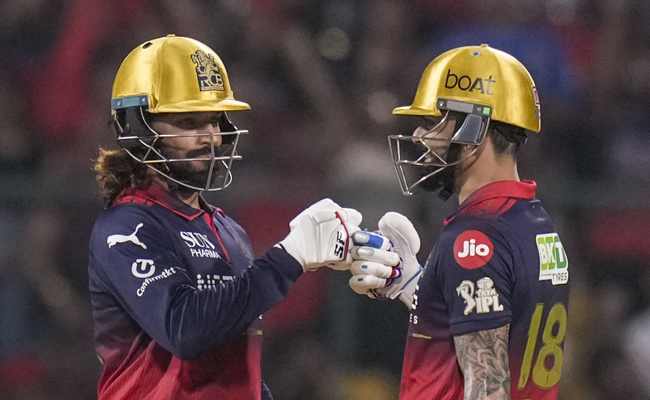
Delhi Capitals Shreyas Iyer, Rabada hand RCB their sixth loss in IPL
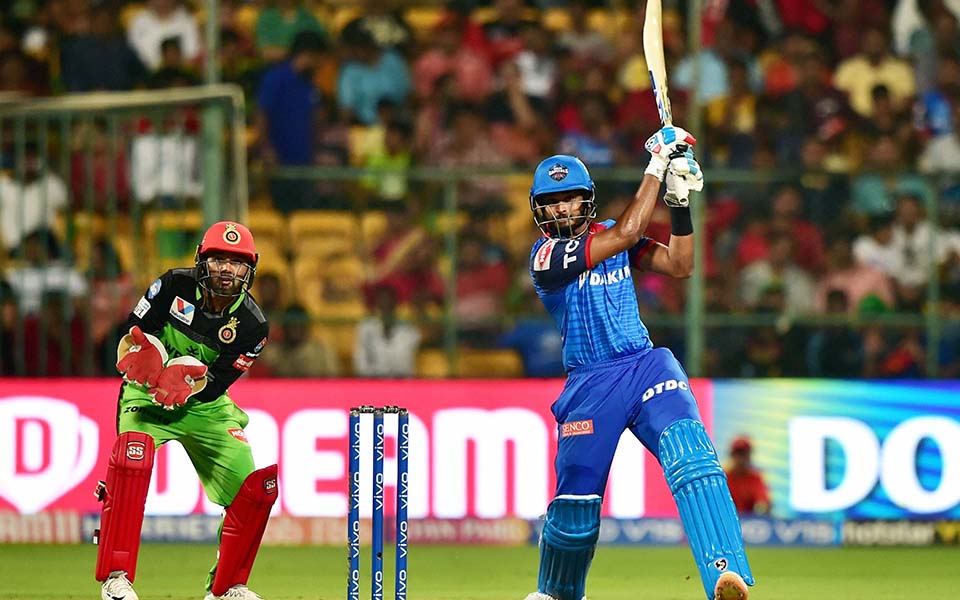
Bengaluru, Apr 7: There was no end to Royal Challengers Bangalore's woeful run this IPL as the Virat Kohli-led side suffered its sixth straight defeat while Delhi Capitals played like a unit to win by four wickets, here Sunday.
RCB batsmen found the going tough on a tough wicket after being invited to bat first and could only manage 149 for 8 in the stipulated 20 overs.
With the ball not coming on to the bat, Kohli scored almost a-run-a-ball before hitting two sixes late in his innings, consuming 33 balls for his 41.
Had it not been for Kohli and Moeen Ali's contributions, RCB would have been in deep trouble. Ali hit a 18-ball 32.
South Africa paceman Kagiso Rabada (4/21) accounted for four RCB batsmen to lead Delhi's bowling attack, which also comprised Chris Morris (2/28), Axar Patel (1/22) and Sandeep Lamichhane (1/46).
Shreyas Iyer then played a captain's knock, making a 50-ball 67 to guide Delhi Capitals to a comfortable win, bringing their IPL campaign back on track.
Iyer anchored the chase with some crucial partnerships as Delhi overhauled the target with 10 balls to spare.
Iyer smashed eight fours and two sixes in his 50-ball innings which helped Delhi grab the fifth place in the points table, snapping a two-match losing streak where they lost to Kings XI Punjab and Sunrisers Hyderabad in the last two games.
Chasing 150 to win, Iyer forged a 68-run partnership with opener Prithvi Shaw (28) after Shikhar Dhawan was dismissed by Tim Southee in the third ball of the innings.
In the 9th over, Pawan Negi removed Shaw after the batsman top-edged a delivery and was caught at deep square leg by Akshdeep Nath.
Iyer then shared 39 runs with Colin Ingram (22), who blasted two fours and a six in his 21-ball stay before being trapped by Moeen Ali in the 14th over while trying to play a shot over the leg side.
Rishabh Pant came out with intent, blasting a couple of fours, while Iyer too smashed a six off Yuzvendra Chahal in the 17th over but the skipper miscued a pull off Navdeep Saini and was caught at short cover by Chahal.
With just five runs needed, Delhi survived some anxious moment after losing Chris Morris (0) and Pant -- both trying to clear the in-field and perishing in the process.
Axar Patel then smashed a four to take Delhi home.
Earlier, Kohli played an uncharacteristic sedate knock.
Ishant Sharma was economical upfront, while Chris Morris was a bit expensive though he sent back Parthiv Patel (9), who slogged hard at a widish delivery and found Sandeep Lamichhane on the boundary ropes.
Young Rabada was introduced to bowl the last over in Powerpay and he got his national teammate AB de Villiers (17).
Kohli was still there but the runs came only in one and twos. In nine overs, RCB scored just 53. Marcus Stoinis hit only second six of the innings by lofting one from Lamichhane over long-on.
Stoinis went after Axar Patel too but ended up giving a catch to Rahul Tewatia.
England all-rounder Ali came to the crease and suddenly batting looked easy. He pulled and drove with ease. Ali spoilt Ishant's figures, hitting him for a six and a four and also dispatched one from Lamichhane to long-off.
The Nepalese spinner, though, had him stumped soon on a googly.
Kohli smashed two sixes off Lamichhane, who bowled first one in slot and the second one very short. However, Rabada dismissed the rival captain, Akshdeep Nath and Pawan Negi in one over.
Let the Truth be known. If you read VB and like VB, please be a VB Supporter and Help us deliver the Truth to one and all.
Chhattisgarh Vedanta power plant blast: Death toll rises to 20; sixteen workers undergoing treatment
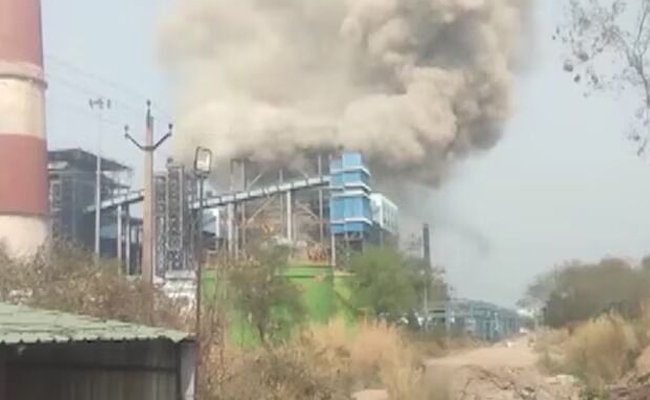
Sakti (Chhattisgarh) (PTI): The death toll in a blast at the Vedanta power plant in Chhattisgarh's Sakti district has mounted to 20 with seven more workers succumbing to injuries, while 16 others are undergoing treatment at different hospitals, officials said on Wednesday.
The deceased include six labourers from West Bengal, five from Chhattisgarh, three each from Jharkhand and Uttar Pradesh, two from Bihar, and one from Madhya Pradesh.
The opposition Congress has demanded registration of an FIR against the plant management and a judicial inquiry into the incident.
The explosion occurred on Tuesday afternoon in a steel tube carrying high-pressure steam from the boiler to the turbine at the Vedanta Ltd power plant located in Singhitarai village, leaving several workers with severe burn injuries.
According to officials, four workers died on the spot, while nine others succumbed to injuries soon after the incident.
Seven more workers have died in hospitals, raising the toll to 20, Sakti Collector Amrit Vikas Topno told PTI on Wednesday.
He said that a total of 36 workers were affected in the blast, and 20 of them died.
"Of the 16 injured workers, five are undergoing treatment in hospitals in Raipur, while 11 others are in hospitals of Raigarh, the neighbouring district of Sakti," he added.
Topno added that every possible effort was being made to provide the best medical treatment to the injured.
The deceased were identified, and their family members are being contacted. Arrangements have been made to transport the mortal remains to their native villages via ambulance following the postmortem examination and to provide immediate financial assistance, he said.
Chief Minister Vishnu Deo Sai has announced a compensation of Rs 5 lakh to the families of each deceased worker and Rs 50,000 for those injured.
Vedanta Power has also announced a Rs 35 lakh compensation for the family of each deceased worker, along with employment support.
The company will also provide Rs 15 lakh to each injured person, ensure salary continuation until recovery, and offer counselling support, a statement from the plant management said.
The chief minister has ordered an inquiry by the Commissioner of the Bilaspur division, assuring strict action against the guilty.
He directed officials to ensure free and proper medical treatment for all injured and emphasised that no negligence in their care would be tolerated.
The district administration has also ordered a separate magisterial probe, while the company has initiated its own internal investigation.
Collector Topno has appointed the Sub-Divisional Magistrate (SDM) of Dabhra to conduct the magisterial inquiry.
The SDM has been asked to submit a report within 30 days covering key aspects, including the cause of the accident, whether it was due to technical or human error, and details of safety inspections carried out at the plant.
Meanwhile, the opposition Congress has demanded registration of an FIR against the plant management and a judicial inquiry into the incident.
State Congress communication wing head Sushil Anand Shukla on Wednesday alleged negligence on the plant management's part and accused the government of attempting to shield those responsible.
He also demanded compensation of Rs 1 crore for the families of the deceased and Rs 50 lakh for the injured.
The construction of a 1,200 MW coal-based thermal power project (two units of 600 MW each) in Singhitarai, originally owned by Athena Chhattisgarh Power Ltd, started in 2009, but remained stalled between 2016 and 2022.
Vedanta acquired the plant in 2022, after which a 600 MW unit was completed and commissioned in August last year, while the second unit is still under construction.
The deceased have been identified as Amrit Lal Patel, Thanda Ram Lahre, Udhab Singh Yadav, Rameshwar Mahilange, and Nadeem Ansari (all from Chhattisgarh); Susanta Jana, Sheikh Saifuddin, Manas Giri, Kailash Mahto, Shibnath Murmu, and Dipankar Singh (West Bengal), Tarun Kumar Ojha, Abdul Karim and Ashok Parhiya (Jharkhand), Raju Ram, Pappu Kumar and Brijesh Kumar (Uttar Pradesh), Aakib Khan and Ritesh Kumar (Bihar), and Chitranjan Dhulai of Madhya Pradesh, officials said.