Dhoni criticised for 'baffling' approach against England
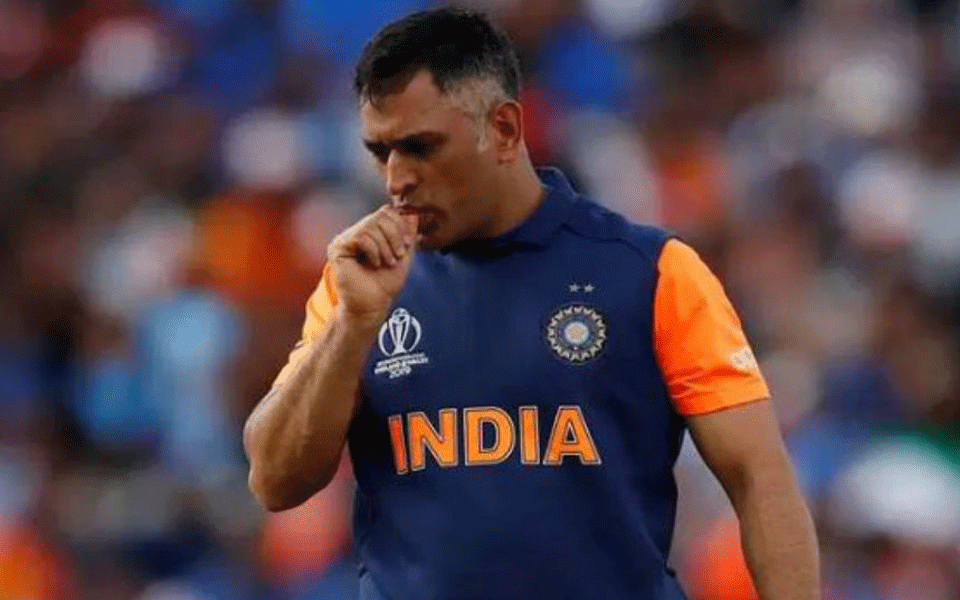
Birmingham, July 1: Wicketkeeper-batsman M.S. Dhoni once again found himself at the receiving end for his lack of intent during India''s first defeat in the ongoing World Cup as they lost to England by 31 runs at Edgbaston.
Chasing 337 on Sunday, India could manage 306/5 in their full quota of 50 overs with Dhoni and Kedar Jadhav remaining unbeaten on 42 (31 balls) and 12 (13 balls) respectively.
After Hardik Pandya fell in the 45th over of the chase, India required 71 from the final five overs. All eyes were on Dhoni who has been known as the chase master and is counted among the best finishers in the game.
However, the 37-year-old along with Jadhav, struggled and the duo were only able to fetch 39 in the final 31 balls, which included 20 singles and seven dot deliveries.
Dhoni''s batting approach was questioned by many, including the likes of former skippers Sourav Ganguly and Nasser Hussain.
"I don't have an explanation for that. You asked me the question but I can't explain these singles. It's also the length and the bounce that has deceived the Indian batsmen. You can’t be chasing 338 and still have five wickets in the end.
"It's about mindset and the way you look at the game. The message had to be clear: no matter where it comes and no matter where the ball lands you have to find the boundary," said Ganguly while commentating during the last 10 overs of India''s chase.
Hussain, who was commentating alongside Ganguly, also failed to understand the batting approach adopted by Dhoni in the death overs.
"I am completely baffled. What's going on! This is not what India needed. They need runs. What are they doing? Some Indian fans are leaving now. Surely they must want to see Dhoni go for his shots, even if he slogs it off in the air. It's a World Cup game, top two sides, give it a go! Indian fans would want their side to do a little bit more. They want their side to go down with a fight. Risk it to win it," said Hussain.
Meanwhile, former Indian cricketer Sanjay Manjrekar also termed Dhoni's batting approach as "baffling".
"If there was any team that had the ability to stop India's winning run. It was England. Dhoni's approach in the last few overs however was baffling," said Manjrekar on Twitter.
Meanwhile, skipper Virat Kohli, once again came to Dhoni's defence and said that the wicket got slower towards the end of the game which made scoring big hits quite difficult.
"I think MS was trying really hard to get the boundary but it wasn't coming off. They bowled in good areas and the ball was stopping, hence it was difficult to bat towards the end," said Kohli after the game.
The good news for India, though, is that MS Dhoni's ODI average has gone up from 50.45 to 50.65
— Alan Gardner (@alanroderick) June 30, 2019
Nasir Hussain:
— Ram Subramanian (@VORdotcom) June 30, 2019
I don’t understand what Dhoni is doing? Atleast give it a go! Now the fans are leaving
Sourav Ganguly:
I have no explanation for this
People on twitter:
Match is fixed bro, match is definitely fixed.
If there was any team that had the ability to stop India’s winning run. It was England. Dhoni’s approach in the last few overs however was baffling. ?
— Sanjay Manjrekar (@sanjaymanjrekar) June 30, 2019
Dhoni & Jadhav scored 39 runs off last 31 balls for the SIXTH wicket! That is beyond explanation! #INDvENG
— Satish Acharya (@satishacharya) June 30, 2019
Let the Truth be known. If you read VB and like VB, please be a VB Supporter and Help us deliver the Truth to one and all.
SC asks Centre to consider amending law on terminating pregnancy of rape survivors

New Delhi (PTI): The Supreme Court on Thursday took strong exception to a plea by AIIMS seeking to set aside its order allowing a 15-year-old girl to medically terminate her 30-week pregnancy, and asked the Centre to consider amending the law to permit rape survivors to terminate unwanted pregnancies even beyond 20 weeks.
The top court said when there is pregnancy due to rape, there should not be a time limit.
Law needs to be organic and in sync with evolving time, it stressed.
A bench of Chief Justice Surya Kant and Justice Joymalya Bagchi said this is a case of child rape and the survivor will have a lifelong scar and trauma if termination is not allowed.
The top court said if the mother does not have permanent disability then it should be carried out.
ALSO READ: Chlorine gas leaks at defunct water purification plant in Pune; 24 persons hospitalised
It asked AIIMS to counsel parents of the survivor over the issue and said the decision has to be of the person concerned.
"There are children for adoption. In this country we have lot of sympathies...There are deserted, abandoned children on the streets and even mafias on it. We have to look at them. This is an unwanted pregnancy of a 15-year-old child.
"This is a curative petition. Unwanted pregnancy cannot be thrusted on a person. Imagine she is a child. She should be studying now. But we want to make her a mother. Imagine the pain, the humiliation the child has suffered in this," the bench said.
Additional Solicitor General Aishwarya Bhati, appearing for AIIMS, mentioned the curative plea, and said the termination of pregnancy is not possible.
"It will be a live baby with severe deformities. Minor mother will have lifelong health issues and cannot reproduce. Minor mother will have lifelong health issues. This child can be given for adoption. It has been 30 weeks now. It is a viable life now," she said.
The top court said the decision on termination has to choice of the survivor and her parents and AIIMS may help them take an informed decision.
On April 24, a bench of Justices B V Nagarathna and Ujjal Bhuyan had allowed the girl to medically terminate her pregnancy of 30 weeks.