Jaipur: Chennai Super Kings captain Mahendra Singh Dhoni escaped a ban and was let off with a 50 per cent fine on his match fee for an unprecedented confrontation with the on-field umpires during the IPL encounter against Rajasthan Royals here.

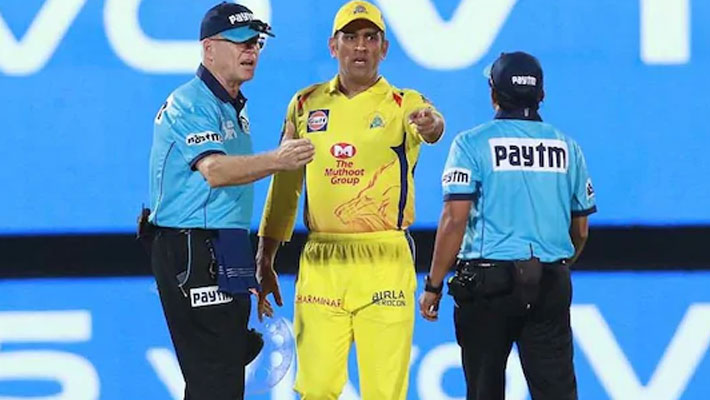
In a rare instance, Dhoni, who was not even meant to be on the field of play, lost his cool and rushed out of the dug-out to challenge umpire Ulhas Gandhe after he flip-flopped on a no ball on Thursday night.

"MS Dhoni, the Chennai Super Kings captain, was fined 50 percent of his match fees for breaching the VIVO Indian Premier League's (IPL) Code of Conduct during his team's match against Rajasthan Royals at Jaipur," the BCCI stated.

Gandhe had tried to rule a waist high full toss as no ball by RR all-rounder Ben Stokes. But he reversed his decision after square leg umpire Bruce Oxenford did not signal for it.

"Dhoni admitted to the Level 2 offence 2.20 of the IPL's Code of Conduct and accepted the sanction," it further stated.

As is the case with IPL teams, it's the franchise that will pay the fine on the player's behalf. Dhoni was seen angrily gesturing at Gandhe for backtracking after initially signalling a no ball.

It took some convincing from Oxenford for Dhoni to head back to the dugout even though he seemed far from convinced.

But the confusion and the ensuing confrontation did not have a bearing on CSK's fortunes.

Stokes failed in the final over and Mitchell Santner finished the match with a six to take his team to a four-wicket win in a chase of 152.

According to the ICC Code of Conduct, which governs the IPL, showing serious dissent at an umpire's decision by words or action can lead to a maximum punishment of one-Test or two-ODI ban.

The ongoing edition of the IPL has had quite a few umpiring controversies so far. Not too long back, India and Royal Challengers Bangalore skipper Virat Kohli lambasted the standards after his team was at the receiving end of a poor no ball call.

The umpire failed to spot a clear case of over-stepping in RCB's clash against Mumbai Indians and Kohli had gone on to say that the officials "should keep their eyes open".

Let the Truth be known. If you read VB and like VB, please be a VB Supporter and Help us deliver the Truth to one and all.


New Delhi (PTI): The Lok Sabha will witness a rare moment most likely on Monday next when Om Birla will not chair proceedings but will be seated amongst the members as the House takes up a notice seeking his removal from office.

As Parliament meets for the second phase of the Budget session on March 9, the Lok Sabha is likely to take up the resolution moved by the opposition against Birla's for allegedly acting in a "blatantly partisan" manner.

According to the rules and laid down procedure, Birla will get a right to defend himself when the resolution is discussed by the lower house. He will also have the right to vote against the resolution, Constitution expert P D T Achary explained.

The expert said while Birla will not chair the proceedings when the resolution comes up before the House, he will be seated in the prominent rows in the Treasury benches.

At least 118 opposition members had submitted a notice for moving the resolution to remove Birla from office for not allowing Leader of Opposition (LoP) Rahul Gandhi and other opposition leaders to speak in the House on the Motion of Thanks to the President's address, as well as for suspending eight MPs.

Congress member and chief whip K Suresh submitted the notice to the Lok Sabha secretariat on behalf of several opposition parties, including his party, Samajwadi Party and DMK.

TMC MPs, however, did not sign the notice.

ALSO READ:  Curbs on movement, assembly remain in force in Kashmir after protests against Khamenei's killing

Achary, a former Lok Sabha secretary general, told PTI, that the "allocation of the seat, which the Speaker occupies under such circumstances is not mentioned in the Rules".

He said Birla will also not be able to vote on the resolution using the automated vote system, but will have to fill a slip to register his vote.

He presumes that a seat belonging to a Union minister, who is from the Rajya Sabha, could be given to him as only Lok Sabha members will be able to cast their votes for or against the resolution.

Deputy speaker of the Lok Sabha and deputy chairperson of the Rajya Sabha have their earmarked seats in their respective Houses when they are not presiding over.

Front seats in the opposition benches are allocated to them.

Article 96 of the Constitution bars a speaker or a deputy speaker from presiding over the House sitting while a resolution for his removal from office is under consideration.

The speaker has a constitutional right to defend himself in the House if the resolution is discussed in the Lok Sabha.

At least two Lok Sabha members have to sign the notice to move a resolution for the speaker's removal. Any number of members can sign the notice but a minimum of two is mandatory.

The speaker can be removed from office by a resolution passed by the House through a simple majority.

Article 94C of the Constitution has provisions for such a move.

"All the members of the House are counted to compute the majority, not the members present and voting, which is the normal practice. It means the effective membership of the House, except for the vacancies, is used to calculate the majority," Achary said.

The notice has to be submitted to the Lok Sabha secretary general, and not the deputy speaker or anyone else, he said.

The document is then examined at the preliminary stage to see whether it contains "very specific charges", he said.

"At the threshold itself, there is a process of admissibility. At that stage, it is seen whether it contains specific charges. Specific charges are required as only then the speaker will be able to respond," Achary explained.

The resolution must not contain defamatory language or content.

Article 96 gives the speaker the opportunity to defend himself or herself in the House.

The language of the proposed resolution is usually examined by the deputy speaker, but since the present Lok Sabha does not have a deputy speaker, it may be examined perhaps by the senior-most member of the panel of chairpersons.

The panel helps the speaker run the House in his or her absence.

"The speaker examining a resolution that seeks his removal looks absurd," Achary said, adding that the rule is silent on the subject.

Once the processing part is over, the resolution reaches the House. But it can go to the House after 14 days, Achary said.

The chair then places it in the House for consideration. It is actually the House which admits it, or as the rule says, "grants permission".

Achary further said, "The chair then asks members in favour of the resolution to stand up. If 50 members stand up in support of it and if the criteria is fulfilled, the Chair announces that the House has granted permission. Once the House grants permission, it has to be taken up for discussion and disposed of within 10 days."

Lok Sabha sources said it will be taken up for discussion on Monday itself.

ALSO READ:  SSLC exam begins in Kerala; Education Minister wishes students success

There are precedents of resolutions being moved. However, none has been adopted so far.

"The reason -- governments have a majority," Achary said.

The resolution alleges that Speaker Birla had acted in a "blatantly partisan" manner in conducting the business of the House and "abused" the constitutional office he occupies.

The Opposition also accused the speaker of making certain false allegations against members of the Congress.

Three Lok Sabha speakers -- G V Mavlankar (1954), Hukam Singh (1966) and Balram Jakhar (1987)-- had faced no-confidence motions in the past, which were negatived.