Dunith Wellalage consigns India to 110-run defeat with five-wicket haul, SL win ODI series 2-0
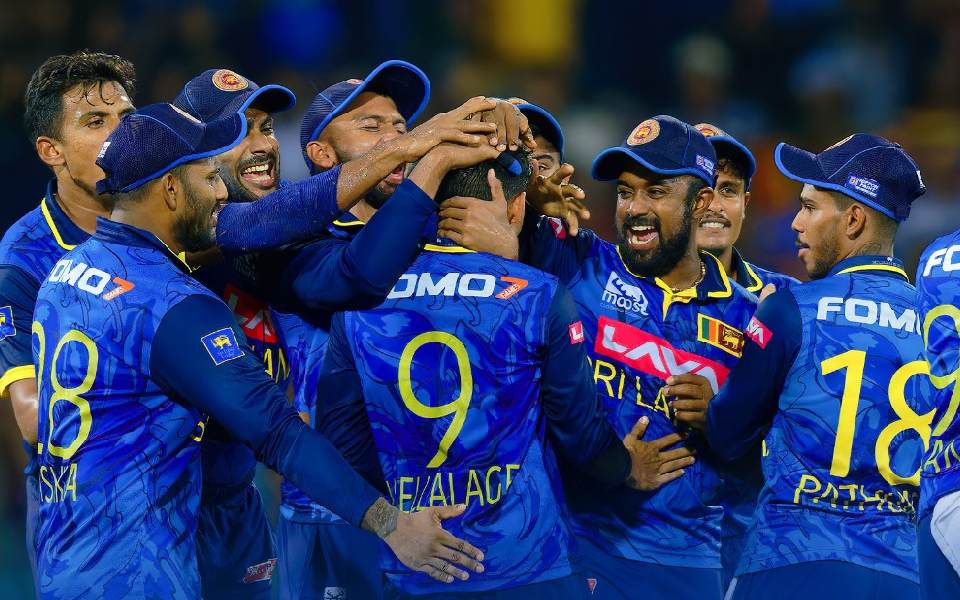
Colombo, Aug 7: The shockingly clueless Indian batting unit was strangled by crafty Sri Lankan spinners, led by five-wicket man Dunith Wellalage, as Rohit Sharma’s men crashed to an embarrassing 110-run defeat in the third and final ODI here on Wednesday.
Sri Lanka won the three-match series 2-0 after the first match ended in a tie, and this is the Islanders’ first bilateral ODI series victory over India since 1997.
Chasing a competitive 249 on a sharp turner at Premadasa, India were bowled out for a woeful 138 in 26.1 overs, and the new head coach Gautam Gambhir will have a few hard points to ponder early into his stint.
The left-arm spinner Wellalage, who hurt India with the bat till now, chose to bruise the visitors by ball taking five for 27 after opener Avishka Fernando made a well-paced 96 to carry Lanka to 248 for seven.
However, India had a rather good beginning, despite the early departure of Shubman Gill, to their chase, courtesy Rohit Sharma’s breakneck 35 off 20 balls that included an 18-run over off Maheesh Theekshana.
The runs cascaded through a sequence of 6, 4, 4, 4 in the fourth over of the innings.
But sweep, one of the favoured shots of Rohit, brought the downfall of the Indian skipper. His attempt to play it off Wellalage ended in the hands of Kusal Mendis behind the stumps.
Once Rohit walked back, the rest of the Indian batters submerged into a whirlpool of confusion.
Virat Kohli (20) played for turn when there was none and was adjudged leg before to Wellalage.
Rishabh Pant, who was playing his first ODI after his comeback from that horrific car crash, trotted down the track and was beaten in the air by Theekshana to eventually get stumped by Kusal.
Riyan Parag, who made his ODI debut while coming in place of Arshdeep Singh, offered no shot to a straight one from leg-spinner Jeffrey Vandersay to get bowled.
In between, Shreyas Iyer also fell leg before to Wellalage, taking the total number of lbw and clean bowled dismissals in this Indian innings to seven, and no other crumb of statistics will offer a clearer picture of the muddled Indian minds than that.
"We knew they are used to small grounds and good wickets in India. So they would struggle on a big Premadasa ground. We knew we could get an advantage with some turn on the wicket, and we have good spinners," Theekshana's post match TV comments with reference to tracks used during ODI World Cup, was like rubbing salt to the wound.
Before their spinners pushed Indian batters deep into trouble, Lanka managed to work through the Indian bowling through opener Avishka Fernando (96, 102 balls, 9x4, 2x6) and Kusal (59, 82b, 4x4).
India fought through an excellent spell of off-spin by Parag (3/54) but apart from Kuldeep Yadav (1/36) there was no real assistance for him.
Fernando’s knock handheld the home side during the most assured batting phase yet in this series, before Parag engineered a familiar mid-innings collapse on a pitch where the proportions of turn increased from mid-way of Sri Lankan innings.
But none of it could take away credit from the effort of Fernando, who stitched two fine partnerships – an 89 for the opening wicket with Pathum Nissanka (45, 65b, 5x4, 2x6) and 82 with Kusal for the second wicket.
Nissanka often matched his associate in aggression, evidenced by the two slog swept sixes off left-arm spinner Axar Patel.
But the blooming stand was cut short by Axar when Nissanka slammed a wide delivery into the hands of Pant.
Lanka stayed ahead of India through the Fernando-Kusal partnership, and the former was the enforcer.
Fernando spoiled the figures of Mohammed Siraj (1/65 in 8 overs), who was unusually wayward in his line and length.
In fact, the Lankan right-hander enjoyed the extra speed of Siraj that enabled him to unfurl his bread and butter pull shot twice in a row to muscle the Indian for sixes.
However, just when he was within touching distance of his fourth ODI hundred, Fernando missed a skiddy leg-break from Parag to get caught in front of the wicket.
At 171 for two in the 36th over, Lanka had an excellent platform to push towards a total in the vicinity of 280 or more.
But Parag removed skipper Charith Asalanka (10), who was trapped leg before, and Wellalage (2) that denied Lanka the late-order momentum.
But Kusal and Kamindu Mendis added 36 runs for the seventh wicket to take the match well beyond India’s reach.
Let the Truth be known. If you read VB and like VB, please be a VB Supporter and Help us deliver the Truth to one and all.
Woman held for murdering her nephew over farm land dispute

Latur (PTI): A 34-year-old woman has been arrested for allegedly killing her seven-year-old nephew over a land dispute with his parents in Chakur town of Latur district in Maharashtra, police said on Monday.
The boy, who is a grandson of a local temple priest, went missing on Sunday morning. After an unsuccessful search, the family approached the police around 1 PM. The body of the boy was recovered by the police near an old house along the Chakur-Ujalamb road.
During the investigation, police detained the aunt of the boy based on leads provided by a dog squad.
According to preliminary findings, the woman allegedly strangled the boy over an agricultural land dispute. She then attempted to conceal the body and destroy evidence.
"In a bid to deflect suspicion, she also staged a false disappearance of her son," police said, adding that further investigation is underway.