England third team to qualify for World Cup semifinals after big win over NZ
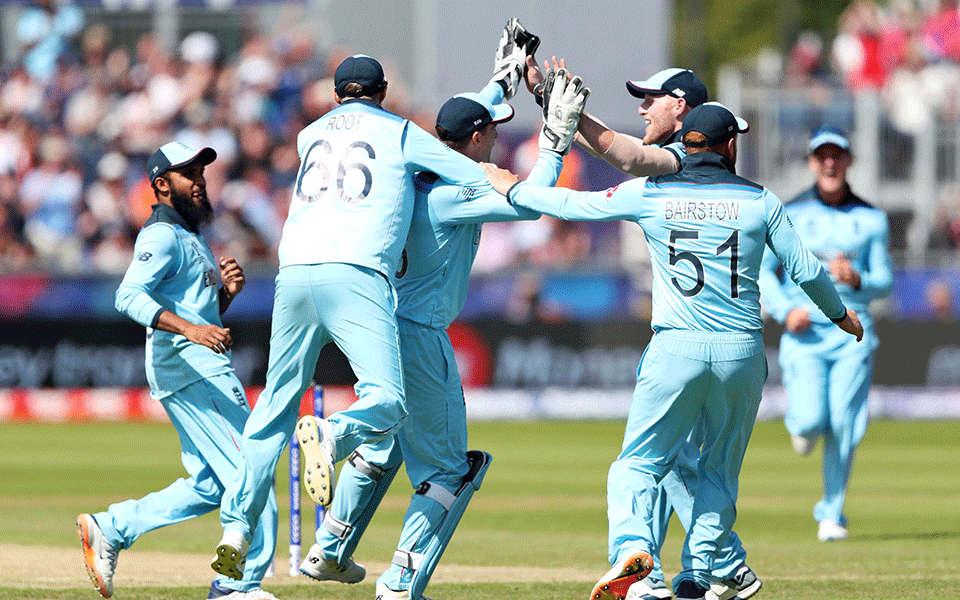
Chester-le-Street, July 3: England entered the World Cup semifinals for the first time since the 1992 edition, beating an erring New Zealand by 119 runs to fuel their "dream" of winning a maiden title.
Jonny Bairstow, who smashed 106 off 99 balls to become the first Englishman to score back-to-back hundreds in a World Cup, was mainly responsible for taking the hosts to 305 for eight on a pitch that got slower as the game progressed.
New Zealand did well to limit England to a little over 300, considering the start provided by Bairstow and Jason Roy (60 off 61) who shared an entertaining 123-run stand after Eoin Morgan opted to bat.
However, moments of brilliance from England and some ordinary cricket from the Black Caps led to their downfall as they folded up for 186 in 45 overs.
New Zealand, who lost their last three leagues games to end with 11 points from nine games, remain in hunt to clinch the fourth and final semifinal spot.
They have a much better net run rate than Pakistan who have nine points and must beat Bangladesh by a big margin in their final league match to have any hopes of pipping New Zealand for the remaining semifinal berth.
England, on the contrary, have got their act together following the defeats against Sri Lanka and Australia. The pre-tournament favourites again look like the team to beat having gotten the better of India and New Zealand. If things stand on the points table as they are, second-placed India will meet third-placed England in the semifinals.
A professional performance on Wednesday have raised hopes of England finally winning their maiden World Cup following heart-breaking losses in three finals (1979, 1987 and 1992).
New Zealand, who lost to England for the first time in a World Cup since the 1983 edition, were virtually out of the game after losing their top four for 69 runs. Both their key players, captain Kane Williamson (27) and Ross Taylor (28), were run out to leave their team in deep trouble.
Williamson, who was backing up too far, was rather unlucky as Mark Wood found a deft touch on his follow through. In the following over, Taylor went for a risky second run which was avoidable at that juncture of the game. The fatal run-outs came after New Zealand lost their openers, Martin Guptill and Henry Nicholls, early in the chase to leave them at 37 for two in 10 overs.
Earlier, Bairstow, who had smashed 111 against India in England's previous contest, raced to his ninth ODI hundred, to lay a perfect platform in a virtual quarterfinal.
Openers Jason Roy (60 off 61) and Bairstow were in punishing mood, sharing a century stand for the second game in a row. Bairstow looked in ominous touch again, hitting as many 15 fours and a six in his enthralling knock.
With England cruising at 194 for one in the 31st over, it seemed the home team would bat New Zealand out of the game.
But New Zealand fought their way back into the game on the back of some tight bowling.
Trent Boult (2/56) was impressive again and removed Joe Root (24) just at the right time to trigger a mini collapse that also led to the fall of centurion Bairstow and the dangerous Jos Buttler (11), leaving England at 214 for four.
Spinner Mitchell Santer, who had opened the bowling, then removed the in-form Ben Stokes (11) to make it 248 for five.
The onus, then, was on captain Eoin Morgan to come up with the late fireworks, but he too perished after scoring 42 off 40 balls.
New Zealand were dealt a severe blow before the start of the game with pacer Lockie Ferguson being ruled out due to a hamstring injury. Tim Southee, playing his first game of the tournament, leaked 70 runs in nine overs.
Let the Truth be known. If you read VB and like VB, please be a VB Supporter and Help us deliver the Truth to one and all.
Bhojshala complex registered as 'mosque' in old revenue records: Muslim side to MP HC
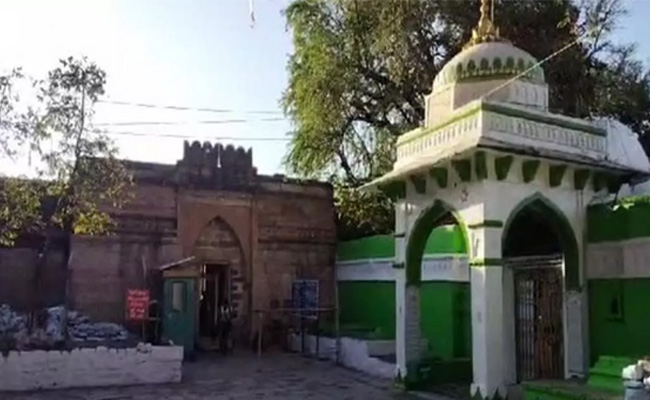
Indore (PTI): The disputed Bhojshala Temple-Kamal Maula Mosque complex has historically been registered as a 'mosque' in revenue records and available sources don't clearly mention any Saraswati temple established by then-king Raja Bhoj, the Muslim side has told the Madhya Pradesh High Court.
The Hindu community considers Bhojshala a temple dedicated to Goddess Saraswati, while the Muslim side calls the 11th-century monument Kamal Maula Mosque. The disputed complex located in Dhar district is protected by the Archaeological Survey of India (ASI).
During the hearing before the HC's Indore bench of Justices Vijay Kumar Shukla and Justice Alok Awasthi on Wednesday, Qazi Moinuddin questioned two PILs filed as intervenors in the Bhojshala case by an organisation named Hindu Front for Justice, one Kuldeep Tiwari and another individual.
Moinuddin claims to be a descendant of Sufi saint Maulana Kamaluddin Chishti and the 'Sajjadanashin' (spiritual head, guru, or successor of a Sufi shrine, khanqah, or religious site).
The PILs state that Bhojshala is actually a Saraswati temple and only Hindus should be granted the right to worship at the disputed complex.
Moinuddin's lawyer, Noor Ahmed Sheikh, claimed in the court that his client's ancestors, who are descendants of Maulana Kamaluddin Chishti, have historically held titles to the complex, and the site was also recorded as a "mosque" in government revenue records.
He contended that those associated with the management of the Kamal Maula Mosque, located within the complex, have been in "continuous and peaceful occupation" of the site for a long time.
Citing Muslim law, Sheikh argued that in the case of religious property, particularly a mosque or its related properties, officials such as the Sajjadanashin and Mutawalli (person entrusted with management, maintenance, and administration of a Waqf), and their descendants, not only have the right to intervene, but also have the right to manage and use such a structure.
Citing provisions of the Ancient Monuments Preservation Act 1904, the Muslim side's lawyer said the term "in-charge of the property" is used in this law, which makes it clear that the person or party who has been in charge of a property for a long time has rights over it.
During the hearing, Touseef Warsi, the lawyer representing the Maulana Kamaluddin Welfare Society of Dhar, claimed that Hindu parties in both PILs had made "misleading representations" regarding historical facts before the high court.
He further claimed that available historical sources do not clearly mention the existence of a Saraswati temple established by Raja Bhoj, the legendary king of the Parmar dynasty who ruled Dhar from 1010 to 1055.
The ASI, a central government agency, has adopted three different positions in the lawsuits filed regarding the Bhojshala dispute, changing its answers from time to time, and this situation raises serious questions about judicial scrutiny of the complex, Warsi submitted.
He raised objections regarding the ASI's process of scientific survey of the Bhojshala complex, carried out on the HC order in 2024, and the method of videography and requested the court to examine these objections.
The hearing in the Bhojshala case will continue on Thursday.
The HC has been regularly hearing four petitions and one writ appeal since April 6, contesting the religious nature of the monument.