England rallies after early setbacks on Day 4 of final Ashes test
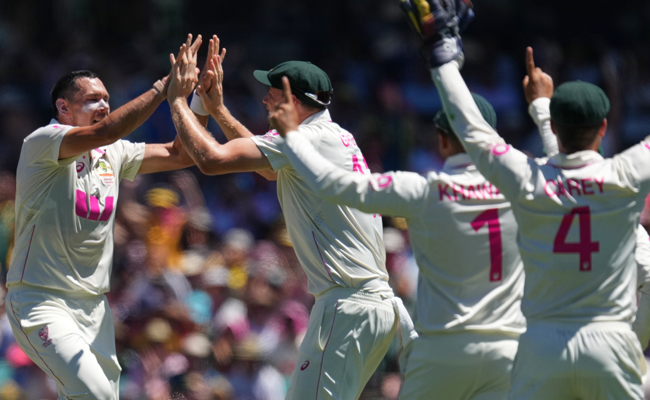
Sydney (AP): England weathered multiple setbacks with skipper Ben Stokes limping from the field and opener Zak Crawley dismissed in the first over of the second innings before rallying to reach 80-1 at lunch Wednesday on Day 4 of the fifth and final Ashes test.
Opener Ben Duckett posted un unbeaten 40, his highest score of the series, but got a huge reprieve minutes before the interval when he fended a Michael Neser delivery and gloved it into the slips, where Cameron Green dropped a chance while diving in front of his skipper, Steve Smith.
ALSO READ: Trump says US to get 30-50 million barrels of oil from Venezuela at market price
Duckett, who was on 37 at the time, was beaten by the next ball but survived the session. Jacob Bethel was not out 28. England still needed 103 to make Australia bat again at the Sydney Cricket Ground.
After dismissing Australia for 567, giving the hosts a 183-run lead, England's second innings started badly when Mitchell Starc struck in the first over to dismiss Crawley lbw on the fifth ball.
As he so often is, Starc was dangerous with his full, swinging deliveries early and Crawley, trying to leave, was trapped lbw without offering a shot to a ball that hit him high on the back pad. England reviewed the decision but the DRS technology upheld the umpire's original decision and England was 4-1.
Duckett got some edges that didn't carry to the wicketkeeper or slips early but settled into his best innings of the tour, hitting six boundaries in his 48-ball innings.
He and Bethell combined in a 76-run second-wicket stand that restored some confidence for the tourists.
The occasional ball was rearing up steeply off a length. Bethell was on 27 when he had to be assessed after a 140 kph (87 mph) short ball from Green glanced his batting helmet before skidding away to the boundary for four leg byes.
The follow-up ball was also a bouncer which the England batter ducked away from.
Stokes injured
England picked up the last three wickets for 49 runs after the Australians resumed at 518-7 but the morning session was overshadowed by an injury to Stokes. He bowled 10 deliveries before leaving the field, leaving question marks over his participation in the remainder of the SCG test. England team management said Stokes was being assessed for a right adductor complaint.
Australia's innings
Australia's commanding innings was built on centuries from stand-in opener Travis Head, his third of the series, and Steve Smith (138) and a late contribution from allrounder Beau Webster, who remained unbeaten on 71.
The Australians will be pushing for victory to complete a 4-1 series win after retaining the Ashes in 11 days of action with wins in the first three tess. England is determined to narrow the margin after its drought-breaking win in the fourth test at Melbourne.
Smith was 129 overnight but didn't settle into a rhythm before he was caught behind off Josh Tongue's bowling, ending a 107-run eighth-wicket partnership with Webster.
The last two wickets fell within six deliveries, with Starc (5) bowled by a full delivery from Tongue that moved late off the seam and off-spinner Will Jacks (1-34) having Scott Boland caught for a first-ball duck at first slip.
Tongue finished with figures of 3-97 from 20 overs.
The century was Smith's 13th in Ashes tests, the 37th of his career and his fifth at the Sydney Cricket Ground. With it, he moved up to sixth on the all-time list of most test centuries.
Let the Truth be known. If you read VB and like VB, please be a VB Supporter and Help us deliver the Truth to one and all.
India should create strategic buffers to navigate 'most difficult' energy shock: CEA Nageswaran
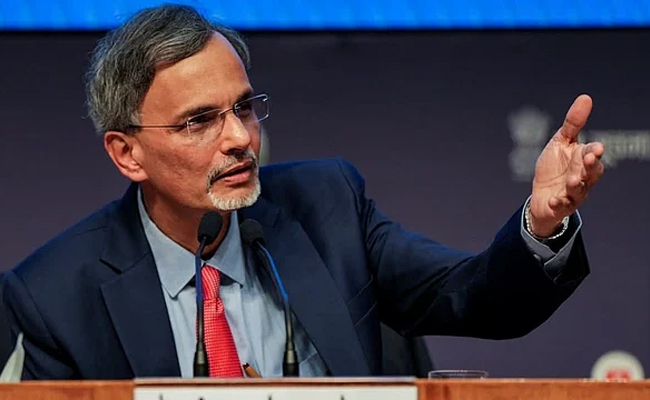
New Delhi (PTI): Chief Economic Advisor V Anantha Nageswaran on Saturday said India needs to create strategic buffers in the face of the "most difficult" energy shock that the country is facing amid the West Asia crisis.
Nageswaran also said the rising prices of fertiliser and petroleum products globally due to the crisis will make it challenging to achieve the 4.3 per cent fiscal deficit target for the current fiscal, while below normal monsoon and pass-through of higher energy prices could lead to "potential inflation spike".
He also said India has employment challenge emanating from AI, and there is a need to ensure that IT sector becomes more competitive and not lose jobs to AI, and instead create jobs that use AI within the IT sector or in other services.
Speaking at the ICPP Growth Conference organised by the Ashoka University, Nageswaran said the current account deficit (CAD) in the current fiscal could rise to over 2 per cent of GDP, from less than 1 per cent in FY'26.
"The ... priority for us is to create strategic buffers. This energy shock is the most difficult one compared to any other previous energy shock in terms of energy lost as a percentage of total global energy supply, not just oil, including gas.
"And we also need to use this occasion to think about other areas where we are vulnerable in terms of import dependence, nickel, tin, and copper. We need to build strategic buffers if we have to make a shot at manufacturing and becoming indispensable," Nageswaran said.
Since the beginning of the war in West Asia on February 28, crude oil prices soared to a four-year high of USD 126 per barrel on Thursday, from about USD 73 level before the war.
Stating that geopolitics will compel policymakers to be nimble and flexible and shed old model of thinking, Nageswaran said India is better prepared than many other countries to deal with the crisis because of the fiscal leeway that the country has due to lowering of fiscal deficit ratio to 4.4 per cent of GDP in FY'26.
Nageswaran said the West Asia conflict is more of a price shock than supply shock for India as the government is managing the supply side deftly.
"This particular conflict, which is going to be on a low simmer or a high flame situation, whatever it is, it is going to be there with us in some form or the other because the military conflict may be over, but the strategic conflict is well and truly alive. It will be so for some time," Nageswaran said.
He said the conflict has four channels of shock: price and supply shock, trade impact, sticky logistics costs and remittance shock.
India imports 60 per cent of its LPG usage and of that, 90 per cent flows through the now closed Strait of Hormuz.
Nageswaran said the pass-through of high global energy prices would have to be a "balancing act". He said some pass-through is already happening in commercial LPG, and the levy of export duty on diesel and ATF.
The government has cut excise duty on petrol and diesel to shield customers from the impact of the rise in petroleum prices. "We are coming around to arriving at a certain modus vivendi with respect to burden-sharing between the fiscal policy side, inflation, households and the oil marketing companies. So it has to be a balancing act," Nageswaran said.