Euro 2020: Morata scores as Spain beats Croatia 5-3 in extra time
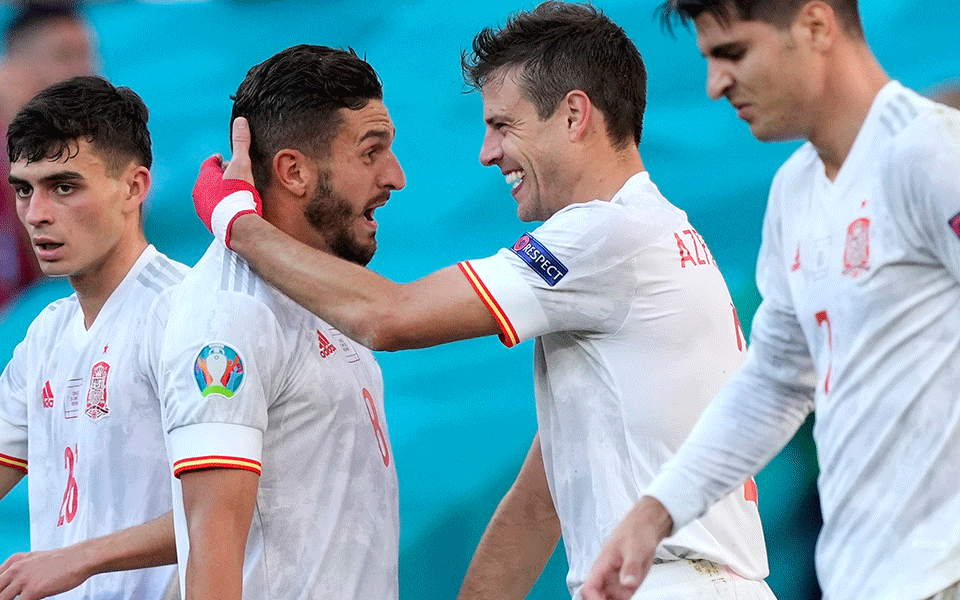
Copenhagen: Spain first gifted Croatia a bizarre own-goal, then threw away a late 3-1 lead. Alvaro Morata made sure it didn't matter in the end.
Morata and Mikel Oyarzabal scored in extra time Monday to give Spain a 5-3 win over Croatia and a place in the European Championship quarterfinals after a wildly entertaining see-saw match at Parken Stadium.
"I've lived through really intense matches as a player and manager but this one genuinely had a bit of everything, Spain coach Luis Enrique said.
It was the second-highest scoring game in the history of the European Championship, trailing only Yugoslavia's 5-4 win over France in the opening game of the inaugural tournament in 1960.
And it had nearly as many momentum shifts as goals.
After Croatia midfielder Mario Pasalic equalized in injury time to cap an improbable late comeback, the much-maligned Morata scored what proved the winner in the 100th minute.
The Spain striker controlled a cross with one deft touch and then sent a rising shot past goalkeeper Dominik Livakovic for his second goal of the tournament.
Oyarzabal doubled the lead three minutes later, receiving a pass in the middle of the area and holding off a defender before scoring.
Morata had received a torrent of online abuse including death threats after a string of misses during the group stage. But his fierce finish from a tight angle proved decisive on Monday.
I don't think there's any coach in the world who wouldn't admire a player like Morata, Luis Enrique said.
He dominates in the air, he scores goals, he is physically powerful. He is a striker we should really value.
Spain had been knocked out in the round of 16 in its previous two tournaments but netted five goals for a second straight game after a slow start with two draws. The Spanish will play Switzerland in the quarterfinals on Friday in St. Petersburg. The Swiss beat World Cup champion France on penalties after also coming from 3-1 down in the final minutes.
Croatia netted three goals for a second straight game but fell well short of replicating its feat of reaching the World Cup final in 2018.
At the start of extra time we had them on the ropes but we failed to score from two good chances, Croatia captain Luka Modric said.
"Then the game turned around and we didn't have the strength to come back.
Not for a second time, anyway.
Spain had led 3-1 in the 85th minute but Mislav Orsic pulled one back after a goalmouth scramble and Pasalic equalized with a header in injury time.
Spain had dominated the first 20 minutes but goalkeeper Unai Simon was at fault for his team's early deficit after a massive blunder when he failed to control a long back pass. The ball bounced over Simon's foot and trickled into the net behind him.
We know that's football and that those things happen, Spain captain Sergio Busquets said.
The most important thing is to pick yourself up and show a strong mentality. And I think both Unai and the whole team did that today.
Spain quickly recovered and Pablo Sarabia equalized in the 38th. Right back Cesar Azpilicueta then made it 2-1 with a header in the 57th and Ferran Torres doubled the lead when he finished off a quick counterattack with a low shot past Livakovic in the 77th.
It looked like Spain was heading for an easy win before Croatia fought back.
Boy, we had to suffer there," Azpilicueta said.
"It wasn't great to be scored against twice late in normal time, but we were the better team in extra time and we deserve to go through.
Croatia's late surge allowed both Morata and Simon to redeem themselves.
The goalkeeper made a crucial save to deny Andrej Kramaric at the start of extra time, then got up and punched the air in celebration.
I think that when we missed that chance at 3-3 in extra time, that was the determining factor, Croatia coach Zlatko Dalic said. I think if we had scored a goal it would have been completely different.
Simon also made a big stop at 3-2 when he got down quickly to make a one-handed save on Josko Gvardiol's shot from just outside the box.
We have complete confidence in (Simon), Busquets said.
He was unlucky with that own-goal but Unai has a very laid-back mentality. He's very ambitious at the same time and I think he showed that with his reaction, and with the saves he made.
Let the Truth be known. If you read VB and like VB, please be a VB Supporter and Help us deliver the Truth to one and all.
Man kills 12-year-old nephew over property dispute in Karnataka’s Sindhanur
Sindhanur: A 12-year-old boy was killed and his mother seriously injured after a man allegedly attacked his elder brother’s family with a knife over a property dispute in Alabanur village of Sindhanur taluk on Wednesday morning.
The deceased has been identified as Nagaraj Siddappa Alvi (12). Amrutha Siddappa (42) sustained serious injuries in the attack. Police said the accused is Basavaraj Rudrappa Alvi, the younger brother of the victim boy’s father.
According to preliminary information, Basavaraj had arrived in Alabanur village on Tuesday and was staying at his mother’s house.
On Wednesday morning, he allegedly went to the house of his brother Siddappa carrying a knife. At the time, Siddappa’s wife Amrutha and children Nagaraj and Dhanush were present in the house.
Police said the accused allegedly attacked them with the knife. Nagaraj died in the incident, while Amrutha and Dhanush suffered serious injuries.
The injured were shifted to the government hospital in the city for treatment.
Deputy Superintendent of Police G. Chandrashekhar visited the spot and gathered information.
Sources said Chinnamma Rudrappa of Alabanur village has two sons Siddappa, who lives in Alabanur, and Basavaraj, who resides in Alliganur village of Siruguppa taluk.
Police suspect the long-standing property dispute between the two brothers led to the fatal attack.