Everyone from selectors to officials requested Virat to reconsider quitting T20 captaincy: Chetan
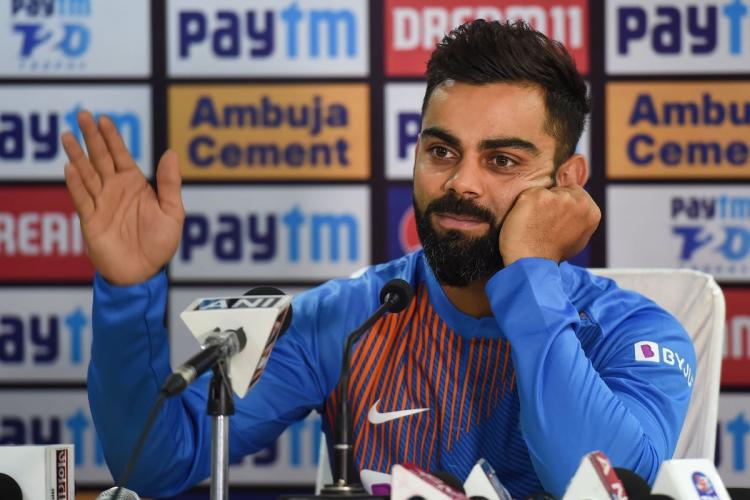
New Delhi, Dec 31: Virat Kohli was requested by everyone, including BCCI office bearers, to reconsider quitting T20 captaincy before the ICC T20 World Cup, said chairman of selectors Chetan Sharma on Friday, contradicting the Indian Test captain's version before leaving for South Africa.
In his explosive pre-departure press conference, Kohli had dropped a bomb shell by contradicting BCCI president Sourav Ganguly's claims that he was never asked by anyone not to quit the T20 captaincy and was informed about his sacking from ODI leadership only 90 minutes before the Test squad selection for the tour of South Africa.
Asked if the skipper's assertion was true, former pacer Chetan's reply was completely opposite.
"When meeting started, it was a surprise for everybody. If the World T20 is round the corner and you hear something like this, what will be your reaction? Everyone present in that meeting had told him that he should think hard about his decision (to quit T20 captaincy) and we can talk about it after the World Cup," Chetan answered a query from PTI during a media conference after the ODI team selection.
In fact, everyone told him to continue for "sake of Indian cricket", but apparently, he had made up his mind.
"All selectors felt at that time that this can affect us in the World Cup. It was told to Virat for sake of Indian cricket, please continue as the captain and it was told by everybody (BCCI president Sourav Ganguly and secretary Jay Shah) present in the meeting.
"The convenors were there, board officials were there. Sabhi ne bola hai (everyone told him), Who won't tell you? If this news comes to you, you are in a shock," Chetan said.
"But since we had a World T20 to play, we never wanted it (decision) to affect team. He (Kohli) had his plans and we respect him. He is a pillar of the team and if he has taken a decision we respect it. But yes, everybody told him to think about it," he said.
Let the Truth be known. If you read VB and like VB, please be a VB Supporter and Help us deliver the Truth to one and all.
Tribal man brings dead sister's skeleton to bank to withdraw money from her account
Keonjhar (PTI): A tribal man in Odisha's Keonjhar district on Monday brought the skeleton of his dead sister to a bank to withdraw the money deposited in her name, police said.
The incident occurred at Maliposi branch of Odisha Grameen Bank located at Patana block of Keonjhar district. The man was identified as Jeetu Munda (50) of Dianali village. He was seeking to withdraw Rs 20,000 from the bank account of his elder sister, Kalra Munda (56), who died on January 26, 2026.
"I have run several times to the bank, and the people there told me to bring the account holder to withdraw money deposited in her name. Though I told them that she had died, they did not listen to me and insisted on bringing her to the bank. Therefore, out of frustration, I dug the grave and brought out her skeleton as proof of her death," an illiterate Jeetu Munda told reporters.
Patana Police Station Inspector in charge (IIC) Kiran Prasad Sahu, who reached the bank after getting information, said, "Jeetu is an illiterate tribal man. He does not know what the legal heir or nominee is. The bank officials have failed to make him understand the procedure to withdraw money from the dead person's account."
However, after the incident, the police assured Jeetu Munda that they would facilitate the withdrawal of money from the bank account of his dead sister. Later, the skeleton was again buried at the graveyard in presence of police.
Meanwhile, local Block Development Officer (BDO) Manas Dandpat said that he was not approached by anyone for the legal heir of late Kalra Munda. "Today only, I came to know about it. We will see what can be done to resolve the issue," the BDO said.
Meanwhile, bank sources said that the nominee in Kalra Munda's bank account was also dead. Therefore, Jeetu Munda was the lone claimant over the money deposited in her name.
The local administration has directed the bank officers to make arrangements and ensure that Jeetu Munda, who is the only claimant as per the rules, gets the money as soon as possible.