Fake degree: No action against woman cricketer Harmanpreet
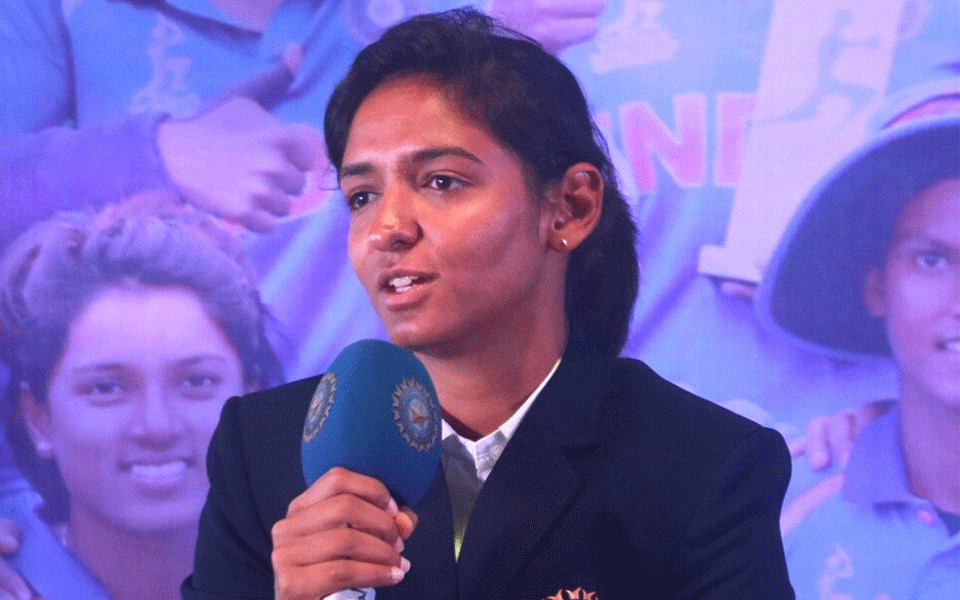
Chandigarh, July 10: The Punjab government will remove woman cricketer Harmanpreet Kaur the DSP's post for submitting a fake degree, but will not initiate any criminal proceedings against her, informed sources said on Tuesday.
Government and police sources said no criminal proceedings for forgery and cheating were in the offing against the Indian T20 women cricket team captain. The graduation certificate submitted by her to fulfil the eligibility criterion for becoming a Punjab Police DSP was found to be fake.
Enquiries by Punjab Police with the Chaudhary Charan Singh University in Meerut had revealed that Harmanpreet's graduation degree was not genuine and in fact she was never enrolled as a varsity student.
The state has now offered her a constable's post on the basis of her Class 12 pass certificate.
Harmanpreet was appointed Deputy Superintendent of Police on March 1, with Punjab Chief Minister Amarinder Singh and Director General of Police Suresh Arora pinning the stars on her uniform.
The Chief Minister had offered the DSP's post to Harmanpreet, who hails from Moga district, in July last year, following her scintillating performance in the Women's World Cup 2017.
Amarinder Singh had said that the Parkash Singh Badal government's refusal to accede to her request to join Punjab Police was an "injustice" to her.
Harmanpreet was earlier employed with the Railways as a Superintendent.
Amarinder Singh had intervened to seek a waiver for her from a bond signed with the Railways to enable her to join as DSP in Punjab. The state had, in February, received a formal communication from the Railways about the waiver.
The woman cricketer, who is leaving for England, has not reacted in detail, telling the media that she has no idea about the controversy over her degree.
Let the Truth be known. If you read VB and like VB, please be a VB Supporter and Help us deliver the Truth to one and all.
Rickelton's ton in vain as SRH beat MI by 6 wickets
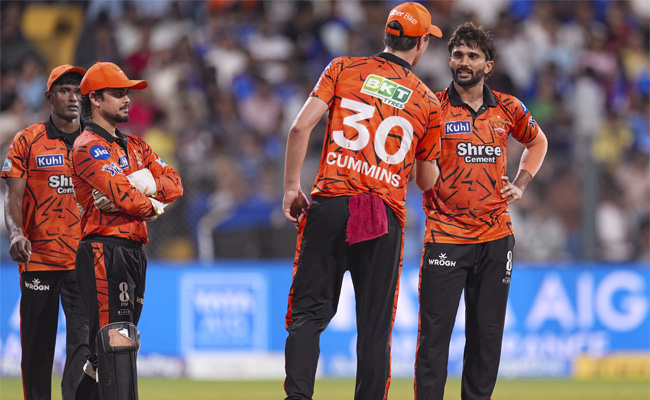
Mumbai (PTI): Ryan Rickelton's whirlwind unbeaten ton was overshadowed by Heinrich Klaasen's unbeaten 65 as Sunrisers Hyderabad defeated Mumbai Indians by six wickets in an IPL match here on Wednesday.
Chasing an imposing 244-run target, Travis Head (76 off 30) and Abhishek Sharma (45 off 24) shared 129 runs for the opening wicket to set the platform for SRH.
Klaasen (65 not out off 30 balls) then displayed his all-round hitting abilities to guide SRH home with the help of Nitish Kumar Reddy (21) and Salil Arora (30 not out off 10) in 18.4 overs.
Earlier, Rickelton's knock powered MI to 243 for five.
MI rode on a 93-run stand between Rickelton (123 not out off 55 balls) and Will Jacks (46 off 22) in 7.1 overs for the opening stand to power the side.
MI skipper Hardik Pandya scored a valuable 31 off 15 balls before being dismissed.
Praful Hinge (2/54), Eshan Malinga (1/29), Sakib Hasan (1/39) and Nitish Kumar Reddy (1/31) were the wicket-takers for SRH.
Brief Scores:
Mumbai Indian: 243 for 5 in 20 overs (Ryan Rickelton 123 not out; Praful Hinge 2/54).
Sunrisers Hyderabad: 249 for 4 in 18.4 overs (Travis Head 76, Heinrich Klaasen 65 not out; AM Ghazanfar 2/51).