Fiery pacers blast Bangladesh out for 150, India 86/1 on day 1
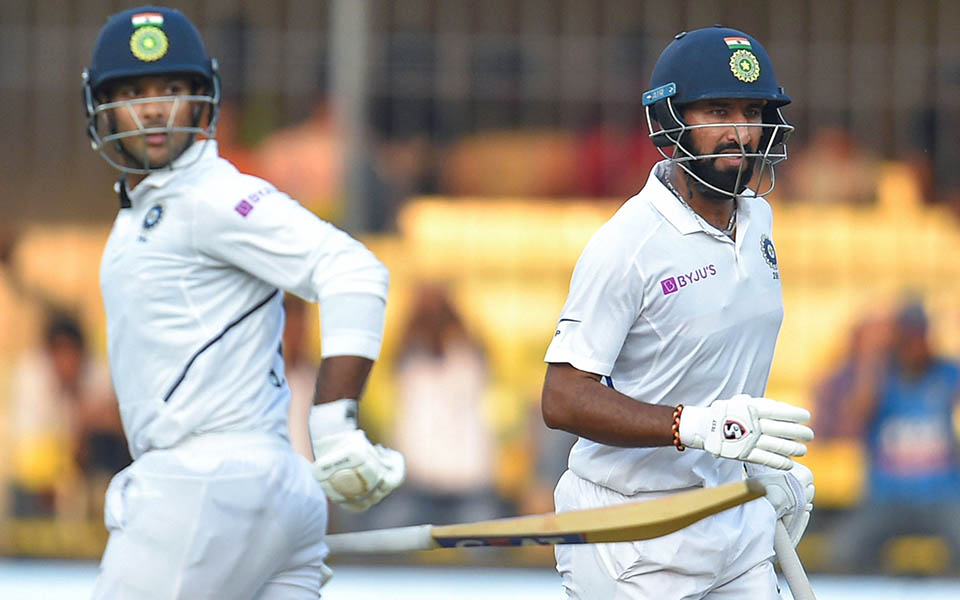
Indore, Nov 14: India's pace troika was at its menacing best against an under-confident Bangladesh, helping the home team seize control of the first Test here on the opening day itself.
On one of the bounciest tracks in recent times, Bangladesh were bundled out for 150 in 58.3 overs, lasting barely two sessions and a few overs more here on Thursday.
With ample time at their disposal, India ended the day at 86 for 1 in 26 overs, losing Rohit Sharma's (6) wicket to Abu Jayed.
The notable aspect during the Indian innings was Cheteshwar Pujara (46 batting) outscoring the more flamboyant Mayank Agarwal (37 batting) during their unbroken 72-run stand, leaving ominous signs for the four-man Bangladesh attack.
The first day's proceedings starkly highlighted the gulf between world's No.1 and No.9 Test sides.
Umesh Yadav (2/47 in 14.3 overs), Ishant Sharma (2/20 in 12 overs) and Mohammed Shami (3/27 in 12 overs) made life difficult for a team whose batsmen lacked both in technique and temperament.
A luckless Ravichandran Ashwin (2/43 in 16 overs), let down by Ajinkya Rahane in the slips cordon, also had a couple of clean-bowled dismissals in his kitty in the post-lunch session.
The three Indian pacers consistently bowled at 140 kmph, with seam, swing and bounce making life miserable for Bangladeshi batsmen.
Each of the three displayed different qualities and it was evident from the manner of dismissals.
Ishant's bowling was about disconcerting bounce from length that had opener Shadman Islam caught behind and the occasional fuller delivery holding its line that forced Liton Das to edge one to Virat Kohli in the slips.
For Umesh, it started with brisk pace and getting it to seam into other opener Imrul Kayes and making him expect more incoming deliveries. Just when Kayes was getting used to a pattern, Umesh produced away going deliveries for the left-hander, squaring him up and the edge flew to slips.
He again came in the post-tea session during which the tailenders looked scared, retreating towards square leg in fear of getting hurt.
Mohammed Shami, probably the craftiest among the contemporary Indian pacers, showed there is no one better when it comes to getting reverse swing with 50-over old SG Test ball.
Mushfiqur Rahim (43), Bangladesh's top scorer, who led a charmed life and was dropped twice, didn't have a clue when one swung back to knock the stumps back after he was beaten by away going deliveries.
The next one by Shami swung even more as Mehidy Hasan Miraj (0) was adjudged leg-before although a DRS call could have saved him had he opted for one.
In the first session, Shami had dismissed Mohammed Mithun with conventional inswing.
Even without Jasprit Bumrah, who is nursing a stress fracture, the unit looked so formidable that one could sympathise with Bangladeshi batsmen facing their combined might.
They attacked relentlessly and it didn't matter that India weren't exactly having a great day as far as slip catching was concerned. Umesh could have got Mushfiqur early had Kohli latched on to one in the third slip.
Ashwin had both Mushfiqur and Mahmudullah Riyad dropped by Rahane at first slip.
It didn't cost the team much but the frustrated bowler then decided that breaching the defence was the best option as Mominul Haque (36) and Mahmudullah were dismissed due to poor judgement and shot selection respectively.
First he angled one to left-hander Mominul, who thought it will be a conventional off-break and decided to leave the delivery.
To his horror, it came in with the angle to peg the off-stump back.
Mahmudullah was lucky when Rahane dropped a regulation catch at slips but a rank bad shot brought about his downfall.
The right-hander tried to sweep Ashwin from outside the off-stump and in the process was bowled round the legs, leaving all three stumps exposed.
Let the Truth be known. If you read VB and like VB, please be a VB Supporter and Help us deliver the Truth to one and all.
Bengaluru Police bust major drug network; 16 arrested, narcotics worth Rs 36.67 crore seized

Bengaluru: In a major crackdown on drug trafficking and illegal narcotics trade, Bengaluru City Police have arrested 16 accused persons and seized narcotic substances worth Rs 36.67 crore.
According to Bengaluru City Police Commissioner Seemanth Kumar Singh, those arrested include four foreign nationals, eight persons from other states and four locals. Police said the network had interstate as well as international links.
Police recovered 9 kg 64 grams of MDMA, 5 kg 195 grams of hydro ganja, 19,755 LSD strips, 156 grams of heroin, 618 grams of charas, 332 grams of cocaine, 315 grams of drug-mixed gummies and 11 kg 470 grams of ganja from the accused.
The Commissioner said the action was carried out as part of a major anti-drug operation in the city. The network was busted with the support of the CCB Narcotics Control Squad and police stations of Bagaluru, Adugodi, Chikkajala, HSR Layout, Yeshwanthpur, Jalahalli and Jnanabharathi.
Cases were registered in CCB, East Division and West Division police stations based on specific intelligence received on different dates, following which raids were conducted.
Preliminary investigation revealed that the accused were procuring drugs at lower prices from foreign, interstate and local sources and selling them in Bengaluru at higher rates.
Police said college students and working professionals were among the main targets of the accused.