Former India captain Sourav Ganguly takes over as 39th BCCI president
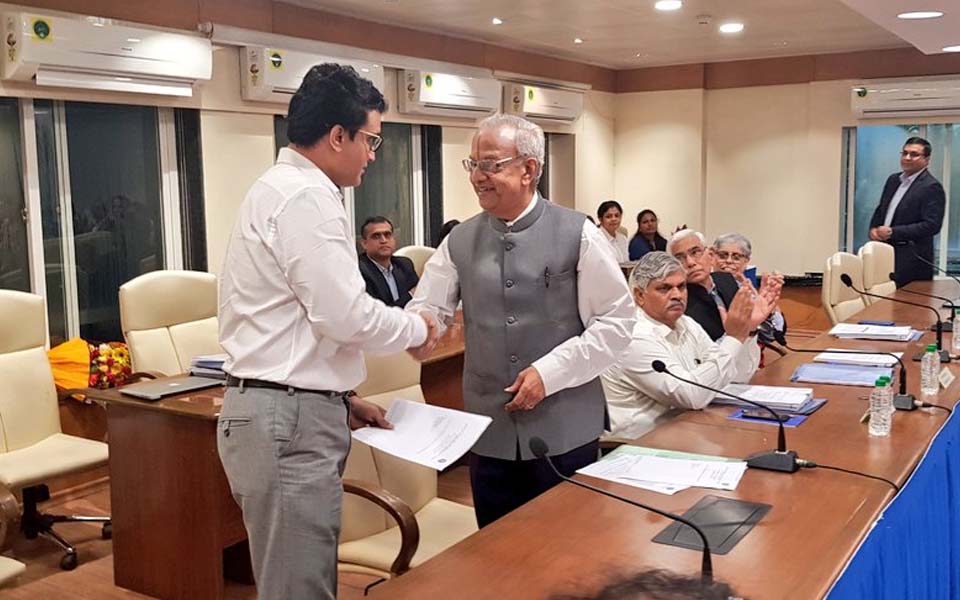
Mumbai, Oct 23: Former India captain Sourav Ganguly on Wednesday took over as the BCCI's 39th president, becoming the biggest name to head the world's richest cricket board.
The 47-year-old Ganguly was officially entrusted with the task of heading Indian cricket for the next nine months at the BCCI's General Body meeting here, ending a tumultuous 33-month reign of the Supreme Court-appointed Committee of Administrators (CoA).
"It's official - @SGanguly99 formally elected as the President of BCCI," the BCCI posted on its Twitter page.
Ganguly's appointment was finalised last week.
In the meeting that was also a reunion of sorts for some of the familiar faces associated with the board before the CoA's institution, Union Home Minister Amit Shah's son Jay Shah was made the secretary.
During his tenure, Ganguly will look to coordinate with old guard such as former President N Srinivasan and ex-Secretary Niranjan Shah, whose children are now part of the BCCI.
Mahim Verma of Uttarakhand became the new vice-president.
Former BCCI president and current junior finance minister Anurag Thakur's younger brother Arun Dhumal became the treasurer while Kerala's Jayesh George took the joint secretary's position.
Ganguly, who took over as India captain during one of its darkest hours following the 2000 match-fixing scandal, will need to demit office by the end of July next year as per the provisions of new constitution, which makes 'Cooling Off' period mandatory after six years in office.
One of the most elegant left-handers to have represented India, Ganguly is expected to make use of his experience gained as the secretary and later president of Cricket Association of Bengal (CAB).
He has set a few goals and the primary ones are restructuring of first-class cricket as well as getting the administration back in shape along with getting India's position of reverence back in the corridors of International Cricket Council (ICC).
With the conflict of interest rules in place, Ganguly will face the challenge of having quality cricketers on board as far as the Cricket Advisory Committee (CAC) and national selection committees are concerned.
His take on veteran Mahendra Singh Dhoni's international future, Day/Night Test cricket, permanent Test centres will also be dissected.
His tenure begins at a time when the International Cricket Council has left India out of its newly-formed working group, which might affect the country's share in the ICC revenue.
The group has been formed to figure out a new governance structure for the world body.
It's official - @SGanguly99 formally elected as the President of BCCI pic.twitter.com/Ln1VkCTyIW
— BCCI (@BCCI) October 23, 2019
Let the Truth be known. If you read VB and like VB, please be a VB Supporter and Help us deliver the Truth to one and all.
Rickelton's ton in vain as SRH beat MI by 6 wickets
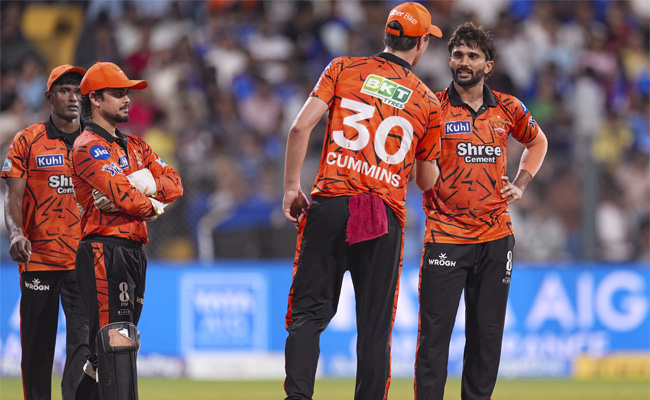
Mumbai (PTI): Ryan Rickelton's whirlwind unbeaten ton was overshadowed by Heinrich Klaasen's unbeaten 65 as Sunrisers Hyderabad defeated Mumbai Indians by six wickets in an IPL match here on Wednesday.
Chasing an imposing 244-run target, Travis Head (76 off 30) and Abhishek Sharma (45 off 24) shared 129 runs for the opening wicket to set the platform for SRH.
Klaasen (65 not out off 30 balls) then displayed his all-round hitting abilities to guide SRH home with the help of Nitish Kumar Reddy (21) and Salil Arora (30 not out off 10) in 18.4 overs.
Earlier, Rickelton's knock powered MI to 243 for five.
MI rode on a 93-run stand between Rickelton (123 not out off 55 balls) and Will Jacks (46 off 22) in 7.1 overs for the opening stand to power the side.
MI skipper Hardik Pandya scored a valuable 31 off 15 balls before being dismissed.
Praful Hinge (2/54), Eshan Malinga (1/29), Sakib Hasan (1/39) and Nitish Kumar Reddy (1/31) were the wicket-takers for SRH.
Brief Scores:
Mumbai Indian: 243 for 5 in 20 overs (Ryan Rickelton 123 not out; Praful Hinge 2/54).
Sunrisers Hyderabad: 249 for 4 in 18.4 overs (Travis Head 76, Heinrich Klaasen 65 not out; AM Ghazanfar 2/51).