Former Pakistan skipper Ramiz Raja formally elected as PCB chairman
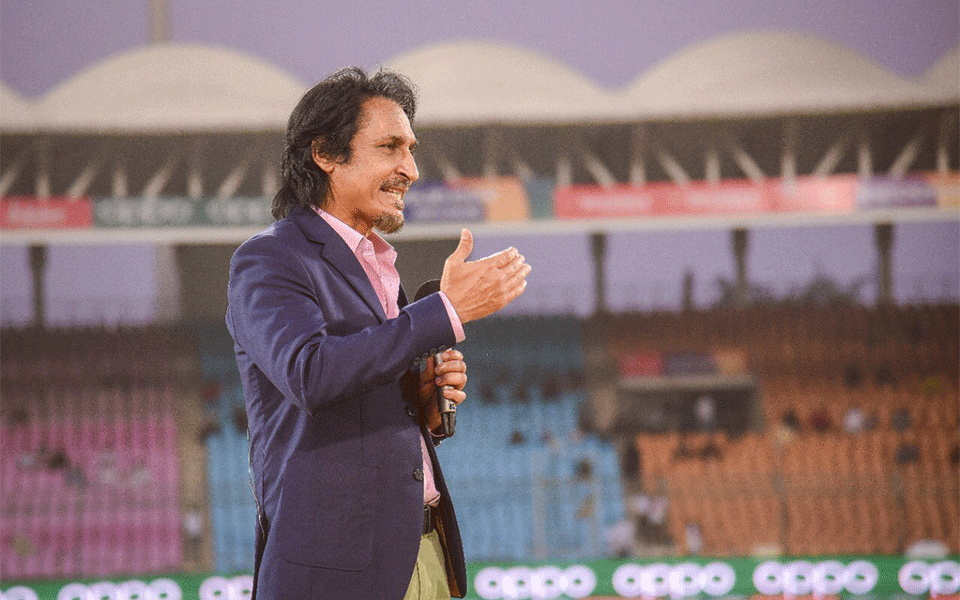
Lahore, (PTI): Former captain Ramiz Raja was on Monday unanimously elected as the chairman of the Pakistan Cricket Board (PCB) for a three-year term, succeeding Ehsan Mani who stepped down from the post last month.
This is Raja's second stint with the PCB. He had served as the Board's chief executive from 2003 to 2004.
The special meeting was presided by PCB election commissioner, Justice (retd) Sheikh Azmat Saeed at the National High Performance Centre.
Raja was nominated for the position by Prime Minister Imran Khan, who is also the patron-in-chief of the Board. Addressing a media conference after taking over, Raja promised to empower the national captain.
"I am not going to be that Chairman who will deflect responsibility to others. I am prepared to face everything. There are two things on which I am not going to be on the back-foot, cricket and broadcasting because I have ample experience in both areas," he said at a media conference here after taking over.
"I am very clear in my mind that cricket may have changed over the years but one thing remains the same and that is total authority must be with the team captain because he is the one who has to make the team fight on the field and get results," Raja added
The 59-year-old commentator, who was part of Pakistan's triumphant campaign in the 1992 World Cup, has become the fourth international cricketer to head the PCB after Abdul Hafeez Kardar (1972-1977), Javed Burki (1994-1995) and Ijaz Butt (2008-2011).
Raja, who played more than 250 international matches for Pakistan from 1984 to 1997 and scored 8,674 runs, replaces the country's veteran cricket administrator Mani.
Raja said one of his biggest aims is to bring back the glory days of the Pakistan men's team that was once a force to reckon with in the international arena.
Addressing the Board of Governors (BoG) following his election, Raja said: "I am thankful to all of you for electing me as the PCB chairman and look forward to working with you to ensure Pakistan cricket continues to thrive and grow stronger, both on and off-the-field."
"One of my key focuses will be to help introduce in the Pakistan men's cricket team the same culture, mind-set, attitude and approach that once made Pakistan one of the most feared cricket playing nations.
"As an organisation, we all need to get behind the national team and provide them the desired assistance and support so that they can produce that brand of cricket, which the fans also expect from them each time they step on to the field of play."
In 2003-04, he had also served as the CEO of the Board under the chairmanship of Shahryar Khan.
The former opener added, "Obviously, as a former cricketer, my other priority will be to look into the welfare of our past and present cricketers.
"The game has and will always be about the cricketers and, as such, they deserve more recognition and respect from their parent institution."
Let the Truth be known. If you read VB and like VB, please be a VB Supporter and Help us deliver the Truth to one and all.
4 held for sexually assaulting woman, girl on moving bus after social media alert in UP's Agra

Agra (UP) (PTI): Four people were arrested, after a prompt response by police following a social media alert, for allegedly sexually assaulting a woman and a girl inside a moving bus here, officials said on Tuesday.
According to an official police statement, at 12:27 am on April 27, information was received on the social media platform X about an incident of sexual assault on a bus travelling from Kanpur to Ahmedabad, which was approaching Namner crossing in Agra.
Acting under the direction of Police Commissioner Deepak Kumar, the Agra Police social media team immediately alerted the Rakabganj police station within minutes and coordinated with the victims to confirm the incident and obtain the exact location, it stated.
Police teams launched intensive checking at Namner crossing and intercepted the bus as it reached the spot. The four accused involved in the incident were apprehended on the spot, and legal action was initiated against them, the statement said.
The police said the swift response and coordination between the social media team and field units ensured timely action, bringing relief to the victims and other passengers, who expressed gratitude towards the police, it added.