Franz Beckenbauer, who won the World Cup both as player and coach for Germany, passes away at 78
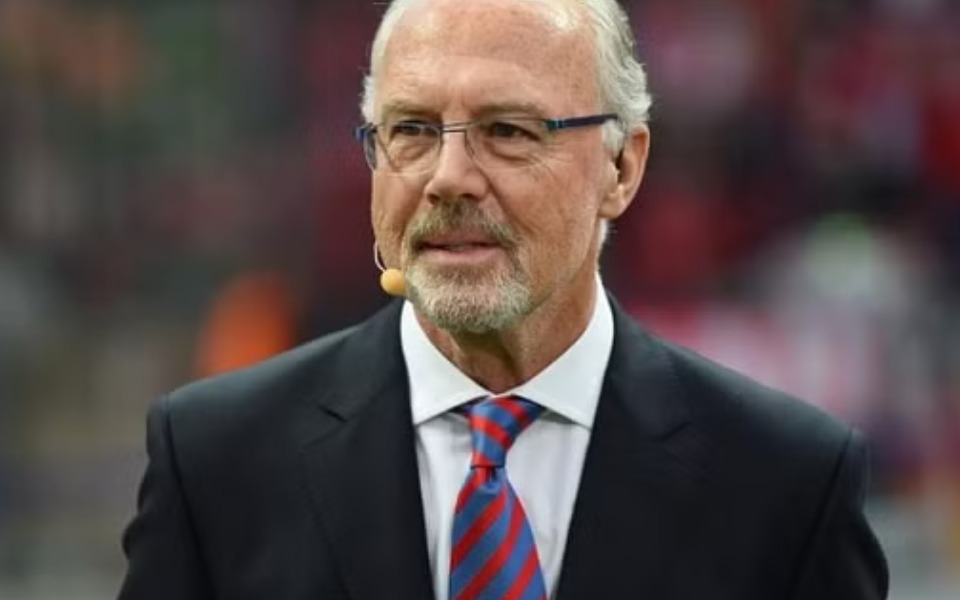
Munich, Jan 8: Franz Beckenbauer, who won the World Cup both as player and coach and became one of Germany's most beloved personalities with his easygoing charm, has died, news agency dpa reported on Monday. He was 78.
"It is with deep sadness that we announce that my husband and our father, Franz Beckenbauer, passed away peacefully in his sleep yesterday, Sunday, surrounded by his family," the family said in a statement to dpa, the German news agency. "We ask that we be allowed to grieve in peace and be spared any questions."
The statement did not provide a cause of death. The former Bayern Munich great had struggled with health problems in recent years.
Beckenbauer was one of German soccer's central figures. As a player, he reimagined the defender's role in soccer and captained West Germany to the World Cup title in 1974 after it had lost to England in the 1966 final. He was the coach when West Germany won the tournament again in 1990, a symbolic moment for a country in the midst of reunification, months after the Berlin Wall fell.
Beckenbauer's death comes just two days after the announcement that Mario Zagallo, the Brazilian who became the first person to win the World Cup as a player and coach, had died at the age of 92.
Beckenbauer was also instrumental in bringing the highly successful 2006 World Cup to Germany, though his legacy was later tainted by charges that he only succeeded in winning the hosting rights with the help of bribery. He denied the allegations.
"We did not want to bribe anyone and we didn't bribe anyone," Beckenbauer, who headed the World Cup organizing committee, wrote in his last column for daily tabloid Bild in 2016.
Beckenbauer and three other members of the committee were formally made criminal suspects that year by Swiss prosecutors who suspected fraud in the true purpose of multi-million euro payments that connected the 2006 World Cup with FIFA. But he was eventually not indicted in 2019 for health reasons and the case ended without a judgment when the statute of limitations expired in 2020 amid delays to the court system caused by the coronavirus pandemic.
Beckenbauer was in 2014 briefly suspended by FIFA's ethics committee from all football-related activity for failing to cooperate with prosecutor Michael Garcia's probe of alleged corruption in the 2018 and 2022 World Cup votes. The suspension was lifted during the 2014 World Cup in Brazil when he agreed to cooperate.
The allegations damaged Beckenbauer's standing in public perception for the first time. Until then, Beckenbauer had seemingly been unable to say or do anything wrong. Germans simply loved him.
"He did everything that a German is not supposed to do," former Bayern Munich teammate Paul Breitner once said of the man popularly known as "Der Kaiser."
"He got divorced, he left his children, took off with his girlfriend, got into trouble with tax collectors, left his girlfriend again.
"But he is forgiven for everything because he's got a good heart, he's a positive person and he's always ready to help. He doesn't conceal his weaknesses, doesn't sweep his mistakes under the carpet," Breitner said.
The son of a post official from the working-class Munich district of Giesing, Beckenbauer became one of the greatest players to grace the game in a career that also included stints in the United States with the New York Cosmos in the late 1970s and early 1980s.
Born on September 11, 1945, months after Germany's surrender in World War II, Beckenbauer studied to become an insurance salesman but he signed his first professional contract with Bayern when he was 18.
"You are not born to become a world star in Giesing. Football for me was a deliverance. Looking back, I can say: Everything went according to how I'd imagined my life. I had a perfect life," Beckenbauer told the Sueddeutsche newspaper magazine in 2010.
Beckenbauer personalised the position of "libero," the free-roaming nominal defender who often moved forward to threaten the opponent's goal, a role now virtually disappeared from modern football and rarely seen before his days.
An elegant, cool player with vision, Beckenbauer defined as captain the Bayern Munich side that won three successive European Cup titles from 1974 to 1976.
In his first World Cup as player in 1966, West Germany lost the final to host England as Beckenbauer chased Bobby Charlton around the field having been given the task of marking the England standout.
Four years later, with his arm strapped to his body because of a shoulder injury, Germany lost a memorable semifinal to Italy.
Finally, in 1974 at home, Beckenbauer captained West Germany to the title.
Beckenbauer left Bayern for New York in 1977 and later recalled fondly the time spent in the United States.
"From Munich-Giesing to New York City, that was a huge step," Beckenbauer said.
Beckenbauer said the decisive step in luring him to the Cosmos was the helicopter ride the club officials gave him from the roof of the Pan Am Building across Manhattan to the Giants stadium in New Jersey.
"That was then the most modern stadium in the world, with VIP boxes. We didn't have that in Europe. As we flew over the stadium, I told them, Fine, stop it, I am coming.'"
In that 2010 interview, Beckenbauer also recalled visits to famed nightclub Studio 54 with fellow Cosmos stars Pele and Carlos Alberto.
Beckenbauer missed the 1978 World Cup because the Germans decided not to invite players playing abroad. He returned to Germany in 1980, spent two seasons with Hamburger SV and won another Bundesliga championship, his fifth before returning for a final season at the Cosmos.
Although he had never coached before, Beckenbauer was hired to revive West Germany in 1984 after a flop at the European Championship.
West Germany made it to the final of the 1986 World Cup, losing to Diego Maradona's Argentina in Mexico City. Although West Germany failed to win the 1988 Euros title at home, it went to the final of the 1990 World Cup and defeated Argentina in the final in Rome, another highlight in the year after the fall of the Berlin Wall.
The penalty goal came from Andreas Brehme, a defender Beckenbauer had once told to "play the piano, pay the flute but not football."
While his team celebrated, Beckenbauer cut a lonely figure walking and reflecting at the Olympic Stadium.
Later, at the news conference, he said he was "sorry for the rest of the world" because a united Germany would be unbeatable for years to come. But Germany had to wait 24 years before winning another World Cup title.
Once he left for New York, Beckenbauer never had a home in Munich. He lived just across the border in the Austrian Alpine resort of Kitzbuehel, where taxes were lower.
Beckenbauer was a voracious traveller and personally visited all 31 countries who had qualified for the World Cup in Germany in 2006.
Beckenbauer said he got the urge to travel as a child by collecting pictures for a sticker album. "There were photos from Africa, America. It got me interested ... but I never thought I'd experience it personally."
"There are many who travel but who see nothing because they are too busy. I was always curious."
Beckenbauer retired from the West Germany job after coaching the team to the 1990 World Cup triumph. The Berlin Wall had fallen the year before and Germany was in the process of reunifying after the Cold War. The final was the last tournament game played by a West Germany-only team.
He didn't have much success at coaching Marseille, but won the Bundesliga title with Bayern in 1994 and the UEFA Cup in 1996, both after taking over as coach late in the season. He later became Bayern's president, until leaving most functions when he turned 65 in 2010.
Beckenbauer's legal issues around the 2006 World Cup continued into his retirement, but he remained a much-loved figure in German soccer and society.
Let the Truth be known. If you read VB and like VB, please be a VB Supporter and Help us deliver the Truth to one and all.
T'gana RTC strike: Talks between govt, employees successful

Hyderabad (PTI): Talks between employees of Telangana State Road Transport Corporation (RTC) who were on strike and the state government concluded successfully on Friday as the government agreed to the key demands of the workmen.
Following a day-long marathon of talks between the leaders of the employees' Joint Action Committee (JAC) and the cabinet sub-committee, the government announced after midnight that it acceded to the demands, including a merger of RTC with the government, 11 per cent pay revision and elections to the employees' unions.
A committee comprising officials and employee leaders would be appointed over the merger of RTC with the government, it said.
The RTC management has also agreed to address the remaining issues as well, an official release said.
The employees would call off their strike and the RTC buses would hit the roads shortly, it said.
The employees had been on an indefinite strike since April 22 over a series of demands, including the merger of RTC with the government.
Earlier in the day, a driver of the RTC, who attempted suicide on April 23 during the strike, died at a hospital here in the early hours of Friday.
Shankar Goud, a 55-year-old driver, set himself ablaze by pouring petrol at Narsampet in Warangal district when the employees were staging a protest on Thursday in support of their demands.
Goud suffered serious burns, was initially admitted to a state-run hospital in Warangal, and later shifted to a super-speciality hospital in Hyderabad for advanced treatment.
"He succumbed (to injuries) at about 1.30 am on Friday," a senior official said.
The driver’s body was taken to his relative’s village, Muttojipet in Warangal district, for funeral rites.
Tension prevailed in Muttojipet as his family members and RTC employees attempted to take the body to the Narsampet bus station, where he worked, to enable his colleagues to pay their last respects. However, police did not permit this, citing law-and-order concerns.
This led to a deadlock before the funeral could proceed.
Union Minister Bandi Sanjay Kumar criticised the Telangana government for not allowing the body to be taken to the Narsampet bus station.
Kumar, Minister of State (Home), visited Muttojipet village in Warangal district, where the funeral was held, and paid homage to Goud.
“They (family members) want to take the body to the bus depot for five minutes. Is the RTC bus depot in Pakistan or Bangladesh? They are emotionally attached to taking the body there. The government is hurting sentiments and creating fear among RTC employees,” Kumar told reporters.
He also expressed anger at the police for not allowing the body to be taken to the bus station and staged a protest, according to a release from his office.
RTC employees and BJP workers attempted to take the mortal remains in an ambulance to Narsampet, but were stopped by the police.
Later, after discussions with the police, the family members and RTC employees agreed to conduct the funeral in the village.
Sanjay Kumar, stating he would abide by the family’s decision, left the village after the funeral was conducted there.
Transport Minister Ponnam Prabhakar said an ex gratia of Rs 10 lakh, a house, and a government job would be provided to the kin of Goud.
Chief Minister A Revanth Reddy expressed shock over the employee’s death and conveyed deep condolences to the grieving family, according to the release.
The RTC employees’ JAC had earlier announced an agitation programme from April 24 to 29, including silent marches and submission of memorandums to MLAs and other leaders.