
Government will decide on T20 World Cup participation: PCB chief Naqvi after Bangladesh ouster
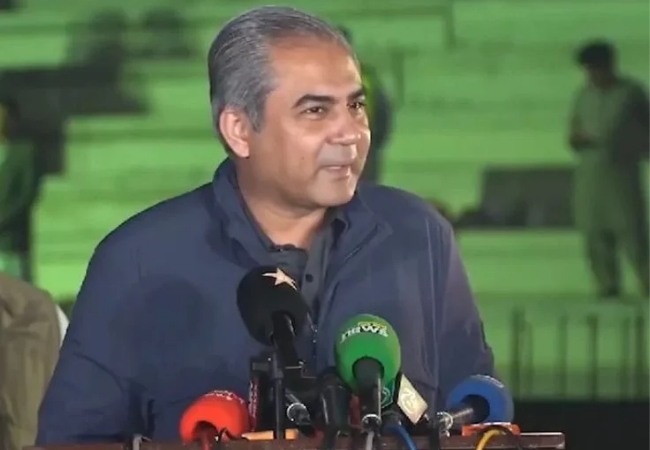
Lahore (PTI): PCB chairman Mohsin Naqvi on Saturday said the Pakistan government will take the final and binding decision on whether its national team will participate in the upcoming T20 World Cup, following Bangladesh's removal from the tournament.
Addressing a press conference here, Naqvi said the matter would be placed before Prime Minister Shahbaz Sharif, who is currently out of the country, once he returns.
"Whether we play in the T20 World Cup or not, the decision will be taken by the government," Naqvi said.
"Our PM (Shahbaz Sharif) is out of the country. When he comes, we will take advice from him. The decision by the government will be final and binding and if they say no then they (ICC) may invite any other team."
Bangladesh lost their place in the T20 World Cup after refusing to travel to India citing security reasons, a move that prompted the International Cricket Council (ICC) to replace them with Scotland.
Pakistan are scheduled to play all their matches in Sri Lanka as per an agreement with the BCCI.
Pakistan Cricket Board (PCB) was the only member nation to support Bangladesh in their demand to move their matches to Sri Lanka as 14 others voted against it.
Naqvi said Bangladesh, whom he described as a “big stakeholder” in world cricket, had been unfairly treated by the ICC.
"Bangladesh is a big stakeholder and they have been unfairly treated in this case. This I maintained in Wednesday's meeting as well and their stance has many factors which I will tell when the situation arrives," he said.
The PCB chairman also questioned what he termed selective decision-making by the global body, alleging that "one member nation" was exerting undue influence.
"One country is dictating. When the ICC changed venues for Pakistan and India in a favour, then why it was not done for Bangladesh?” asked Naqvi.
"Our policy and position is clear when the time comes and the government takes a decision everyone will know about it. We are not under the ICC, we are subservient to our government. Once the PM returns he will decide. We will follow government directives."
Let the Truth be known. If you read VB and like VB, please be a VB Supporter and Help us deliver the Truth to one and all.
KMC Mangaluru team led by Dr. Haroon files patent for absorbent pads for elderly women
Aims to address urinary incontinence in elderly women
_vb_78.jpeg)
Mangaluru: Kasturba Medical College (KMC) has filed a patent application for “Absorbent Pads” designed to address urinary incontinence among elderly women, a condition that remains largely underreported despite its widespread impact.
Urinary incontinence does not command urgency like a heart attack, nor does it evoke the same collective response as more visible illnesses. However, for those living with it, the burden is constant, intimate, and often isolating.
There is a gradual and often unspoken impact on daily life. It begins with hesitation, declining invitations, avoiding travel, and choosing silence over conversation. Over time, this can lead to withdrawal, where fear of embarrassment starts shaping everyday decisions. For many elderly women, dignity becomes tied to small, often invisible compromises, including limiting outings or adjusting routines.
What makes this condition particularly poignant is not just its prevalence, but its invisibility. It is endured, not expressed. Accepted, not addressed.
It is in this context that the recent innovation assumes importance. The team at KMC, which includes clinicians such as Dr Haroon Hussain, has approached the issue not merely from a technical standpoint but from the perspective of lived experience.
The proposed solution, biodegradable, antimicrobial absorbent pads with improved fluid control and reduced irritation, aims to go beyond basic functionality, addressing comfort, safety, and dignity.
The development also reflects the role of academic institutions in addressing everyday health challenges. When research focuses not only on major diseases but also on conditions that affect quality of life, it reinforces the broader purpose of healthcare.
However, experts note that innovation alone cannot fully address the issue. Urinary incontinence continues to be underreported, often dismissed as an inevitable consequence of ageing. Many women do not seek medical help, not due to a lack of solutions, but because of stigma and discomfort associated with discussing the condition.
This creates a paradox, a widespread issue that is often experienced in isolation.
Medical professionals emphasise that greater awareness and open conversations are essential. Families must learn to speak about such issues without embarrassment. Healthcare providers must create spaces where patients feel heard without judgment.
The significance of this innovation lies not only in its technical aspects but also in what it brings into focus, that even the most private discomforts deserve public attention.
The patent application was filed by a team comprising Dr. Haroon Hussain, Dr. Sameena, Dr. Ritu Raval of Manipal Institute of Technology, Syed Ayaan Hussain Rizvi, and Suzanne Riya Dsouza.
_vb_49.jpeg)
_vb_90.jpeg)