Gujarat Titans beat RCB by six wickets in IPL
Mumbai(PTI): Gujarat Titans extended their dominance at the top of the table with a six-wicket win over Royal Challengers Bangalore in the Indian Premier League here on Saturday and inched closer towards clinching a play-off spot in their inception year.
After failing multiple times, Virat Kohli finally came out out of a prolonged slump in form by registering his first IPL fifty in 14 matches, including nine this season, as Royal Challengers Bangalore posted a challenging 170 for six.
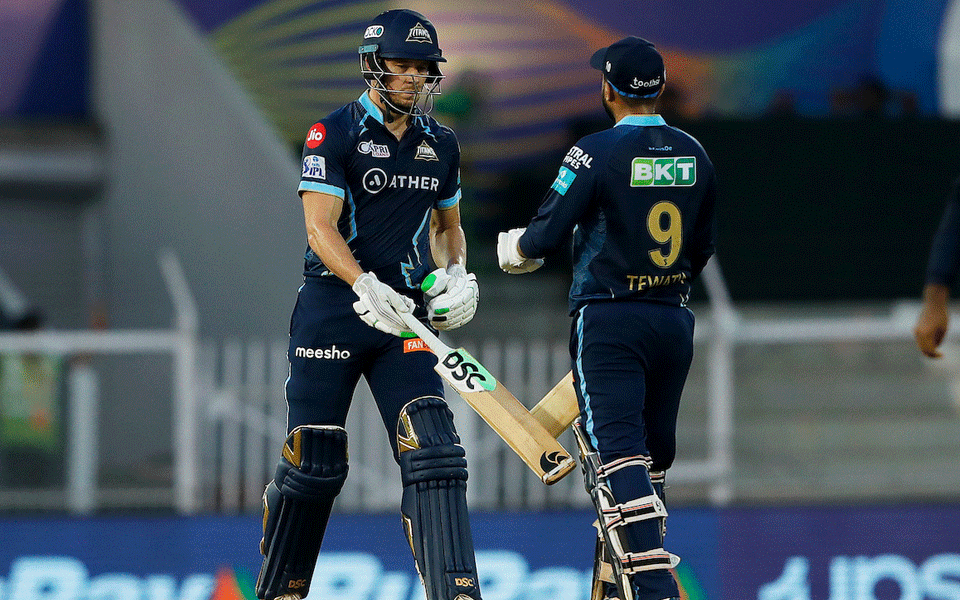
In reply, Rahul Tewatia (43 not out) and David Miller (39 not out) did the job for GT after the table toppers were struggling at 95 for four in the 13th over. With 16 points which has been the magic mark, Titans are well on course towards a top-two finish at the end of league stage.
On the day, Kohli made 58 off 53 balls before walking back to the dugout amid a standing ovation at the Wankhede Stadium. Rajat Patidar blasted a 32-ball 52 -- his maiden IPL fifty -- while Glenn Maxwell blazed away to 33 in 18 deliveries to prop up RCB
The returning Pradeep Sangwan was excellent with the ball, finishing with figures of 2/19, while Rashid Khan gave away just 29 runs in his four over to check the flow of runs in the middle overs.
GT were off to a sound start with Wriddhiman Saha (31) and Shubman Gill (29) putting on 51 runs before Wanindu Hasaranga effected the first breakthrough by removing the former.
Left-arm spinner Shahbaz Ahmed had Shubman Gill trapped in front of the wicket. GT skipper Hardik Pandya (3) once again got out cheaply, falling to Shahbaz.
Sai Sudharsan chipped in with a 14-ball 20 before Hasaranga picked up his second wicket, the batter caught by substitute keeper Anuj Rawat as Dinesh Karthik did not take to the field.
Sudharsan's dismissal left RT at 95 for four with the innings entering the 14th over.
Needing 71 from six overs, David Miller hit Hasaranga for a six and four to collect 13 runs, and then, two boundaries by Rahul Tewatia and four off a leg bye got GT 15 runs from a Mohammed Siraj over.
Harashl Patel bowled an economical 17th over before Tewatia flicked Josh Hazlewood for a six over fine-leg. Two more fours followed in the same over as GT closed in on yet another win.
Earlier, Mohammed Shami pulled out twice in his run up, the false starts leaving the umpire annoyed, before the seasoned India seamer beat Kohli with his late movement.
Out in the middle was a batting maestro battling a lean patch but it didn't quite look like that really when the former India captain played Shami for two lovely boundaries -- one down the ground past mid-of and the second a flick square of the wicket on the leg-side.
RCB's top-order woes continued, though, as left-arm seamer Sangwan marked his return to the league with the wicket of rival skipper Faf du Plessis in his very first over.
Fresh from his invaluable half-century in the previous game, Wriddhiman Saha had no problem holding on to du Plessis' thick outside edge after the bowler had set him up.
Alzarri Joseph was introduced, and he saw Kohli play a classic cover drive and then pull a short one over the mid-wicket region for a boundary.
In came Lockie Ferguson and the New Zealand pacer's low full toss was smashed over long-on by Kohli, who followed that up with a four towards backyard point.
Even as Kohli was getting into the groove, Patidar was gaining in confidence, thanks to the flurry of confident strokes that flowed from his willow during their 99-run association.
Alzarri bowled one short and Patidar pulled him over deep mid-wicket for a six and found a four in the next ball to close in on his maiden IPL fifty. He got there soon, reaching the landmark in only 29 balls with a four off Ferguson.
There was a bigger roar at the ground just before that as Kohli reached his half-century in 45 balls.
Patidar took the risks and largely succeeded, helping Kohli to settle down and get som runs under his belt.
Sangwan got his second of the match when Patidar top-edged the seamer, and Kohli too failed to convert his fifty into a bigger score as a Shami delivery made its way through, even as the batter tried to make room and play it through cover.
Let the Truth be known. If you read VB and like VB, please be a VB Supporter and Help us deliver the Truth to one and all.
It's govt's responsibility to support youth who dare to dream: Omar Abdullah
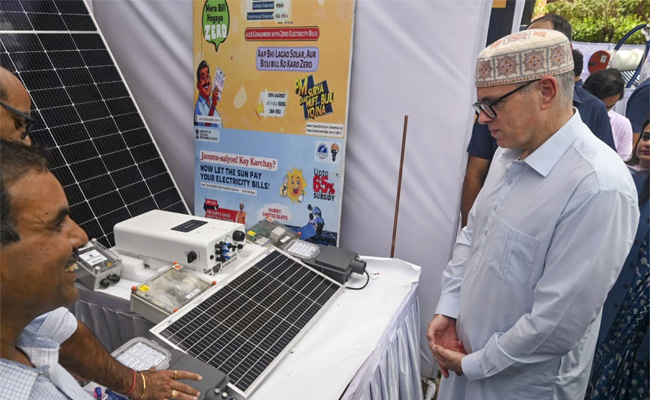
Jammu (PTI): Jammu and Kashmir Chief Minister Omar Abdullah on Monday said the government may not be able to provide jobs to everyone, but it can create an ecosystem for youngsters to become entrepreneurs and innovators.
It is the responsibility of the government to support youth who dare to dream, he said.
After inaugurating the 11th National Conference and Exhibition on Emerging and Innovative Trends in Engineering Technology (NCEEITET) at the Government College of Engineering and Technology (GCET) in Jammu, Abdullah said, “We may not be able to provide jobs to everyone, but we can certainly create an environment where our youngsters become entrepreneurs and innovators.”
The two-day conference is being organised by the GCET in collaboration with the Indian Institute of Technology-Kharagpur and the World University Consortium (WUC).
Addressing the gathering, Abdullah assured that all necessary steps would be taken to strengthen infrastructure and support systems at the GCET, ensuring that it continues to evolve as a premier institution.
The chief minister also inaugurated a new building for the School of Architecture in the college, built at Rs 19.71 crore.
Stressing the need to balance modernity with the region’s cultural and historical identity, Abdullah said, “Not every building needs to be made of glass and steel. Our structures must reflect our heritage and preserve our cultural ethos.”
Highlighting the role of emerging technologies such as artificial intelligence and machine learning, Abdullah said they could significantly improve tourism management, visitor experience and service delivery in Jammu and Kashmir.
However, he cautioned that technological advancement should complement human effort rather than replace jobs, especially in a region where unemployment remains a concern.
The chief minister said that attracting tourists to Jammu and Kashmir was not difficult, but ensuring repeat visits required consistently enriching experiences and better infrastructure across tourism segments, including pilgrimage, border and leisure tourism.
To address the infrastructure gaps in the college, Abdullah announced that funds would be provided this year for the construction of an auditorium.
He also assured support for setting up an incubation centre in GCET.
During the event, Abdullah also released the e-proceedings of the conference, comprising 28 shortlisted research papers.