Harmanpreet's double strike hands India 3-1 win over Pakistan in ACT hockey
takes team closer to semis
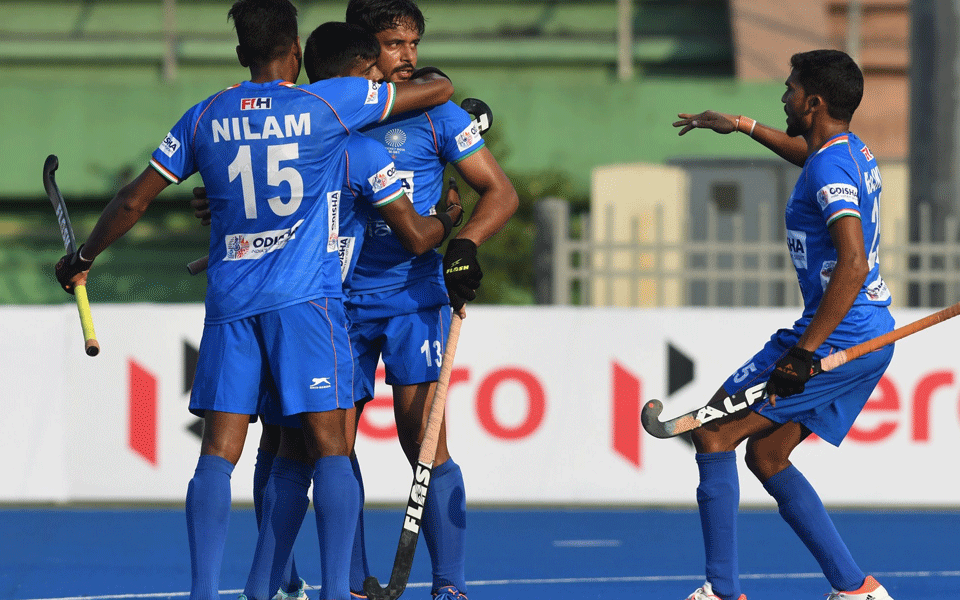
Dhaka (PTI): Vice-captain Harmanpreet Singh scored a brace as Olympic bronze-medallists India defeated arch-rivals Pakistan 3-1 to register their second consecutive win and virtually qualify for the semifinals of the Asian Champions Trophy men's hockey tournament here on Friday.
Harmanpreet (8th, 53rd minutes) converted two penalty corners, while comeback-man Akashdeep Singh, who couldn't make the Tokyo Olympics squad, found the net from a field effort in the 42nd minute for his second goal of the tournament.
Pakistan's lone goal was scored by Junaid Manzoor in the 45th minute. It was India's second win in the tournament after their 9-0 drubbing of hosts Bangladesh, while Pakistan are still winless, having drawn goal-less against Japan in their opening match.
India had earlier drawn 2-2 against Korea in their tournament opener.
India are currently leading the points table with seven points from three games and will take on Japan in their last round-robin match of the five-team tournament on Sunday. Pakistan, meanwhile, have just one point from two games.
India and Pakistan were the joint winners in the last edition of the tournament in Muscat after the final was washed out.
The Indians completely dominated possession in the first two quarters while Pakistan preferred to sit back. But they defended admirably save for Harmanpreet's lone strike.
The play was mostly on the Pakistan half in the first two quarters as Indians pressed hard from the onset and created a couple of chances but credit must go to goalkeeper Mazar Abbas who was brilliant overall.=
But expectedly, it was India who took the lead in the eighth minute when Harmanpreet converted the team's first penalty corner with a powerful low flick to the left of the Pakistan goalie.=
Four minutes later, skipper Manpreet Singh' deflection from outside the circle was saved by an alert Abbas.
The second quarter continued in the same manner as India made numerous inroads but the Pakistan defence was upto the task. While Pakistan defence stood out, the team's forward line looked unimpressive as it failed to register a single shot on the goal or secure a penalty corner.
Leading 1-0 at half time, the Indians kept up the pressure on the Pakistan goal and increased their lead in the 42nd minute when Akashdeep slapped in Sumit's drive from the left flank with a reverse hit.
But the fighting Pakistanis didn't give up hope and upped their game from here on, reducing the margin 27 seconds from the end of the third quarter through Manzoor's diving deflection from Abdul Rana's pass.
If the first three quarters belonged to India, Pakistan gave Manpreet and his men a run for their money in the final quarter, which produced end-to-end enthralling hockey. Pumped up by the goal, Pakistan went on the offensive and secured their first penalty corner of the tournament in the 47th minute, which was rejected after India asked for the referral.
Pakistan didn't lose hope and continued to press hard and secured two more penalty corners in quick succession but young Indian custodian Suraj Karkera made two brilliant saves to keep his side's lead intact.
In between, India secured their second penalty corner and once again Harmanpreet was precision personified with his drag-flick. India earned another penalty corner just three minutes from the final hooter but Varun Kumar's effort was saved by the Pakistan goalkeeper.
Let the Truth be known. If you read VB and like VB, please be a VB Supporter and Help us deliver the Truth to one and all.
Road crash in UP leaves 10 dead
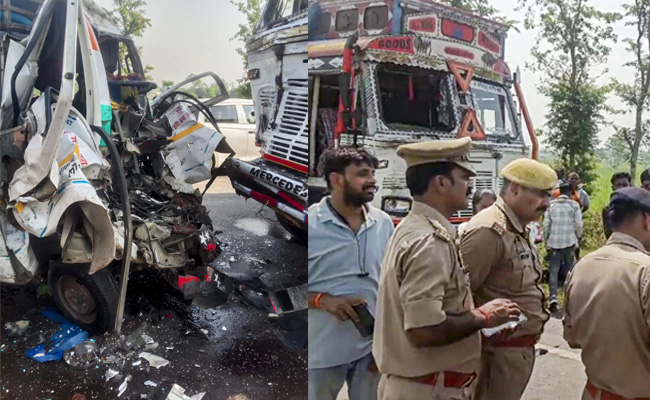
Lakhimpur Kheri (UP) (PTI): Ten people were killed when a van collided head-on with a truck on the Sisaiya-Lakhimpur national highway on Monday, police said.
The van was going to Sisaiya from Lakhimpur when the accident took place between Unchgaon and Bharehta villages.
Circle Officer of Dhaurahra, Shamsher Bahadur Singh, said all nine passengers travelling in the van and the driver were killed.
District Magistrate of Lakhimpur Kheri Anjani Kumar Singh told reporters that the van collided with a truck coming from the opposite direction, leading to nine casualties on the spot, while one succumbed to injuries at the district hospital.
Circle Officer, Dhaurahra, Shamsher Bahadur Singh told PTI, "Efforts are on to establish the identity of other deceased persons."
The seven of the deceased have been identified as Jaideep Singh (25), Pawan (23), Sohan (21), Ram Goyal (42), Sahajram (35), Pappu (18), all residents of Bahraich district and Adnan Khan (15), a resident of Lakhimpur Kheri district, police said.
Condoling the loss of lives in the accident, Uttar Pradesh Chief Minister Yogi Adityanath in a post on X, said, "The loss of life in the unfortunate road accident in Lakhimpur Kheri district is deeply distressing and heart-wrenching. My condolences are with the bereaved families."
"I have directed the local administration to provide prompt and adequate assistance to the injured and the victims. I pray to Lord Shri Ram to grant the departed souls a place at His divine feet and to bestow a speedy recovery upon the injured," Adityanath said on X.
Deputy Chief Minister Keshav Prasad Maurya and Brajesh Pathak too condoled the loss of lives in the accident.
"The loss of lives resulting from the road accident in Lakhimpur Kheri district is deeply tragic and heart-wrenching. My deepest condolences go out to the bereaved families," Maurya said.