I got injections, blood removed from ankle: Pandya recalls painful recuperation after WC injury
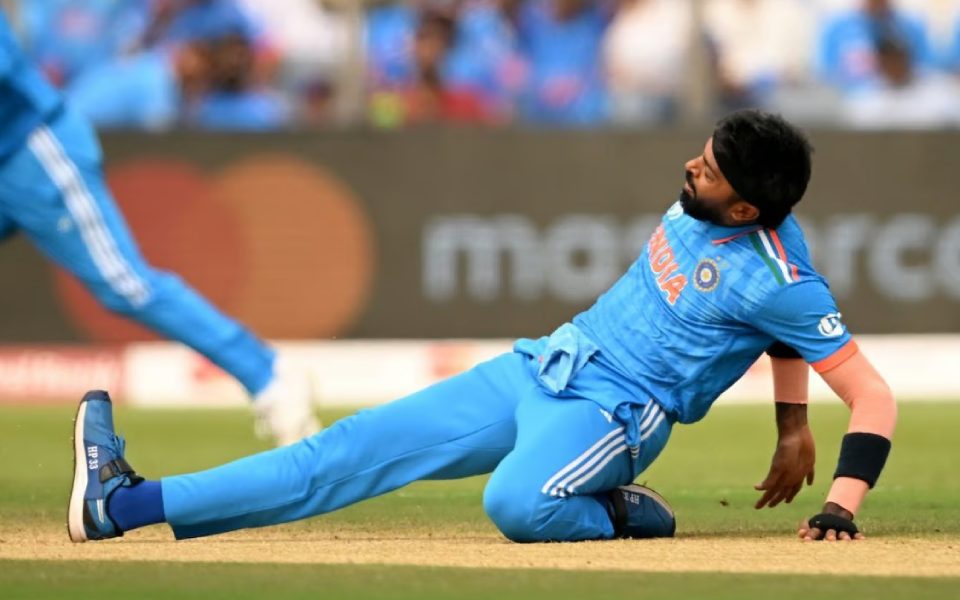
Mumbai, Mar 17: In his desperation to regain fitness for the remaining World Cup matches last year, India all-rounder Hardik Pandya said he resorted to extreme measures like taking multiple injections and removing blood clots from his ankle but pushing the boundaries only aggravated the injury, forcing him to sit out of the showpiece.
Pandya injured his ankle during India's fourth World Cup game against Bangladesh while bowling his first over of that match, and had to limp off the field with the help of the team physio. He did not play any further part in the tournament.
"I got injections done on my ankles at three different places and I had to remove blood from my ankle because of the swelling. I didn't want to give up (on playing the remainder of the World Cup); for the team I will give my best. If there is one percent chance that I can be with the team I will try my best," Pandya told Star Sports.
However, Pandya said he was aware that pushing himself hard could bring adverse results, but that's the risk he took to be with the team during a home World Cup.
"I was aware that (if) I keep pushing myself I might get injured for (a) long time. For me, that was never the answer.
"While I was pushing myself, I had this re-occurrence (of injury) and it became a three-month injury. I was not able to walk but I was trying to run (at) that point of time," Pandya recalled.
At that time, the 30-year-old was confident of coming back in five days, but the recuperation took much longer than he expected.
"When I came out (of the field following injury), I informed team that I will be back in five days. I tried to push myself for 10 days, took pain-killers to make a comeback and rejoin the team. But this was a freak injury and very few people know about it.
"My injury got extended and I had to take more time because when I got injured, it was a 25-day rehab injury," he added.
Pandya said that not being able to play fully in the World Cup would always weigh heavily on his heart.
"For me the biggest pride is to play for the country. This was my baby; playing the World Cup at home is my child. So, I wanted to be there for them (the team).
Nonetheless, whether we win or not, all I wanted (was) to be there for my child. Obviously, I missed out and that is something which is always going to (be) heavy on my heart," he detailed.
Pandya said he had started preparations for the 50-over World Cup more than a year in advance.
"I am such (a) kind of cricketer who doesn't start 2-3 months before; I started my journey one year back for this World Cup. I already planned my routine one-and-half year before and worked accordingly."
But now, Pandya, who had led Gujarat Titans to IPL title in 2022, has another heavy job at his hands, leading five-time champions Mumbai Indians in IPL 2024.
"From my journey as a young lad in Baroda to Mumbai, this city has taught me growth, instilling in me humility and resilience. The city's love and teachings are invaluable to me, shaping me into the cricketer I am today.
"Mumbai always challenges you to be better and now with the IPL, I have returned home after two years," he said.
Pandya had joined the Titans ahead of the 2022 season, but he returned to Mumbai before this edition and replaced Rohit Sharma as the team's captain.
The Baroda man said the IPL 2015 season with MI was pivotal to transforming his career.
"Coming from Baroda, it was a life-changing experience for me when I remember the 2015 IPL. That year was pivotal in my career. Representing Mumbai Indians amidst seasoned players was a turning point for me. When you get a chance to play with such established players on such a big platform, your life changes.
"I was fortunate enough that I was able to contribute on a much larger scale in the knockout games. Bagging two 'Man of the Match' awards during crucial knockout games was surreal. It marked the beginning of an extraordinary journey for me."
Let the Truth be known. If you read VB and like VB, please be a VB Supporter and Help us deliver the Truth to one and all.
Chadha, others wouldn't have left AAP had it followed 'right' path: Anna Hazare
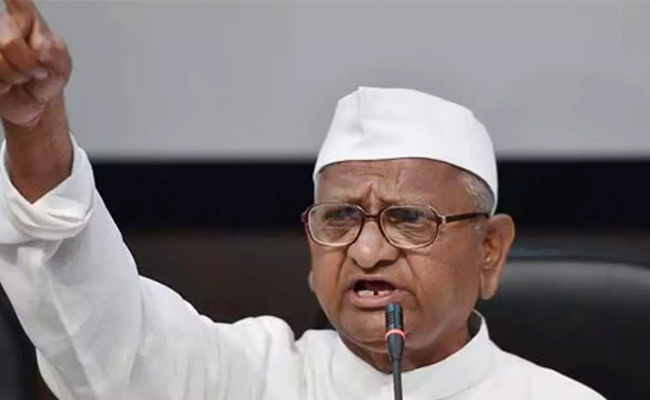
Mumbai (PTI): Social activist Anna Hazare has said Raghav Chadha and six other Aam Aadmi Party (AAP) Rajya Sabha members would not have quit the party had it followed the "right" path.
"Everyone has the right to hold an opinion in a democracy. They (Chadha and others) must have faced some trouble, which is why they left," Hazare told reporters on Friday in Ahilyanagar district of Maharashtra.
AAP Rajya Sabha members Raghav Chadha and Sandeep Pathak addressed a joint press conference in Delhi on Friday, announcing their exit from the Arvind Kejriwal-led party to join the BJP.
Chadha claimed that nearly two-thirds of AAP's Rajya Sabha members had quit the party and would function as a separate faction.
"It is their (AAP leadership’s) fault. Had that party followed the right way, they would not have left," Hazare said.
Hazare reiterated that Chadha and others must have faced difficulties within AAP, and that is why they left. "Had the party gone in the right direction, they would not have quit the party," he added.
"There must be some or the other reason (for their leaving AAP). In a democracy, every person has a view about where to stay and leave," Hazare said.
The Chadha-led exodus marks a significant setback for the Kejriwal-led party since its formation in 2012, which followed the momentum of Anna Hazare’s anti-corruption movement.