I just focus on execution and stick to what I've practised: Arshdeep
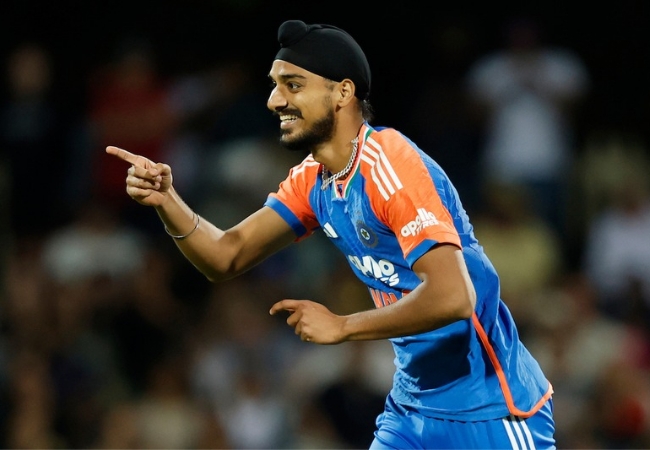
Hobart (PTI): Arshdeep Singh's incisive new-ball burst and ice-cool execution at the death powered India to a series-levelling win over Australia in the third T20 International here on Sunday, and the left-arm seamer credited a clear mind and hard training for his performance.
Arshdeep, who was named Player of the Match, said he has been focussing on clarity and consistency rather than trying too hard for results.
"I've just been working on my process, trusting my skills, and executing the plans I’ve practised," Arshdeep, who took three wickets for 35 runs, said after the game.
"It feels great to contribute when I get the chance. When someone like Bumrah is bowling from the other end, batters often take more risks against me, and that gives me wicket-taking opportunities."
"I just try to enjoy my bowling and keep things simple. No matter the situation — powerplay or death — I just focus on execution and stick to what I’ve practised."
India captain Suryakumar Yadav praised his side’s balanced effort with both the bat and ball, calling the Bumrah-Arshdeep combination “lethal” and applauding the new players in the playing XI for stepping up.
"It was really important to win the toss. Good to break the streak and be on the winning side," Suryakumar said.
"Those guys who came in today were practising really hard. This was a really good combination. Washy (Washington Sundar) is a flexible batter, and both Bumrah and Arshdeep are a lethal combination.
"Shubman and Abhishek are fire and ice; same for Bumrah and Arshdeep. Bumrah did his job brilliantly and Arshdeep was very clear with his plans."
Australia, asked to bat first, were restricted to 186 for 6 despite fighting knocks from Tim David and Marcus Stoinis.
Captain Mitchell Marsh admitted his team was “probably 20 runs short” and credited India’s bowlers for executing better on the day.
"Credit to India — they bowled really well. We gave it our best in the field, but they deserved the win. I liked the intent from our batters, especially Tim David, who came in after early wickets and played superbly. Stoinis too showed great experience at the end," Marsh said.
"In T20s, small margins — one or two good overs or bad overs — can change everything."
The Australian skipper also revealed that Glenn Maxwell was close to featuring in the match but wasn’t fully fit.
"He was close to playing today but not quite ready. Hopefully he’ll be fit and available for Thursday. He’s such an experienced T20 campaigner — we’d love to have him back."
The series now heads to Gold Coast which will host the fourth T20I on Thursday.
Let the Truth be known. If you read VB and like VB, please be a VB Supporter and Help us deliver the Truth to one and all.
Questioning religious practices will break religion, civilisation: SC in Dawoodi Bohras case
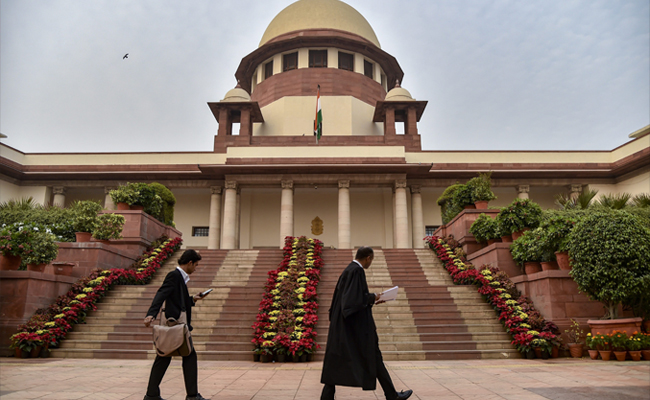
New Delhi (PTI): The Supreme Court on Thursday remarked that if individuals start questioning certain religious practices or matters of religion before a constitutional court then there will be hundreds of petitions questioning different rituals, leading to the breaking of religions and the civilisation.
The nine-judge Constitution bench is hearing petitions related to discrimination against women at religious places, including the Sabarimala temple in Kerala, and on the ambit and scope of the religious freedom practised by multiple faiths, including Dawoodi Bohras.
The bench comprises Chief Justice of India (CJI) Surya Kant and Justices B V Nagarathna, M M Sundresh, Ahsanuddin Amanullah, Aravind Kumar, Augustine George Masih, Prasanna B Varale, R Mahadevan and Joymalya Bagchi.
The Central Board of Dawoodi Bohra Community filed a PIL in 1986 seeking the setting aside of a 1962 judgment, which had struck down the Bombay Prevention of Excommunication Act, 1949 -- this law made excommunication of any community member illegal.
The 1962 Constitution bench judgment said, "It is evident from the religious faith and tenets of the Dawoodi Bohra community that the exercise of the power of excommunication by its religious head on religious grounds formed part of the management of its affairs in matters of religion and the 1949 Act in making even such excommunication invalid, infringed the right of the community under Article 26(b) of the Constitution."
Senior advocate Raju Ramachandran, representing a group of reformist Dawoodi Bohras, submitted that a practice which is conducted in response to secular and social actions of an individual cannot be the subject of Constitutional protection under Article 25 of the Constitution and consequently cannot be a ‘matter of religion’ under Article 26 of the Constitution.
Ramachandran told the court that a practice which may have a religious aspect but also significantly and adversely impacts fundamental rights is not immune to restriction under Article 25 of the Constitution or Article 26 of the Constitution.
Responding to the submission, Justice Nagarathna said that if everybody starts questioning certain religious practices or matters of religion before a constitutional court, then "what happens to this civilisation where religion is so intimately connected with the Indian society".
"There will be hundreds of petitions questioning this right that right, opening of the temple, and the closure of the temple. We are conscious of this," she said.
Adding to the response, Justice Sundresh said, "Every religion will break and every constitutional court will have to be closed.
"If the dispute between two entities are allowed then everybody will question everything. In your case there may be a civil wrong committed to you but in another case, another member will say I don't agree. It is regressive. To what extent can we go in a country like ours which is progressive and on the move is the question," he said.
Justice Nagarathna went on that what sets apart India from any other region is that "we are a civilisation" despite having so many pluralities and diversities?
Asserting that diversity is the country's strength, she added, "One of the constants in our Indian society is the relationship of human beings -- man, woman and child -- with the religion."
"Now, how a religious practice or a matter of religion is questioned, where it is questioned, whether it can be questioned, whether it has to be a question within a denomination for a reform or whether the state will have to do or you want the court to adjudicate upon all these aspects. This is troubling us.
"What we lay down, is for a civilisation that is India. India must progress despite all its economy, everything there is a constant in us. We can’t break that constant. That is what is troubling us ," she said.
Ramachandran replied that India is a civilisation under the Constitution and therefore nothing which goes against the grain of constitution can be continued in a civilised society.
He said that's where court's task come in and "it can't throw hands" and say there will be so many petitions.