I was considered as failed captain for not winning an ICC trophy: Virat Kohli
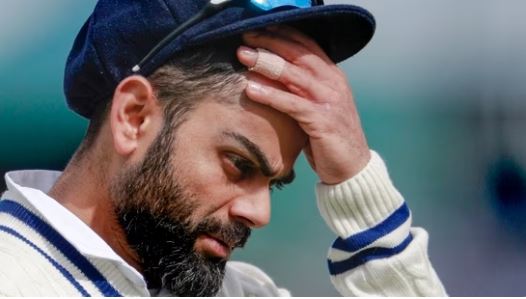
New Delhi, Feb 25: Former India skipper Virat Kohli says he was labelled a "failed" captain by a section of experts and fans for not winning an ICC trophy.
Under Kohli's captaincy, India failed to win the 2017 Champions Trophy, the 2019 World Cup, the 2021 World Test Championship final against New Zealand, besides suffering a premature exit from the 2021 T20 World Cup in the UAE.
But Kohli said a lot was made out of the losses, given that he was part of the 2011 World Cup-winning side, the 2013 Champions Trophy-winning unit under MS Dhoni and also a member of the team that won five Test maces.
Asked if he ever felt the pinch of not lifting an ICC trophy while leading the side, Kohli said, "Look you play to win tournaments. A lot was made of it (not lifting an ICC trophy as skipper). I captained in the 2017 Champions Trophy, I captained the 2019 World Cup side, I captained India in the (inaugural) World Test Championship final.
"So, after three ICC tournaments... we lost the last (2021) T20 World Cup. We didn't qualify. We reached the finals of 2017 Champions Trophy, semi-finals of the (2019) World Cup, final of (World) Test Championship, and I was considered as a failed captain."
Kohli was speaking at the Season 2 of the RCB Podcast.
The former captain said he prided himself for the "cultural changes" he was able to bring into the team.
"I never judged myself from that point of view (defeats in ICC tournaments). What we ended up achieving as a team and as a cultural change for me, that's always going to be a matter of pride because a tournament happens for a certain period of time, but a culture happens over a long period of time, and for that you need consistency," Kohli said on Royal Challengers Bangalore's podcast.
"For that (bringing about cultural change), you need more character than just winning a tournament. So, I won the (2011) World Cup as a player, I won the (2013) Champions Trophy as a player, I've been part of a team that has won five Test maces.
"If you look at it from that point of view, there have been people who have never won a World Cup. I'm always grateful for what I have."
He drew comparison with Sachin Tendulkar, saying the legend won a World Cup in his sixth attempt, while he was part of the team that won the global trophy in his very first appearance.
"Sachin Tendulkar was playing his sixth World Cup if I am not wrong, and that was the one he won. I was able to be a part of the team first time and I ended up being part of a winning side.
"So, if I have to look at what has gone wrong in my career, it's very easy to do that. But I have to look at what's gone right in my career and I'm grateful for that.
"I'm not mad for my trophy cabinet to be full. To me that's always been a byproduct of how you conduct yourself, (the) kind of discipline you have and how you are striving towards excellence on a daily basis. I feel I have been very honest to that aspect."
Kohli said Dhoni was the only person who reached out to him when he was going through a lean patch. The Delhi cricketer has overcome that phase and last month scored his third hundred in four ODIs.
The Indian superstar had ended a long wait for his first hundred in close to three years with a ton in the Asia Cup T20 tournament last September.
Kohli shares a strong bond with Dhoni and that reflects in the manner in which he talks about India's World Cup-winning skipper.
"What is interesting is that throughout this phase apart from (wife) Anushka, who has been the biggest source of strength for me because she has been with me throughout this whole time and she has seen me very closely as how have I felt, things that I have gone through, the kind of things that have happened.
"The only person who, apart from my childhood coach and family, genuinely reached out to me has been MS Dhoni," Kohli said.
Kohli shared the dressing room with Dhoni for 11 years between 2008 and 2019 and calls the charismatic cricketer from Ranchi his 'captain forever'.
"He reached out to me and you can rarely get in touch with him. If I call him on any random day, 99 percent he will not pick up (the phone), because he just does not look at the phone.
"So, for him to reach out to me, twice it has happened now and one of the things that he'd mentioned in the message while reaching out to me was that: 'when you are expected to be strong and looked at as a strong individual people forget to ask how are you doing'?
"So, it (Dhoni's words) hit home for me because I have always been looked at as someone who is very confident, mentally very strong, who can endure any circumstances and find a way and show us the way.
"Sometimes, what you realise is that at any given point of time in life as a human being you need to take a couple of steps backwards, understand how you are doing, how your wellbeing is placed. He knows exactly what is going on. He understand it because he's been there himself and he experience what I experienced right now.
"So it is only out of experience and feeling those feelings in that moment is the only way you can truly be compassionate towards another individual who is going through the same thing," Kohli added.
When Kohli abruptly quit Test captaincy following the tour of South Africa in January 2022, he had revealed that Dhoni was the only one who had messaged him.
Let the Truth be known. If you read VB and like VB, please be a VB Supporter and Help us deliver the Truth to one and all.
Rahul's exhilarating 152 powers DC to 264/2
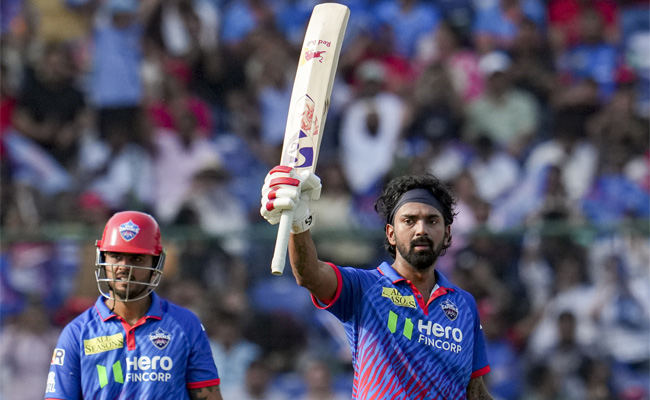
New Delhi (PTI): KL Rahul blended grace with power to script a stroke-filled 152, the third-highest individual IPL score, while Nitish Rana (91) batted with authority as the duo powered hosts Delhi Capitals to a mammoth 264 for 2 against Punjab Kings here on Saturday.
Setting a target for the first time this season, the Capitals came out with clear intent, attacking anything in their arc from the outset.
The home team hit a total of 29 fours and 13 sixes to put on board the highest total of the 2026 IPL season.
Striking at over 200 throughout the 20 overs, Rahul (152 off 67 balls) unfurled a range of classical strokes all around the ground, seamlessly combining timing with aggression to put up the highest-score ever by an Indian in the IPL.
With the knock, he also became only the third player to go beyond 150-run mark after Chris Gayle (175) and Brendon McCullum (158).
Dropped on 18 by Shashank Singh, he made full use of the reprieve, forging a 220-run stand with local boy Rana for the second wicket. It was second biggest stand in IPL history behind 229 set by Virat Kohli and AB de Villiers.
Rana looked completely at ease on his home ground. His 44-ball knock, laced with 11 fours and 4 sixes, provided the perfect foil as the duo kept the scoreboard ticking at a brisk pace.
Rahul set the tone early, striking back-to-back boundaries in the second over before Pathum Nissanka chipped in with a crisp four.
Although Punjab struck an early blow with Nissanka top-edging to the keeper, their bowlers found little respite thereafter. They were also guilty of a few misfields, which only added to their woes.
Rahul and Rana seized control, punishing anything loose and propelling Delhi to 68 for one, DC's best powerplay score of the season before plundering 145 runs in the middle overs.
Rana then shifted gears in spectacular fashion, taking apart Australian pacer Xavier Bartlett in the 12th over for 28 runs.
The left-hander dealt exclusively in boundaries, smashing two sixes and four fours in a sequence of 6,4,4,4,4,6.
At the other end, Rahul was equally ruthless, taking a liking to Vijaykumar Vyshak in the 16th over, from which he plundered three sixes and a four, as Delhi tightened their grip on the contest.