ICC rejects Pakistan's request to relocate two of their ODI World Cup games in India

Karachi (PTI): All of the objections raised by the Pakistan Cricket Board (PCB) on the schedule and venues for the national team team in the ODI World Cup in India have been rejected by the International Cricket Council (ICC).
In the final schedule of the World Cup released on Tuesday by the ICC and BCCI, Pakistan's match against India is scheduled in Ahmedabad as proposed in the draft earlier while PCB's request to switch venues for the matches against Afghanistan and Australia have been ignored.
As per wishes of the Pakistan team management, the PCB had asked ICC and BCCI to reschedule its match against Afghanistan from Chennai to Bengaluru and the game against Australia from Bengaluru to Chennai.
The Pakistan team management had concerns that given the Chepauk's history of helping spinners, it would leave the side at a disadvantage against Afghanistan, who have quality spinners.
But none of Pakistan's objections or requests have been paid heed to and even the semi finals have been scheduled in Mumbai and Kolkata although the PCB has conveyed to the ICC it is not comfortable playing in Mumbai due to political and diplomatic reasons.
The ICC not entertaining Pakistan's request was on expected lines as it usually addresses concerns over venues on potential security threat and not on cricketing grounds.
With the elections for the post of PCB chairman now postponed at least until July 17, it remains to be seen how the board reacts to the World Cup schedule announcement.
An official source however made it clear that the schedule would be sent to the government for clearance.
"Our participation in the World Cup and us playing in Ahmedabad on October 15 or in Mumbai if we qualify for semi-finals will all be dependent on government clearance," he said.
He said until now the government had not issued any NOC to the PCB to travel to India and since it was a sensitive issue the board can only move forward after geting clear directives from its government.
"We have already informed the ICC that our participation in the tournament or any issues over venues is linked to firstly the PCB getting clearance from the government to travel to India," he reminded.
Pakistan last played in India in 2016 in the T20 World Cup.
With the Balochistan High Court issuing a stay order against the holding of elections for the chairman's seat on Monday on petitions filed by two former members of the PCB's cricket management committee, confusion reigns in Pakistan cricket over how it will react to the WC schedule.
At present the board is being run by interim chairman, Ahmed Shehzad Farooq Rana.
Zaka Ashraf, nominated for the chairman's post, has to win votes of the board of governors to officially take charge of the key post.
Let the Truth be known. If you read VB and like VB, please be a VB Supporter and Help us deliver the Truth to one and all.
Choose faith or future: BJP alleges 'second-class treatment' of Hindus in K'natka CET row
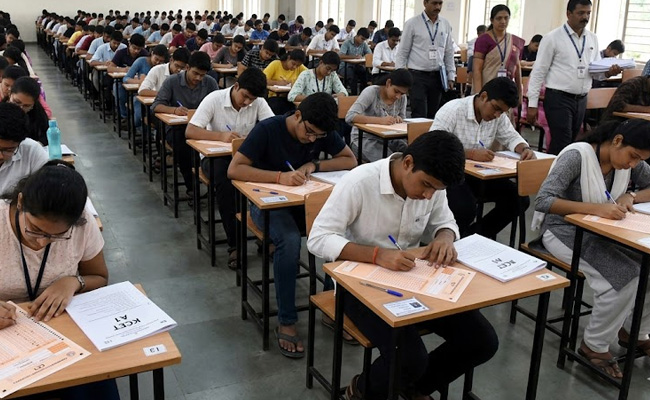
New Delhi (PTI): The BJP on Saturday accused the Karnataka Congress government of being "anti-Hindu" and following double standards after students appearing for the Common Entrance Test (CET) were allegedly asked to remove their 'janeu'.
A political row erupted after five Brahmin students were allegedly forced to remove the thread, considered sacred and worn across the torsos, at a city college in during the CET on Friday.
Students alleged that the invigilators at Madivala asked them to remove their janeu/yajnopaveetha if they wanted to write the exam.
In a video post on X, BJP national spokesperson Shehzad Poonawalla lambasted the act.
"Is it a crime to be a Hindu in Karnataka? In Karnataka, students were stopped from entering the examination hall for wearing a janeu and were given a brutal option -- choose your faith or your future. This happened last year as well," Poonawalla alleged.
ALSO READ: ECI to release exact voter turnout in TN
He accused the Karnataka government of practising double standards and engaging in appeasement politics.
"In Karnataka, we have seen the politics of appeasement. Muslim reservation, a Muslim-only budget, and quotas and contractual work for Muslims. But Hindus have to remove their sacred thread if they want to take an exam, which even the courts have, by the way, allowed," he alleged.
He accused the Congress government of adopting a similar approach in other states where it is in power, while allowing hijab and burka in classrooms.
"It has happened in various Congress-ruled states. We have seen that the Congress party advocates the right to hijab and burkha within the classroom. They say this should be allowed. Even the courts have overruled it.
"But in the case of janeu, they want it to be removed. This is not the first time this has happened. In Telangana and other states, the tilak and mangalsutra were removed. But hijab is fine. This is the kind of second-class treatment being given to Hindus," he added.
Poonawalla said the Congress should rename itself from INC to "MMC -- Muslim League Maowadi Congress" or the "Islamic National Caliphate Party".
As the controversy took a political turn, the college suspended the invigilator pending inquiry. The government also ordered a probe.
The police registered a case and detained three staff members of Krupanidhi College who were in charge of examination checking for questioning, officials said.
A similar incident took place last year in Karnataka, following which the government directed that the candidates would not be asked to remove the janeu while appearing for the CET.