India beat Ireland 2-0 in men's hockey competition at Paris Olympics
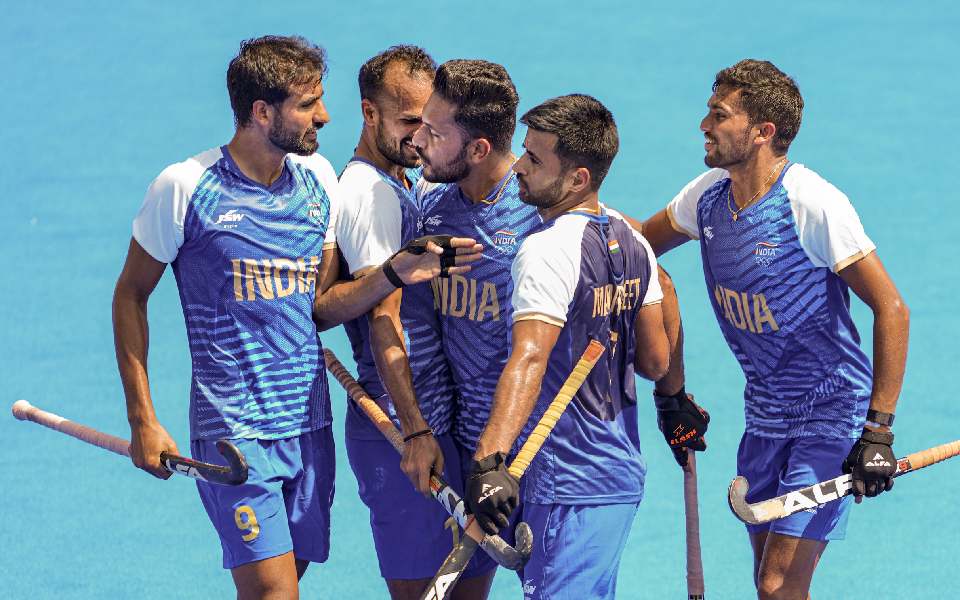
Paris, Jul 30: Reigning bronze medallist India beat Ireland 2-0 to consolidate their position in the tough Pool B of the men's hockey competition at the Paris Olympics here on Tuesday.
Skipper Harmanpreet Singh (11th, 19th minutes) scored a brace for India, converting a penalty stroke and then a penalty corner to hand his side the crucial win.
India had earlier defeated New Zealand 3-2 in their opener before securing a 1-1 draw against Argentina.
Unlike the last two games, India started on the offensive against Ireland and secured their first penalty corner in the second minute but Harmanpreet failed to beat the first rusher.
But India took the lead in the 11th minute when Harmanpreet converted a penalty stroke.
Gurjant Singh made a fine interception in the midfield and then linked up with Mandeep Singh to enter the circle where the Irish defence committed a foul, resulting in the stroke.
India secured back-to-back penalty corners in the 19th minute, and Harmanpreet was on target with the second chance.
India will next play reigning Olympic champions Belgium on Thursday before finishing their pool engagements against the mighty Australia on Friday.
Let the Truth be known. If you read VB and like VB, please be a VB Supporter and Help us deliver the Truth to one and all.
UP: Bareilly man throws acid on woman, family after marriage proposal rejected

Bareilly (UP) (PTI): A man allegedly threw acid on a married woman and her family members after she turned down his marriage proposal, police said.
The incident took place in the Shergarh area on Saturday, leaving the woman, her husband and two children injured.
The police said the family was sleeping in the verandah of their house when the accused allegedly entered through the roof and threw the acid on them through a mosquito net.
Circle Officer, Mirganj, said, "Shergarh police received information around 6 am that four members of a family had suffered burn injuries after a flammable substance was thrown on them."
He said police found during the investigation that the accused, Umesh Kashyap, allegedly wanted to marry the woman despite being married himself.
After she refused to marry him, Kashyap allegedly tried to throw a flammable substance on Devi. In this process, other members of the family also suffered injuries, the officer said.
The injured were taken to the Shergarh Community Health Centre, from where one of them was referred to the district hospital, police said.
An FIR has been registered, and teams have been formed to arrest the accused, they added.