India beat Lebanon 4-2 in penalty shootout to enter SAFF C'ships final

Bengaluru, Jul 1: Defending champions India held their nerves to beat Lebanon 4-2 in a tense penalty shootout after a goalless 120 minutes of play to enter the final of the SAFF Championship football here on Saturday.
The home side face Kuwait, a 1-0 winner over Bangladesh in the other semifinal of the day, in the summit clash on July 4.
India will be playing in the final of the regional tournament for the 13th time and ninth on the trot. They have won eight times in the earlier 13 editions. The only time India did not make it to the top two was in 2003.
In the penalty shootout, skipper Sunil Chhetri, Anwar Ali, Mahesh Singh and Udanta Singh found the back of the net for India.
Lebanon could only score twice through Walid Shour and Mohammad Sadek.
India goalkeeper Gurpreet Sandhu saved the kick from Hassan Maatouk while Khalil Bader's sailed above the crossbar.
It was also India's second successive win over Lebanon after defeating them 2-0 in the recent Intercontinental Cup in Odisha.
Before the late drama unfolded, the first half began with Lebanon dominating the proceedings. India were not even in the picture for the first 10 minutes.
Lebanon had a brilliant chance to go ahead in the second minute. But Nader Matar was a bit too eager to execute a volley, failing to impart direction as it sailed over the bar.
India found their bearings soon and got their first crack at the opposition goal in the 16th minute.
For once, Chhetri played the role of an orchestrator and pushed forward Jeakson Singh with a well-directed pass. Jeakson found Sahal Abdul Samad inside the box with a cross. However, Sahal's shot was parried away at the goal line by Ali Dhaini.
Lebanon were the better side in the first half and they got another chance to take lead in the 42nd minute. However, captain Hassan Maatouk could not evade the stretched hands of Indian goalkeeper Gurpreet Sandhu.
Action continued to be at a furious pace in the second half as well. But both India and Lebanon could not break the deadlock. Both sides also defended well.
Despite the midfield of both the teams showing a competitive streak, they failed to come up with a creative moment as the match meandered into the extra time.
Chhetri could have scored twice in the 93rd and 95th minutes, but on both the occasions the Indian captain uncharacteristically could not find the target.
Let the Truth be known. If you read VB and like VB, please be a VB Supporter and Help us deliver the Truth to one and all.
Choose faith or future: BJP alleges 'second-class treatment' of Hindus in K'natka CET row
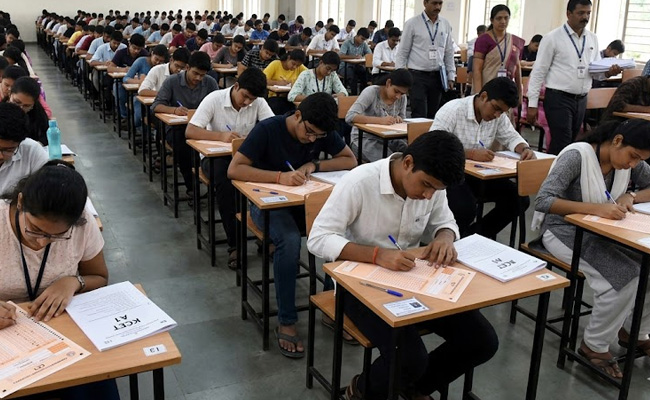
New Delhi (PTI): The BJP on Saturday accused the Karnataka Congress government of being "anti-Hindu" and following double standards after students appearing for the Common Entrance Test (CET) were allegedly asked to remove their 'janeu'.
A political row erupted after five Brahmin students were allegedly forced to remove the thread, considered sacred and worn across the torsos, at a city college in during the CET on Friday.
Students alleged that the invigilators at Madivala asked them to remove their janeu/yajnopaveetha if they wanted to write the exam.
In a video post on X, BJP national spokesperson Shehzad Poonawalla lambasted the act.
"Is it a crime to be a Hindu in Karnataka? In Karnataka, students were stopped from entering the examination hall for wearing a janeu and were given a brutal option -- choose your faith or your future. This happened last year as well," Poonawalla alleged.
ALSO READ: ECI to release exact voter turnout in TN
He accused the Karnataka government of practising double standards and engaging in appeasement politics.
"In Karnataka, we have seen the politics of appeasement. Muslim reservation, a Muslim-only budget, and quotas and contractual work for Muslims. But Hindus have to remove their sacred thread if they want to take an exam, which even the courts have, by the way, allowed," he alleged.
He accused the Congress government of adopting a similar approach in other states where it is in power, while allowing hijab and burka in classrooms.
"It has happened in various Congress-ruled states. We have seen that the Congress party advocates the right to hijab and burkha within the classroom. They say this should be allowed. Even the courts have overruled it.
"But in the case of janeu, they want it to be removed. This is not the first time this has happened. In Telangana and other states, the tilak and mangalsutra were removed. But hijab is fine. This is the kind of second-class treatment being given to Hindus," he added.
Poonawalla said the Congress should rename itself from INC to "MMC -- Muslim League Maowadi Congress" or the "Islamic National Caliphate Party".
As the controversy took a political turn, the college suspended the invigilator pending inquiry. The government also ordered a probe.
The police registered a case and detained three staff members of Krupanidhi College who were in charge of examination checking for questioning, officials said.
A similar incident took place last year in Karnataka, following which the government directed that the candidates would not be asked to remove the janeu while appearing for the CET.