India beat Sri Lanka by seven wickets in Women's T20 World Cup
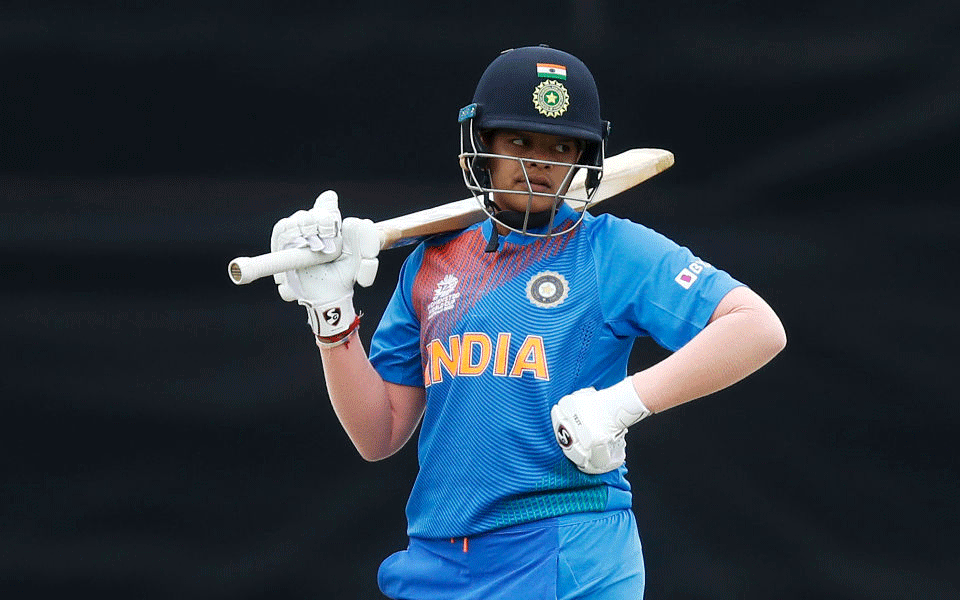
Melbourne: Shafali Verma shone yet again with a blistering 34-ball 47 after spinner Radha Yadav's career-best 4/23 to power India to a seven-wicket victory over Sri Lanka in the Women's T20 World Cup here on Saturday.
Verma smashed seven fours and a six in her brisk knock as India completed the chase of 114 with 32 balls to spare and enter the semifinals with an all-win record.
Earlier, Radha tore apart the rival batting line up with a career-best four-wicket haul to help India restrict Sri Lanka to a modest 113 for nine.
The left-arm spinner ran through the Sri Lankan batting line-up, claiming the prized scalp of skipper Chamari Atapattu, in the process.
Opting to bat, Sri Lanka were dealt an early blow when opener Umesha Thimashini (2) tried to go for a big shot off a Deepti Sharma delivery but was caught by Rajeshwari Gayakwad in the third over.
Skipper Atapattu (33), who has shined throughout the tournament, continued to attack, hitting five fours and a six. She stitched a 30-run partnership with Harshitha Madavi (12).
Brief scores:
Sri Lanka: 113/9 in 20 overs (Chamari Atapattu 33; Radha Yadav 4/23)
India: 116/3 in 14.4 overs (Shafali Verma 47).
Let the Truth be known. If you read VB and like VB, please be a VB Supporter and Help us deliver the Truth to one and all.
Man kills 12-year-old nephew over property dispute in Karnataka’s Sindhanur
Sindhanur: A 12-year-old boy was killed and his mother seriously injured after a man allegedly attacked his elder brother’s family with a knife over a property dispute in Alabanur village of Sindhanur taluk on Wednesday morning.
The deceased has been identified as Nagaraj Siddappa Alvi (12). Amrutha Siddappa (42) sustained serious injuries in the attack. Police said the accused is Basavaraj Rudrappa Alvi, the younger brother of the victim boy’s father.
According to preliminary information, Basavaraj had arrived in Alabanur village on Tuesday and was staying at his mother’s house.
On Wednesday morning, he allegedly went to the house of his brother Siddappa carrying a knife. At the time, Siddappa’s wife Amrutha and children Nagaraj and Dhanush were present in the house.
Police said the accused allegedly attacked them with the knife. Nagaraj died in the incident, while Amrutha and Dhanush suffered serious injuries.
The injured were shifted to the government hospital in the city for treatment.
Deputy Superintendent of Police G. Chandrashekhar visited the spot and gathered information.
Sources said Chinnamma Rudrappa of Alabanur village has two sons Siddappa, who lives in Alabanur, and Basavaraj, who resides in Alliganur village of Siruguppa taluk.
Police suspect the long-standing property dispute between the two brothers led to the fatal attack.